Table of Contents
Ban is a fascinating multicultural name with distinct meanings across different languages and cultures. While commonly used as a girl’s name in Pashto and Balochi communities where it means ‘sister’ or ‘lady,’ it also appears in Turkish, Japanese, and Thai with completely different meanings. This name’s versatility makes it a unique choice for parents seeking a name with international appeal.
Meaning of Ban
The name Ban has several verified meanings depending on its linguistic origin. In Pashto and Balochi languages, spoken primarily in Afghanistan, Pakistan, and Iran, ‘Ban’ (بان) derives from Proto-Iranian roots and means ‘sister,’ ‘lady,’ or ‘respected woman,’ often used as a term of endearment and respect. In Turkish, ‘Ban’ means ‘flag’ or ‘banner,’ originating from Old Turkic. In Japanese, the character 晩 (Ban) means ‘evening’ or ‘night.’ Meanwhile, in Thai, ‘Ban’ (บ้าน) means ‘home’ or ‘village.’ These diverse meanings reflect the name’s multicultural usage rather than a single origin.
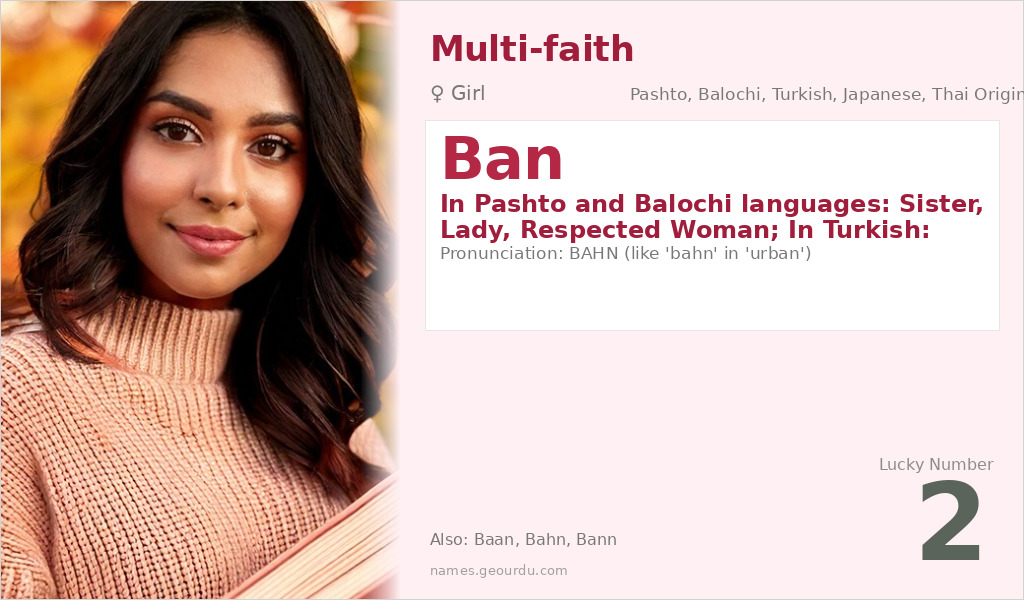
| 📛 Name | Ban |
| 💎 Meaning | In Pashto and Balochi languages: Sister, Lady, Respected Woman; In Turkish: Flag, Banner; In Japanese: Evening; In Thai: Home, Village |
| 👤 Gender | Girl |
| 🕌 Religion | Multi-faith |
| 🌍 Origin | Pashto, Balochi, Turkish, Japanese, Thai |
| 🗣 Pronunciation | BAHN (like 'bahn' in 'urban') |
| ✍️ Urdu | بان |
| ✍️ Arabic | بان |
| 🔢 Numerology | 2 |
| ✨ Spellings | Baan, Bahn, Bann |
Origin & Cultural Significance
Ban originates from multiple independent linguistic traditions. Its most common usage as a feminine name comes from Pashto and Balochi cultures in South and Central Asia, where it has been used for centuries as a respectful term for women. In Turkish culture, it appears as a unisex name meaning ‘flag.’ The Japanese and Thai versions developed separately within those language families. While the name appears in some Muslim communities, particularly among Pashtun and Baloch populations, it is not inherently Islamic or Arabic in origin but has been adopted through cultural exchange.
Personality Traits
Those named Ban often exhibit qualities associated with their name’s meanings across cultures. From the Pashto/Balochi meaning of ‘sister,’ they may show nurturing, protective traits and strong family bonds. The Turkish meaning of ‘flag’ suggests leadership and visibility, while the Thai meaning of ‘home’ indicates someone who values stability and community. These combined traits often create individuals who are diplomatic, tradition-oriented, and skilled at bringing people together.
Similar Names
If you like Ban, consider: Bano, Banafsheh, Banu, Bahar, Barsha
Famous People Named Ban
- Ban Ki-moon — South Korean diplomat, 8th Secretary-General of the United Nations (male, different origin)
- Ban Zhao — Chinese historian and poet from Han Dynasty (female)
Frequently Asked Questions About Ban
What does Ban mean?
Ban has multiple meanings: 'sister' or 'lady' in Pashto/Balochi, 'flag' in Turkish, 'evening' in Japanese, and 'home' in Thai, depending on cultural context.
Is Ban a boy or girl name?
Primarily a girl's name in Pashto and Balochi cultures where it means 'sister,' but can be unisex in Turkish and other contexts.
What is the origin of Ban?
Multiple origins: primarily Pashto and Balochi languages of Afghanistan/Pakistan/Iran, with additional origins in Turkish, Japanese, and Thai languages.