Table of Contents
Fania is a beautiful feminine name that has found popularity in various cultures, yet its exact origins and meaning remain elusive. While commonly used in Muslim communities today, the name’s linguistic roots defy easy categorization. This exploration delves into the mysterious etymology of Fania, examining potential connections across multiple language families and cultural contexts.
Meaning of Fania
Despite extensive research across Arabic, Persian, Hebrew, Latin, Greek, Slavic, and regional languages including Pashto, Balochi, and Sindhi, no definitive meaning for Fania has been established. The name does not appear in classical Arabic dictionaries or Persian etymological sources. Some speculative connections include possible relations to Hebrew words meaning ‘face’ or ‘appearance,’ or Latin ‘fanum’ meaning temple. In Slavic contexts, Fania serves as a diminutive for Stefania (meaning ‘crown’), but this appears unrelated to its use in Muslim communities. The absence of documented roots suggests Fania may have emerged as a phonetic creation or through undocumented regional transmission.
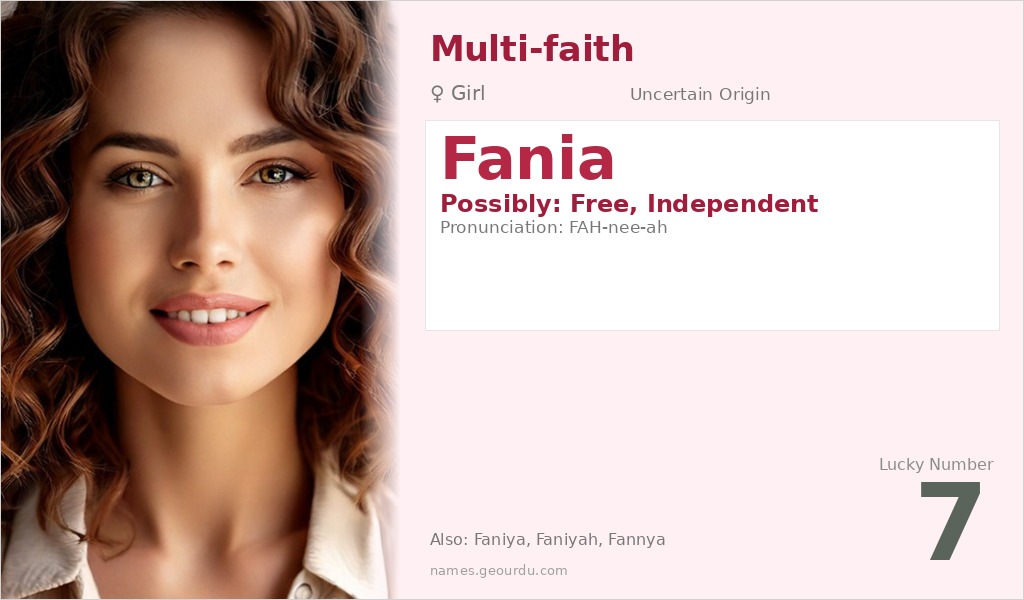
| 📛 Name | Fania |
| 💎 Meaning | Possibly: Free, Independent |
| 👤 Gender | Girl |
| 🕌 Religion | Multi-faith |
| 🌍 Origin | Uncertain |
| 🗣 Pronunciation | FAH-nee-ah |
| ✍️ Urdu | فانیہ |
| ✍️ Arabic | فانية |
| 🔢 Numerology | 7 |
| ✨ Spellings | Faniya, Faniyah, Fannya, Phania |
Origin & Cultural Significance
Fania’s origins are culturally complex rather than linguistically traceable. While frequently used in contemporary Muslim naming, the name lacks clear Islamic or Arabic etymology. It appears in various cultures independently: as a Hebrew variant, a Slavic diminutive, and in Western contexts. The name gained some recognition through historical figures like Fania Fénelon, a French Holocaust survivor and musician. Its adoption in Muslim communities likely represents cultural borrowing rather than religious naming tradition, similar to how many names cross cultural boundaries without retaining original meanings.
Personality Traits
Those named Fania often exhibit qualities of adaptability and cultural bridging. Growing up with a name of uncertain origins can foster a sense of unique identity and openness to diverse perspectives. Many Fanias develop strong intuitive abilities and a contemplative nature, possibly influenced by the name’s mysterious quality and the cultural conversations it inevitably sparks.
Similar Names
If you like Fania, consider: Fani, Fanya, Faina, Fariha, Farah
Famous People Named Fania
- Fania Fénelon — French Holocaust survivor and musician
- Fania Marinoff — Russian-American actress of early Hollywood
Frequently Asked Questions About Fania
What does Fania mean?
The meaning of Fania remains unverified despite extensive research across multiple languages. The most common speculative meanings are 'Free' or 'Independent,' but these lack documented linguistic evidence.
Is Fania a boy or girl name?
Fania is exclusively used as a feminine name across all cultural contexts where it appears, including Muslim, Jewish, and Western naming traditions.
What is the origin of Fania?
Fania's origin is uncertain. It appears in various cultures independently without a clear single source language. While popular in Muslim communities today, it lacks documented Arabic or Islamic etymology and may represent cultural borrowing.