Table of Contents
Emma is a timeless name that has captivated parents across generations and cultures. With roots in ancient Germanic languages, this elegant name carries the beautiful meaning of ‘whole’ or ‘universal’. From medieval queens to modern celebrities, Emma has maintained its popularity while evolving across continents. Its simplicity and strength make it a perennial favorite for baby girls worldwide.
Meaning of Emma
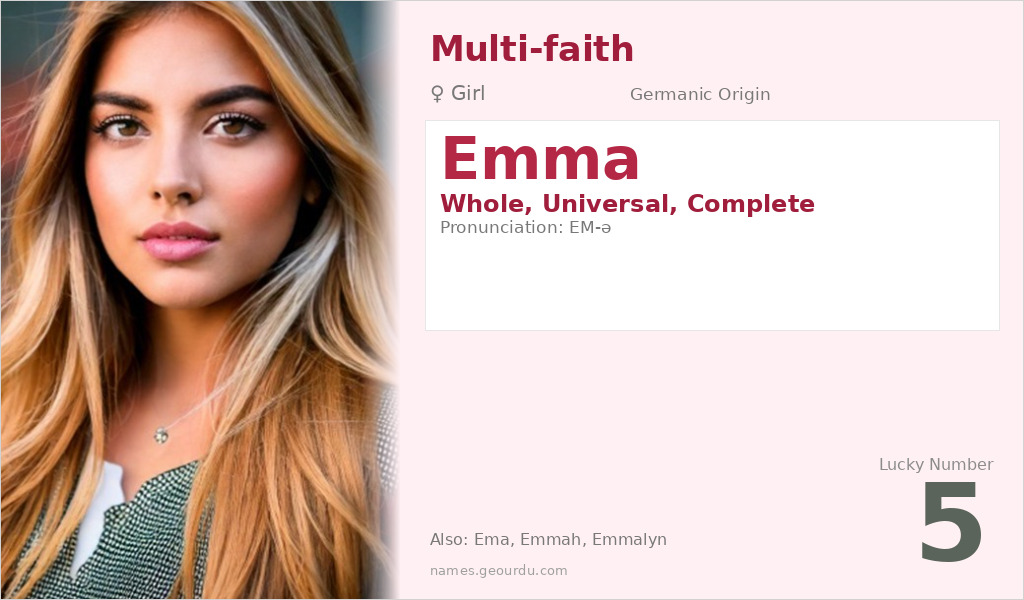
The name Emma originates from the Germanic element ‘ermen’, which means ‘whole’, ‘universal’, or ‘complete’. This linguistic root appears in various Germanic names throughout history, with Emma emerging as a standalone diminutive form. The name’s meaning reflects completeness and entirety, suggesting someone who embodies wholeness or universal qualities. Historically, it was used in medieval Europe before spreading globally through cultural exchange and literature. Today, it retains this core meaning while being adapted across multiple languages and cultures.
| 📛 Name | Emma |
| 💎 Meaning | Whole, Universal, Complete |
| 👤 Gender | Girl |
| 🕌 Religion | Multi-faith |
| 🌍 Origin | Germanic |
| 🗣 Pronunciation | EM-ə |
| ✍️ Urdu | ایما |
| ✍️ Arabic | إيما |
| 🔢 Numerology | 5 |
| ✨ Spellings | Ema, Emmah, Emmalyn, Emmy |
Origin & Cultural Significance
Emma has Germanic origins, first appearing in medieval Europe as a short form of names like Ermintrude. It gained significant prominence through Emma of Normandy, an 11th-century noblewoman who became Queen of England, Denmark, and Norway, helping spread the name across royal courts. During the Norman Conquest, the name entered English usage and later experienced revivals in the 18th and 19th centuries. While commonly used in Christian-majority countries, Emma is truly multi-faith, appearing among Muslim, Jewish, Hindu, and secular families worldwide without specific religious attachment.
Personality Traits
Those named Emma are often perceived as well-rounded individuals with strong social intelligence. They typically exhibit natural leadership qualities combined with genuine warmth that draws people to them. Their adaptability allows them to thrive in various environments while maintaining their core values of integrity and compassion.
Similar Names
If you like Emma, consider: Emily, Emmeline, Emilia, Amelia, Emmalyn
Famous People Named Emma
- Emma Watson — British actress known for Hermione Granger in Harry Potter films
- Emma Stone — American Academy Award-winning actress
Frequently Asked Questions About Emma
What does Emma mean?
Emma means 'whole', 'universal', or 'complete', originating from the Germanic element 'ermen'.
Is Emma a boy or girl name?
Emma is predominantly a girl's name across all cultures where it's used, with very rare exceptions as a masculine name.
What is the origin of Emma?
Emma has Germanic origins, specifically from medieval short forms of names containing the 'ermen' element meaning 'whole'.