Table of Contents
Eszter is a beautiful name with celestial origins that has traveled across continents and centuries. As the Hungarian variation of the classic name Esther, it carries with it a rich history spanning Persian, Hebrew, and European cultures. This name’s journey from ancient Persia to modern Hungary tells a story of cultural exchange and linguistic adaptation. Whether you’re drawn to its stellar meaning or its multicultural heritage, Eszter offers both beauty and depth.
Meaning of Eszter
The name Eszter has one of the most clearly documented etymologies in naming history. It originates from the Persian word ‘ستاره’ (Setareh), which directly translates to ‘star’. This Persian name entered the Hebrew language during the Achaemenid Empire period (550-330 BCE) and appears in the Hebrew Bible as אֶסְתֵּר (Ester). The name then traveled through Greek (as Ἐσθήρ) and Latin before reaching European languages. In Hungarian, it became Eszter, maintaining the original stellar meaning throughout its linguistic journey. The name’s consistency across languages makes its meaning particularly reliable and well-established.
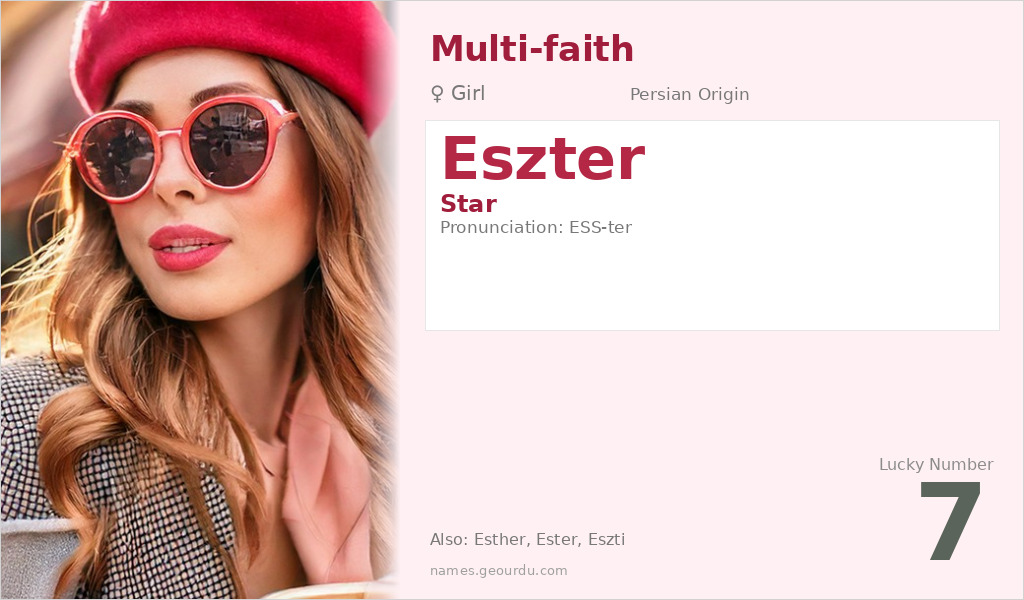
| 📛 Name | Eszter |
| 💎 Meaning | Star |
| 👤 Gender | Girl |
| 🕌 Religion | Multi-faith |
| 🌍 Origin | Persian |
| 🗣 Pronunciation | ESS-ter |
| ✍️ Urdu | ایستر |
| ✍️ Arabic | إستر |
| 🔢 Numerology | 7 |
| ✨ Spellings | Esther, Ester, Eszti, Esztár |
Origin & Cultural Significance
Eszter’s origins trace back to ancient Persia, where the name Setareh (star) was in use. The name gained prominence through the biblical Book of Esther, where Queen Esther saves the Jewish people in the Persian Empire. This biblical connection helped the name spread through Jewish, Christian, and eventually Islamic communities. In Hungary, Eszter became a popular form of the name, particularly among both Jewish and Christian communities. The name’s multicultural acceptance makes it truly multi-faith rather than belonging to any single religious tradition.
Personality Traits
Named after the celestial bodies that light up the night sky, individuals named Eszter often exhibit qualities of guidance, brightness, and inspiration. They tend to be natural leaders who can navigate complex situations with grace and wisdom. The name’s historical association with Queen Esther suggests potential for courage and advocacy, while its stellar meaning implies someone who stands out and illuminates their surroundings.
Similar Names
If you like Eszter, consider: Esther, Estera, Esteri, Hester, Eszti
Famous People Named Eszter
- Eszter Hargittai — Hungarian-American sociologist and internet researcher
- Eszter Mattioni — Hungarian actress known for her work in Hungarian cinema and television
Frequently Asked Questions About Eszter
What does Eszter mean?
Eszter means 'star'. It originates from the Persian word 'ستاره' (Setareh) and is the Hungarian form of the name Esther.
Is Eszter a boy or girl name?
Eszter is exclusively a girl's name. It is the Hungarian feminine form of Esther and has never been used as a masculine name in any cultural context.
What is the origin of Eszter?
Eszter has Persian origins, deriving from the Persian word for 'star'. It entered European languages through Hebrew and Greek, with Eszter being specifically the Hungarian adaptation of this ancient name.