Table of Contents
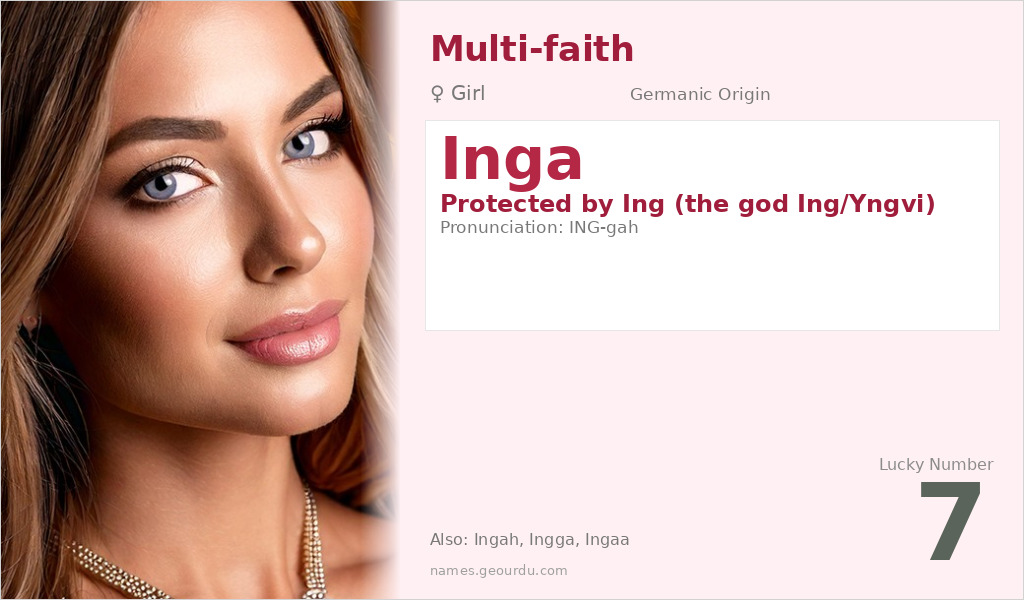
Inga is a beautiful and historic feminine name with roots deep in Norse mythology and Germanic culture. Meaning ‘protected by Ing,’ it references the god Ing/Yngvi, associated with fertility and kingship. While popular in Scandinavia and German-speaking regions, it has also gained appreciation worldwide for its elegant simplicity. This name carries a legacy of strength and divine connection, making it a meaningful choice for parents seeking a name with ancient heritage.
Meaning of Inga
The name Inga originates from Old Norse and Germanic languages, specifically as the feminine form of Ingi. It derives from the theonym Ing or Yngvi, a major Germanic god often identified with Freyr in Norse mythology, who presided over fertility, peace, and prosperity. The suffix ‘-a’ typically denotes femininity, so Inga literally translates to ‘protected by Ing’ or ‘belonging to Ing.’ This etymological construction is common in Germanic names, linking individuals to divine protection. The name has been used since the Viking Age and appears in medieval Scandinavian records. It is unrelated to Arabic, Persian, or other Islamic linguistic traditions, contrary to some misconceptions.
| 📛 Name | Inga |
| 💎 Meaning | Protected by Ing (the god Ing/Yngvi) |
| 👤 Gender | Girl |
| 🕌 Religion | Multi-faith |
| 🌍 Origin | Germanic |
| 🗣 Pronunciation | ING-gah |
| ✍️ Urdu | انگا (transliteration, not native) |
| ✍️ Arabic | إينغا (transliteration, not native) |
| 🔢 Numerology | 7 |
| ✨ Spellings | Ingah, Ingga, Ingaa |
Origin & Cultural Significance
Inga has its origins in pre-Christian Germanic and Norse cultures, where it was used to honor the god Ing/Yngvi. It spread throughout Scandinavia (Sweden, Norway, Denmark, Iceland) and German-speaking areas, becoming a traditional feminine name. With the Christianization of Europe, the name persisted due to its cultural entrenchment rather than religious connotations. In modern times, it is common in countries like Germany, Sweden, and Norway, and has also been adopted in English-speaking and Slavic countries through cultural exchange. It is not traditionally a Muslim name and has no specific affiliation with Islam; its usage in Muslim-majority regions would be rare and likely as a borrowed name without religious significance.
Personality Traits
People named Inga are often described as insightful, reserved, and intellectually curious. They may possess a natural affinity for introspection and spiritual exploration, valuing depth in relationships and endeavors. Their connection to the name’s mythological roots can inspire a sense of resilience and inner strength, though they might prefer quiet determination over overt expression. In social settings, Inga’s tend to be loyal friends who offer wise counsel.
Similar Names
If you like Inga, consider: Ingrid, Ingeborg, Inger, Inge, Freya
Famous People Named Inga
- Inga Swenson — American actress known for 'Benson'
- Inga Muscio — American feminist writer and activist
Frequently Asked Questions About Inga
What does Inga mean?
Inga means 'protected by Ing' or 'belonging to Ing,' referring to the Germanic/Norse god Ing/Yngvi (Freyr). It is of Old Norse and Germanic origin.
Is Inga a boy or girl name?
Inga is exclusively a feminine name. It is the feminine form of the masculine name Ingi, derived from the god Ing.
What is the origin of Inga?
Inga originates from Germanic and Old Norse languages and cultures, with roots in Norse mythology. It is not Arabic, Persian, or Islamic in origin.