Table of Contents
Hafsa is a name rich in history and meaning, carrying the powerful symbolism of the lioness across centuries. From pre-Islamic Arabia to the courts of the Ottoman Empire, this name has been borne by influential women who shaped their eras. Its Arabic roots give it both linguistic depth and cultural resonance that continues to appeal to parents today.
Meaning of Hafsa
The name Hafsa originates from classical Arabic, specifically from the triliteral root ‘ḥ-f-ṣ’ which relates to young lions. In Arabic zoological terminology, ‘ḥafṣa’ refers precisely to a female lion cub, distinguishing it from the male equivalent. This etymology connects the name to qualities of strength, courage, and nobility that lions symbolize across Middle Eastern cultures. The name appears in early Arabic poetry and was well-established before Islam, though it gained particular prominence through Islamic history. Unlike many Arabic names that have religious connotations, Hafsa maintains its natural world origins while acquiring cultural significance.
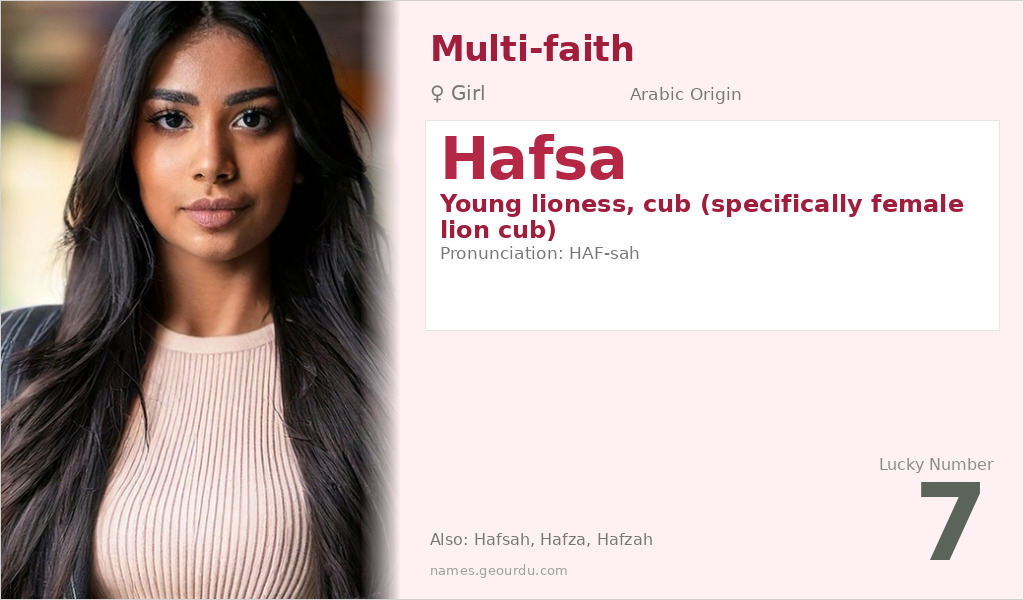
| 📛 Name | Hafsa |
| 💎 Meaning | Young lioness, cub (specifically female lion cub) |
| 👤 Gender | Girl |
| 🕌 Religion | Multi-faith |
| 🌍 Origin | Arabic |
| 🗣 Pronunciation | HAF-sah |
| ✍️ Urdu | حفصہ |
| ✍️ Arabic | حفصة |
| 🔢 Numerology | 7 |
| ✨ Spellings | Hafsah, Hafza, Hafzah, Hafsa |
Origin & Cultural Significance
Hafsa has its origins in pre-Islamic Arabian culture, where names derived from animals, particularly powerful ones like lions, were common. The name gained historical prominence through Hafsa bint Umar (c. 605–665 CE), daughter of Caliph Umar ibn al-Khattab and wife of Prophet Muhammad, who played a crucial role in early Islamic history as a transmitter of hadith and guardian of Quranic manuscripts. This historical association spread the name throughout the Muslim world, from Arabia to Persia, Ottoman Turkey, and South Asia. While particularly popular in Muslim communities, the name has also been used by Arabic-speaking Christians and others who appreciate its linguistic and cultural heritage beyond religious boundaries.
Personality Traits
Those named Hafsa often embody the characteristics associated with their namesake—the young lioness. They typically display a combination of strength and protectiveness, with a natural authority that doesn’t overwhelm their capacity for care. Like the lioness who hunts for her pride, Hafsa’s tend to be providers and guardians in their relationships. Their personality often balances fierce independence with deep loyalty to family and community.
Similar Names
If you like Hafsa, consider: Asad, Layth, Hamza, Nala, Leona
Famous People Named Hafsa
- Hafsa bint Umar — Wife of Prophet Muhammad and mother of believers in Islam, known for her wisdom and preservation of early Quranic manuscripts
- Hafsa Sultan — Ottoman Valide Sultan and mother of Sultan Selim II, influential in 16th century Ottoman politics
Frequently Asked Questions About Hafsa
What does Hafsa mean?
Hafsa means 'young lioness' or 'female lion cub' in Arabic, derived from the root 'ḥ-f-ṣ' relating to young lions.
Is Hafsa a boy or girl name?
Hafsa is exclusively a feminine name in all cultures where it is used, reflecting the female-specific nature of its meaning as a young lioness.
What is the origin of Hafsa?
Hafsa originates from classical Arabic language and pre-Islamic Arabian culture, though it gained particular prominence through early Islamic history with Hafsa bint Umar.