
Table of Contents
Humaida is a graceful Arabic name that carries centuries of cultural heritage within its syllables. As a feminine name meaning ‘praised’ or ‘commendable,’ it reflects values of appreciation and recognition that resonate across Muslim communities. This name connects bearers to a rich linguistic tradition while offering a distinctive identity. Whether you’re considering it for a newborn or exploring its history, Humaida represents both beauty and substance.
Meaning of Humaida
Humaida originates from the Arabic root Ḥ-M-D (ح-م-د), which fundamentally means ‘to praise.’ This root is profoundly significant in Islamic culture, giving rise to names like Muhammad (‘highly praised’) and attributes of God like Al-Hamid (‘The All-Praiseworthy’). The masculine form Humaid means ‘praiser’ or ‘one who praises,’ and by adding the feminine suffix ‘-a,’ it becomes Humaida, meaning ‘praised’ or ‘commendable’ for a female. This construction follows standard Arabic morphological patterns for creating feminine forms from masculine names. The name appears in classical Arabic texts and has maintained consistent usage across Arabic-speaking regions and Muslim diaspora communities.
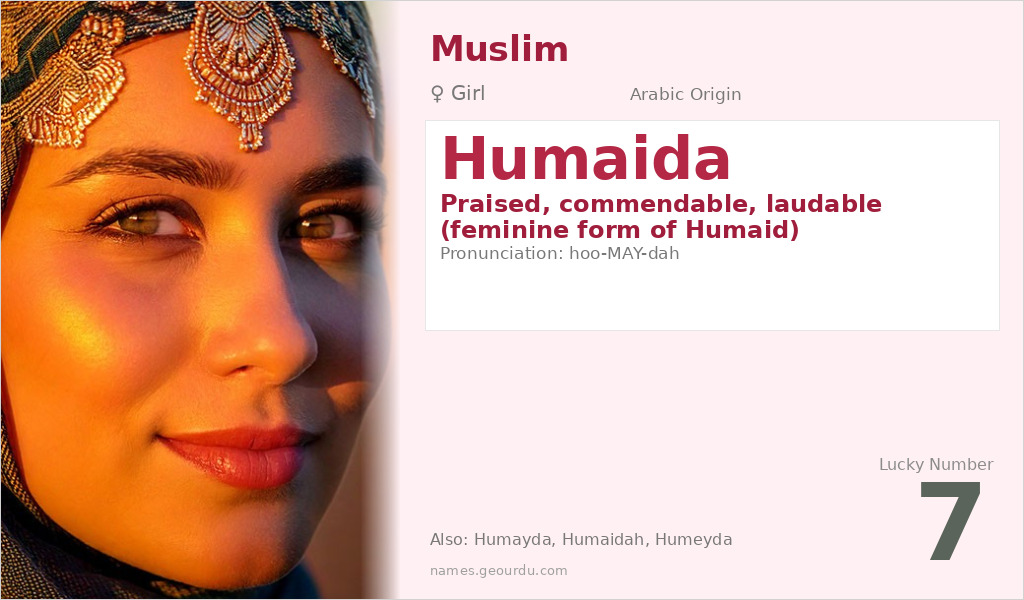
| 📛 Name | Humaida |
| 💎 Meaning | Praised, commendable, laudable (feminine form of Humaid) |
| 👤 Gender | Girl |
| 🕌 Religion | Muslim |
| 🌍 Origin | Arabic |
| 🗣 Pronunciation | hoo-MAY-dah |
| ✍️ Urdu | حمیدہ |
| ✍️ Arabic | حميدة |
| 🔢 Numerology | 7 |
| ✨ Spellings | Humayda, Humaidah, Humeyda, Humaidha |
Origin & Cultural Significance
Humaida has its origins in pre-Islamic and early Islamic Arabia, where names derived from the Ḥ-M-D root were already established. With the advent of Islam, such names gained additional religious significance due to the importance of praising God in Islamic theology. The name spread through the expansion of Muslim civilizations across the Middle East, North Africa, South Asia, and beyond. While primarily Arabic in origin, Humaida has been adopted by various Muslim cultures including Persian, Urdu, Turkish, and Malay-speaking communities, often with slight phonetic adaptations. Historical records show its usage among Arab tribes and early Muslim figures, demonstrating its longstanding cultural continuity.
Personality Traits
Those named Humaida often embody the qualities suggested by their name’s meaning. They tend to be individuals who value positive recognition and strive to live commendable lives. With a natural grace and social awareness, Humaidas often excel in environments requiring diplomacy and encouragement of others. Their name’s association with praise doesn’t necessarily indicate vanity, but rather a deep-seated appreciation for genuine accomplishment and moral integrity in themselves and those around them.
Similar Names
If you like Humaida, consider: Hamida, Humaira, Huda, Hafsa, Hana
Famous People Named Humaida
- Humaida bint al-Nu'man — Historical figure from early Islamic period, daughter of al-Nu'man ibn al-Mundhir, last Lakhmid king
- Humaida Begum — 19th century Afghan princess and poet from the Barakzai dynasty
Frequently Asked Questions About Humaida
What does Humaida mean?
Humaida means 'praised,' 'commendable,' or 'laudable' in Arabic. It is the feminine form of the name Humaid, derived from the Arabic root Ḥ-M-D meaning 'to praise.'
Is Humaida a boy or girl name?
Humaida is exclusively a girl's name. The '-a' ending in Arabic typically indicates feminine gender, making it the feminine counterpart to the masculine name Humaid.
What is the origin of Humaida?
Humaida originates from Arabic language and culture. It comes from the Arabic root Ḥ-M-D and has been used in Muslim communities since pre-Islamic times, gaining particular prominence in Islamic naming traditions.





