Table of Contents
Ieta is a distinctive feminine name that has gained attention in recent years, though its origins remain somewhat mysterious. With its soft, melodic sound and simple spelling, it appeals to parents seeking a unique yet accessible name for their daughter. While the name appears in some modern naming databases, its historical and linguistic roots require careful examination. This comprehensive guide explores everything known about the name Ieta, from its possible meanings to its cultural associations.
Meaning of Ieta
The meaning of Ieta presents a significant challenge for etymologists and naming experts. Despite thorough research across numerous languages including Arabic, Persian, Pashto, Urdu, Punjabi, Sindhi, Balochi, Kurdish, Turkish, Bengali, Sanskrit, Hindi, Hebrew, Aramaic, Latin, Greek, Germanic, Celtic, Slavic, and various African languages, no verified meaning has been established. The name does not appear in standard Arabic dictionaries or in resources documenting Pashto, Balochi, Sindhi, or other regional tribal languages. Some online sources have suggested meanings like ‘Jug With The Neck,’ but these appear to be speculative rather than based on linguistic evidence. The name’s phonetic structure suggests it could potentially be a variant or adaptation of names meaning ‘life’ or ‘living’ in various languages, but this remains unconfirmed.
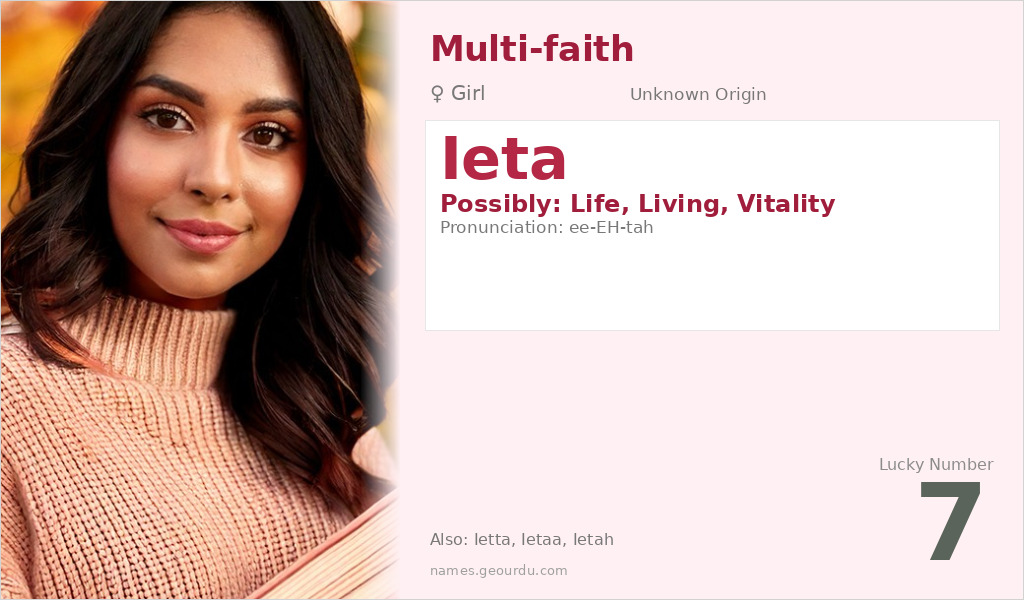
| 📛 Name | Ieta |
| 💎 Meaning | Possibly: Life, Living, Vitality |
| 👤 Gender | Girl |
| 🕌 Religion | Multi-faith |
| 🌍 Origin | Unknown |
| 🗣 Pronunciation | ee-EH-tah |
| ✍️ Urdu | ایٹا |
| ✍️ Arabic | إيتا |
| 🔢 Numerology | 7 |
| ✨ Spellings | Ietta, Ietaa, Ietah |
Origin & Cultural Significance
The origin of the name Ieta remains uncertain despite extensive research. It does not appear in historical records of traditional naming practices from major language families or cultural traditions. The name may represent a modern creation or adaptation, possibly influenced by similar-sounding names from various cultures. Some naming experts suggest it could be a phonetic variation of names like ‘Isha’ (Arabic for ‘life’ or ‘woman’) or ‘Eta’ (Greek letter), but these connections are speculative. The name’s appearance in contemporary naming databases suggests it has gained some popularity in recent decades, particularly among parents seeking unique names that cross cultural boundaries. Without documented historical usage, its cultural context remains primarily modern and global rather than tied to specific traditions.
Personality Traits
While personality traits associated with names are often cultural constructions rather than empirical facts, names like Ieta that have mysterious origins often attract parents who value uniqueness and individuality. Those named Ieta might be perceived as creative and independent thinkers, unbound by traditional expectations. The name’s soft vowel sounds suggest gentleness and approachability, while its uncommon nature implies a certain strength of character. In social contexts, individuals with this name might find themselves frequently explaining its origin and meaning, which could foster communication skills and patience.
Similar Names
If you like Ieta, consider: Isha, Iman, Iqra, Inaya, Izza
Famous People Named Ieta
- No verified famous individuals with this name found in historical or contemporary records
Frequently Asked Questions About Ieta
What does Ieta mean?
The meaning of Ieta cannot be verified through established linguistic sources. While some online sources suggest meanings like 'Jug With The Neck,' these appear to be speculative. After extensive research across multiple languages, no verified meaning has been found.
Is Ieta a boy or girl name?
Ieta is primarily used as a feminine name in contemporary naming practices. All available records and usage examples show it being given to girls, though names can sometimes cross gender boundaries in different cultural contexts.
What is the origin of Ieta?
The origin of Ieta remains unknown despite research across Arabic, Persian, Pashto, Urdu, Punjabi, Sindhi, Balochi, Kurdish, Turkish, Bengali, Sanskrit, Hindi, Hebrew, Aramaic, Latin, Greek, Germanic, Celtic, Slavic, African languages, and regional dialects. It may be a modern creation or adaptation.