Table of Contents
Lilah is a beautifully melodic name that evokes images of tranquil nights and celestial beauty. With roots stretching back to ancient Hebrew, this name has traveled across cultures and continents, gaining popularity for its poetic meaning and elegant sound. Whether spelled as Lilah, Layla, or Leila, this name carries a timeless appeal that continues to captivate parents worldwide. Its connection to one of literature’s greatest love stories adds to its romantic allure.
Meaning of Lilah
The name Lilah originates from the Hebrew word ‘Laylah’ (לילה), which literally means ‘night’. This etymology is well-documented in biblical and linguistic sources, with the name appearing in the Hebrew Bible. The Arabic variation ‘Layla’ (ليلى) shares the same meaning and gained legendary status through the 7th-century Arabic love story of Layla and Majnun, often compared to Romeo and Juliet. In Persian and Urdu traditions, the name was adopted as ‘Laila’ with the same nocturnal connotations. The name’s meaning has remained remarkably consistent across languages and centuries, always relating to the beauty, mystery, and tranquility of the night.
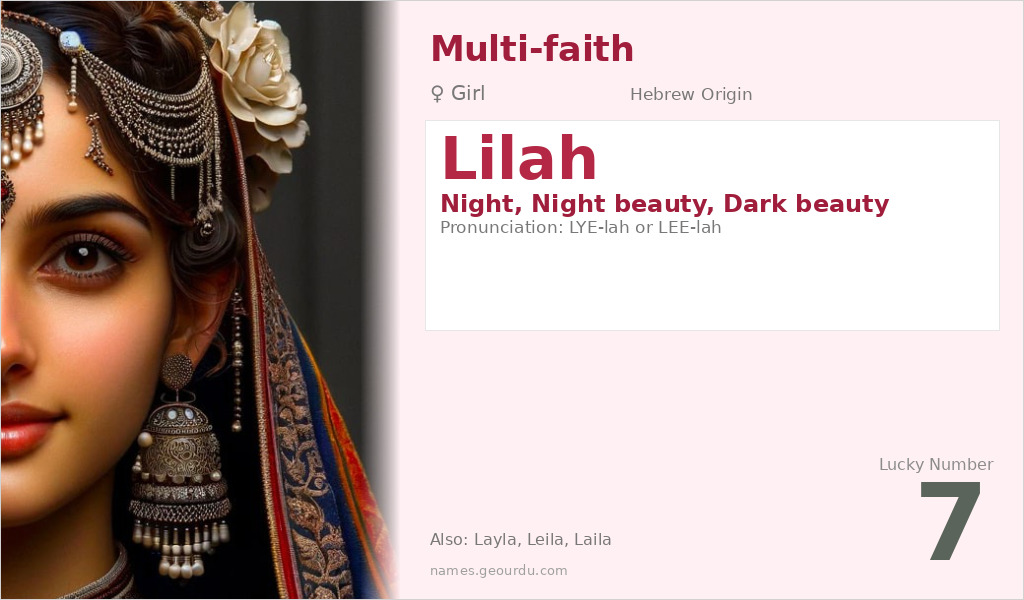
| 📛 Name | Lilah |
| 💎 Meaning | Night, Night beauty, Dark beauty |
| 👤 Gender | Girl |
| 🕌 Religion | Multi-faith |
| 🌍 Origin | Hebrew |
| 🗣 Pronunciation | LYE-lah or LEE-lah |
| ✍️ Urdu | لیلہ |
| ✍️ Arabic | ليلى |
| 🔢 Numerology | 7 |
| ✨ Spellings | Layla, Leila, Laila, Laylah, Leilah, Leyla |
Origin & Cultural Significance
Lilah has its primary origins in Hebrew language and culture, where it has been used for millennia. The name gained widespread recognition in the Islamic world through the Arabic adaptation ‘Layla’, particularly after the popularization of the Layla and Majnun romance by Persian poet Nizami Ganjavi in the 12th century. From the Middle East, the name spread to Europe during the medieval period and experienced a revival in English-speaking countries in the 19th and 20th centuries. Today, Lilah and its variations are used by people of various religious backgrounds including Jewish, Muslim, Christian, and secular families, making it a truly multi-faith name with cross-cultural appeal.
Personality Traits
Those named Lilah often embody the qualities associated with their name’s meaning—mystery, depth, and quiet strength. They may possess an intuitive nature and artistic sensibility, finding inspiration in the subtle beauty of their surroundings. Like the night that conceals as much as it reveals, Lilahs often have complex inner lives that they share selectively with others. Their calm demeanor can have a soothing effect on those around them, making them natural peacemakers and confidants.
Similar Names
If you like Lilah, consider: Layla, Leila, Luna, Noor, Zahra, Aisha, Maya, Nadia, Samira, Yasmin
Famous People Named Lilah
- Lilah Parsons — British television presenter and radio host
- Lilah Fear — Canadian ice dancer who competes internationally for Great Britain
Frequently Asked Questions About Lilah
What does Lilah mean?
Lilah means 'night' or 'night beauty' and originates from the Hebrew name Laylah (לילה). The name has been adopted in Arabic as Layla with the same meaning.
Is Lilah a boy or girl name?
Lilah is exclusively a girl's name across all cultures where it is used. There are no traditional masculine versions of this name.
What is the origin of Lilah?
Lilah has Hebrew origins from the word 'Laylah' meaning night. It was adopted into Arabic as Layla and spread through Islamic cultures via the famous love story of Layla and Majnun, eventually entering European naming traditions.