Table of Contents
Masooma is a beautiful and meaningful Arabic name for girls that carries deep spiritual significance in Islamic culture. Derived from the root meaning ‘innocent’ or ‘sinless,’ this name embodies purity and moral integrity. Popular among Muslim families worldwide, it honors historical religious figures while conveying virtuous qualities. In this guide, we explore the rich etymology, cultural context, and modern usage of the name Masooma.
Meaning of Masooma
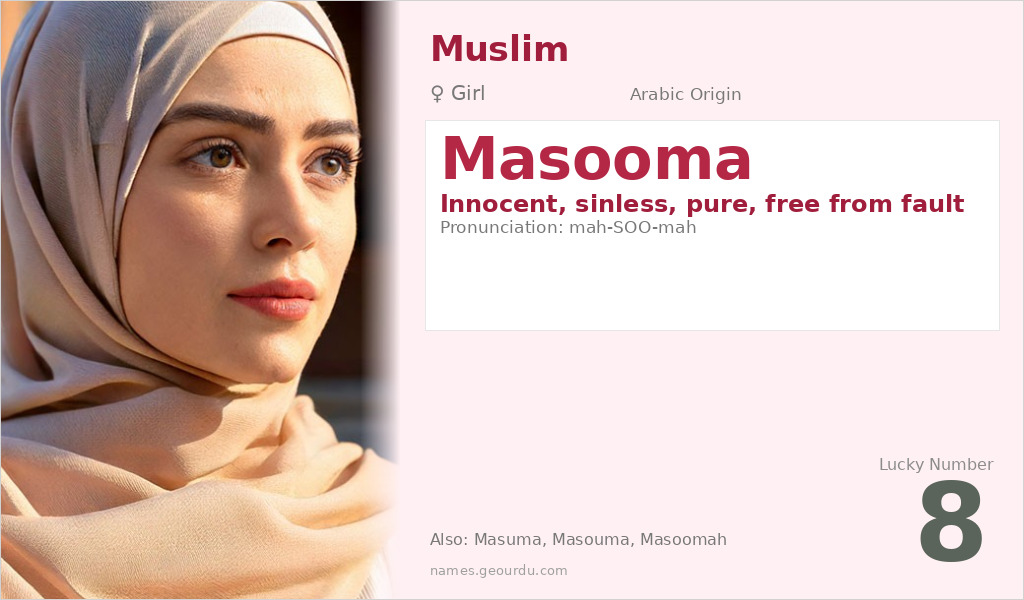
Masooma is an Arabic feminine name that directly translates to ‘innocent,’ ‘sinless,’ ‘pure,’ or ‘free from fault.’ It originates from the trilateral root ‘ṣ-m-m’ (ص-م-م), which conveys the concept of being protected or preserved from sin. The masculine form is ‘Masoom,’ and the feminine ‘Masooma’ emphasizes this state of moral infallibility. In Islamic theology, the term is often associated with the concept of ‘ismah’ (عصمة), meaning divine protection from error, attributed to prophets and certain revered figures. Linguistically, it is a passive participle form, indicating one who has been made innocent or kept pure. This name is particularly significant in Shia Islam due to its association with Fatimah al-Ma’sūmah, symbolizing spiritual purity and righteousness.
| 📛 Name | Masooma |
| 💎 Meaning | Innocent, sinless, pure, free from fault |
| 👤 Gender | Girl |
| 🕌 Religion | Muslim |
| 🌍 Origin | Arabic |
| 🗣 Pronunciation | mah-SOO-mah |
| ✍️ Urdu | معصومہ |
| ✍️ Arabic | معصومة |
| 🔢 Numerology | 8 |
| ✨ Spellings | Masuma, Masouma, Masoomah, Masumah |
Origin & Cultural Significance
Masooma has its origins in classical Arabic language and Islamic tradition, with deep roots in the religious and cultural history of the Muslim world. It gained prominence through Fatimah bint Musa al-Kadhim (known as Fatimah al-Ma’sūmah), the sister of the eighth Shia Imam, who is buried in Qom, Iran, making the name especially popular in Persian-speaking and Shia communities. Over centuries, the name spread across the Muslim world, including regions like South Asia, the Middle East, and Africa, often chosen for its virtuous connotations. While primarily used in Muslim contexts, its linguistic appeal has also seen occasional adoption in multi-faith settings where Arabic names are appreciated. The name reflects Islamic values of morality and divine grace, often given with hopes that the child will embody these pure qualities.
Personality Traits
People named Masooma are often described as calm, sincere, and ethically guided individuals. They tend to approach life with a sense of integrity and a desire to avoid wrongdoing, mirroring the name’s meaning of innocence. Their compassionate nature makes them supportive friends and family members, often seen as peacemakers in conflicts. While gentle, they can also display quiet strength in upholding their principles and protecting those they care about.
Similar Names
If you like Masooma, consider: Fatima, Zainab, Sakina, Mahasin, Munira
Famous People Named Masooma
- Fatimah al-Ma'sūmah (790–816 CE) — A revered figure in Shia Islam, sister of Imam Ali al-Ridha, buried in Qom, Iran, where her shrine is a major pilgrimage site.
- Masuma Esmati-Wardak (1921–2003) — An Afghan politician and women's rights activist who served as Minister of Education and Minister of Public Health in Afghanistan.
Frequently Asked Questions About Masooma
What does Masooma mean?
Masooma means 'innocent,' 'sinless,' 'pure,' or 'free from fault' in Arabic. It is derived from the root 'ṣ-m-m' (ص-م-م), related to protection from sin.
Is Masooma a boy or girl name?
Masooma is exclusively a girl's name. It is the feminine form of the Arabic masculine name 'Masoom,' and its usage is consistently female across Muslim cultures.
What is the origin of Masooma?
Masooma originates from the Arabic language and Islamic tradition. It is particularly associated with Fatimah al-Ma'sūmah, a revered figure in Shia Islam, and is widely used in Muslim communities globally.