Table of Contents
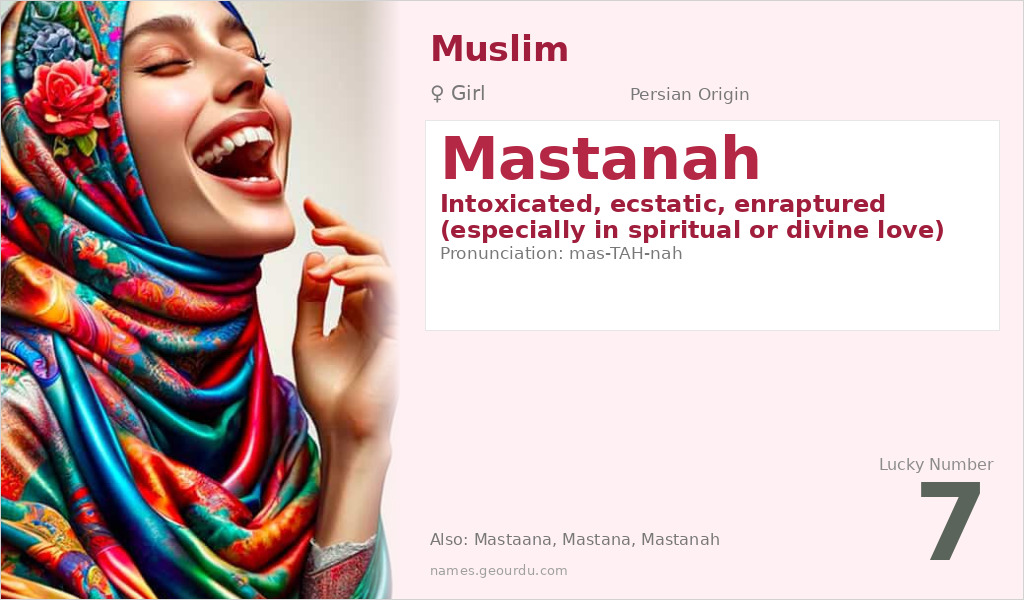
Mastanah is a beautifully poetic Persian name for girls that carries deep spiritual significance in Muslim cultures. Meaning ‘intoxicated with divine love’ or ‘ecstatic in spiritual contemplation,’ this name reflects the rich Sufi traditions of Islamic mysticism. Unlike common names with straightforward meanings, Mastanah evokes complex emotional and religious states that have inspired poets for centuries. Its melodic sound and profound meaning make it a distinctive choice for parents seeking a name with spiritual depth.
Meaning of Mastanah
The name Mastanah originates from the Persian word ‘mast’ (مست), which literally means ‘intoxicated’ or ‘drunk,’ but in spiritual and poetic contexts refers to being enraptured in divine love or spiritual ecstasy. The feminine suffix ‘-anah’ (انه) transforms it into a female name meaning ‘she who is intoxicated.’ This intoxication is not literal but metaphorical, describing a state of spiritual bliss and connection with the divine. In Sufi tradition, being ‘mast’ represents losing oneself in love for God, a central concept in Islamic mysticism. The name appears frequently in classical Persian and Urdu poetry, particularly in works by poets like Rumi, Hafez, and Ghalib, where it describes devotees overwhelmed by spiritual experience.
| 📛 Name | Mastanah |
| 💎 Meaning | Intoxicated, ecstatic, enraptured (especially in spiritual or divine love) |
| 👤 Gender | Girl |
| 🕌 Religion | Muslim |
| 🌍 Origin | Persian |
| 🗣 Pronunciation | mas-TAH-nah |
| ✍️ Urdu | مستانہ |
| ✍️ Arabic | مستانة |
| 🔢 Numerology | 7 |
| ✨ Spellings | Mastaana, Mastana, Mastanah, Mastaana |
Origin & Cultural Significance
Mastanah has its roots in Persian language and culture, specifically within the context of Islamic mysticism (Sufism) that flourished in Persia and spread throughout the Muslim world. The name gained popularity during the Mughal era in South Asia, where Persian was the court language and deeply influenced local naming traditions. While primarily used in Muslim communities, the name’s Persian origin means it transcends specific ethnic boundaries and appears among various Persian-speaking and Persian-influenced cultures. The concept of spiritual intoxication (‘masti’) is central to Sufi philosophy, making this name particularly significant in communities with strong mystical traditions. Historical records show the name appearing in Mughal nobility and among families with literary or religious backgrounds.
Personality Traits
Those named Mastanah are often associated with deep emotional and spiritual sensitivity. They tend to be introspective individuals who value meaningful connections over superficial interactions. Their ‘intoxicated’ nature manifests as passionate engagement with their beliefs, creative pursuits, or relationships. While they can be intensely focused on their spiritual or emotional world, they also possess the ability to inspire others with their depth of feeling and commitment to their principles.
Similar Names
If you like Mastanah, consider: Mastoora, Mastura, Mahvash, Parisa, Gulnar
Famous People Named Mastanah
- Mastanah Begum — 18th century Mughal noblewoman and patron of arts
- Mastanah — Character in classical Urdu/Persian poetry representing spiritual ecstasy
Frequently Asked Questions About Mastanah
What does Mastanah mean?
Mastanah means 'intoxicated with divine love' or 'spiritually ecstatic' in Persian. It comes from the word 'mast' meaning intoxicated, with the feminine suffix '-anah.'
Is Mastanah a boy or girl name?
Mastanah is exclusively a feminine name. The '-anah' suffix in Persian specifically indicates feminine gender, and historical usage shows it has always been used for girls.
What is the origin of Mastanah?
Mastanah originates from Persian language and culture, specifically within the context of Islamic Sufi mysticism. It reflects the concept of spiritual intoxication central to Persian poetic and religious traditions.