Table of Contents
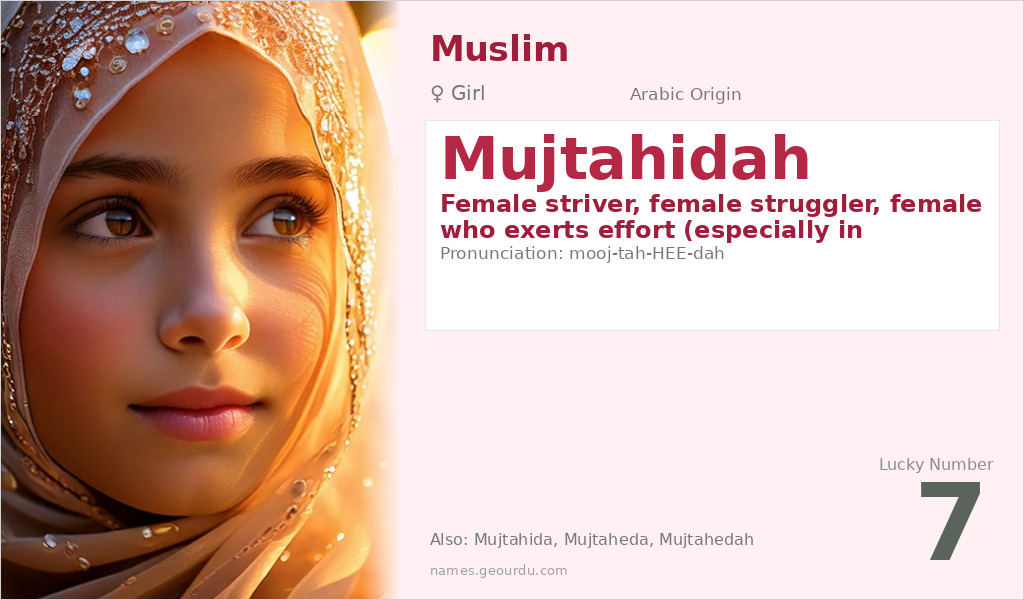
Mujtahidah is a distinctive Arabic feminine name with deep roots in Islamic scholarly tradition. Meaning ‘female striver’ or ‘female who exerts effort,’ this name carries significant religious and intellectual connotations. Primarily used in Muslim communities, it reflects values of diligence and scholarly pursuit. The name’s linguistic structure reveals its connection to important concepts in Islamic jurisprudence and personal development.
Meaning of Mujtahidah
Mujtahidah derives from the Arabic root ج-ه-د (j-h-d), which conveys the core meaning of striving, struggling, or exerting maximum effort. The masculine form ‘mujtahid’ refers to someone who engages in ijtihad—the process of independent legal reasoning in Islamic law. By adding the feminine suffix ‘-ah,’ the name specifically denotes a female who embodies this quality of diligent striving. In classical Arabic, the term was often used as an honorific for women scholars who reached the level of independent reasoning in religious matters. This makes Mujtahidah more than just a descriptive name—it’s a title that acknowledges intellectual and spiritual achievement.
| 📛 Name | Mujtahidah |
| 💎 Meaning | Female striver, female struggler, female who exerts effort (especially in religious or scholarly matters) |
| 👤 Gender | Girl |
| 🕌 Religion | Muslim |
| 🌍 Origin | Arabic |
| 🗣 Pronunciation | mooj-tah-HEE-dah |
| ✍️ Urdu | مجتہدہ |
| ✍️ Arabic | مجتهدة |
| 🔢 Numerology | 7 |
| ✨ Spellings | Mujtahida, Mujtaheda, Mujtahedah, Mujtahidah |
Origin & Cultural Significance
Mujtahidah originates from classical Arabic and developed within Islamic scholarly circles. The concept of ijtihad (independent reasoning) has been central to Islamic jurisprudence since the early centuries of Islam, and the term ‘mujtahid’ emerged to describe qualified scholars. The feminine form ‘mujtahidah’ gained usage particularly in contexts recognizing women’s scholarly contributions, though it remains less common than its masculine counterpart. The name is found across Arabic-speaking regions and Muslim communities worldwide, though it’s more frequently used in educated families who value religious scholarship. Its usage reflects Islamic traditions that, in certain historical periods and regions, acknowledged women’s intellectual capabilities in religious matters.
Personality Traits
Those named Mujtahidah are often associated with traits of perseverance, intellectual depth, and moral conviction. The name suggests someone who approaches challenges with determination and values knowledge acquisition. In cultural contexts, it may imply a person who seeks truth through careful study and reflection rather than accepting things at face value. These associations stem directly from the name’s meaning of ‘female striver’ and its connection to scholarly endeavor in Islamic tradition.
Similar Names
If you like Mujtahidah, consider: Mujahidah, Mujahida, Mujtaba, Mujaddid, Mujib, Ijtihad, Jihad, Muhjah, Mujdah
Famous People Named Mujtahidah
- Historical female Islamic scholars who achieved the rank of mujtahidah — While specific famous individuals with this exact given name are rare in historical records, the term 'mujtahidah' was used as an honorific title for learned women like Fatimah bint Abbas al-Baghdadiyah (13th century) who were recognized for their scholarly ijtihad
Frequently Asked Questions About Mujtahidah
What does Mujtahidah mean?
Mujtahidah means 'female striver' or 'female who exerts effort' in Arabic, specifically referring to a woman who strives diligently, particularly in religious or scholarly matters. It's the feminine form of 'mujtahid,' which denotes someone qualified for independent reasoning in Islamic law.
Is Mujtahidah a boy or girl name?
Mujtahidah is exclusively a girl's name. The '-ah' ending is a feminine suffix in Arabic, making this specifically the female version of the masculine 'mujtahid.' In Arabic grammar and naming conventions, this distinction is clear and consistent.
What is the origin of Mujtahidah?
Mujtahidah originates from classical Arabic and Islamic scholarly tradition. It comes from the Arabic root j-h-d (striving) and developed within the context of Islamic jurisprudence, where 'mujtahid' refers to scholars qualified for independent legal reasoning. The feminine form emerged to acknowledge women's scholarly contributions.