Table of Contents
Mulan is a beautiful and powerful name that has captured global imagination through ancient legend and modern storytelling. While many know Mulan from Disney’s beloved films, the name has deep roots in Chinese culture and history. Meaning ‘magnolia flower,’ this name carries connotations of natural beauty, resilience, and feminine strength. From the legendary warrior heroine to contemporary usage, Mulan remains a timeless choice with rich cultural significance.
Meaning of Mulan
The name Mulan originates from Chinese characters 木兰 (mù lán), where ‘mu’ (木) means ‘wood’ or ‘tree’ and ‘lan’ (兰) means ‘orchid’ or more broadly ‘fragrant plant.’ Together, they specifically refer to the magnolia flower, particularly Magnolia liliiflora, which is native to China and valued for its beauty and fragrance. The name’s etymology reflects Chinese cultural appreciation for nature and floral symbolism. Historically, ‘mulan’ appears in classical Chinese poetry and literature as a reference to this elegant blossom. The magnolia symbolism connects the name to qualities of purity, nobility, and natural grace within Chinese botanical tradition.
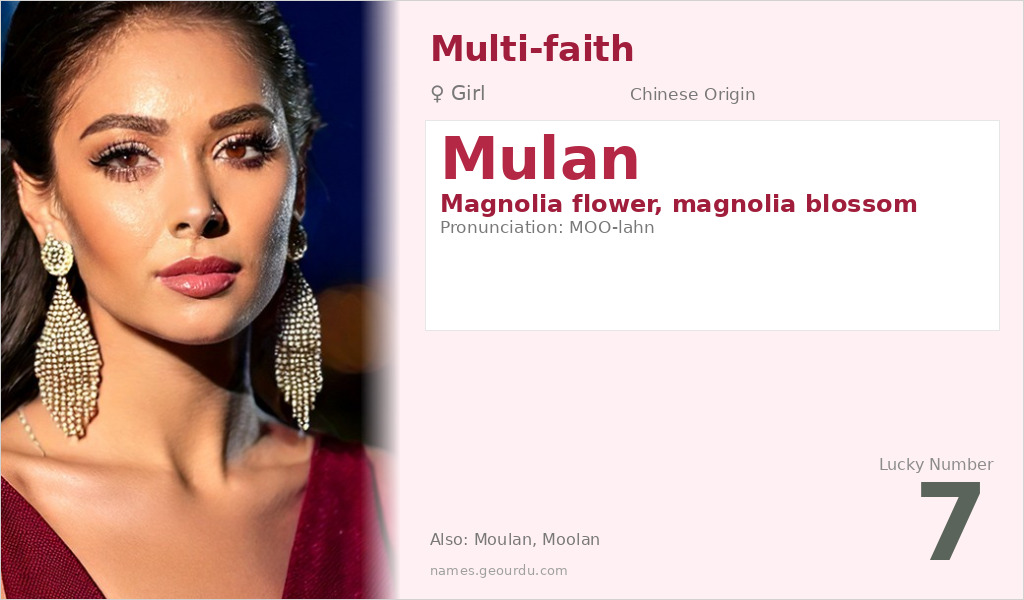
| 📛 Name | Mulan |
| 💎 Meaning | Magnolia flower, magnolia blossom |
| 👤 Gender | Girl |
| 🕌 Religion | Multi-faith |
| 🌍 Origin | Chinese |
| 🗣 Pronunciation | MOO-lahn |
| ✍️ Urdu | مولان |
| ✍️ Arabic | مولان |
| 🔢 Numerology | 7 |
| ✨ Spellings | Moulan, Moolan |
Origin & Cultural Significance
Mulan’s origin is firmly rooted in Chinese culture, dating back to the 6th century Northern Wei dynasty period. The name gained legendary status through the ‘Ballad of Mulan,’ a folk song about the warrior heroine Hua Mulan who took her father’s place in the army. This story was later compiled in the 12th-century anthology ‘Music Bureau Collection’ and has been retold for centuries in Chinese opera, literature, and film. While the name existed as a floral term before the legend, the heroic association significantly enhanced its cultural resonance. In modern times, Disney’s animated (1998) and live-action (2020) adaptations introduced Mulan to global audiences, though the name remains primarily Chinese in origin and usage.
Personality Traits
Those named Mulan often embody the dual qualities of their namesake: the natural beauty of the magnolia flower and the courageous spirit of the legendary warrior. They tend to be determined individuals who value family loyalty and personal integrity above all. With a practical approach to challenges and an ability to adapt to difficult circumstances, they often demonstrate quiet strength and resilience. Their connection to nature and tradition may give them a grounded, thoughtful personality with an appreciation for beauty in both art and everyday life.
Similar Names
If you like Mulan, consider: Meilin, Lian, Lan, Hua, Magnolia
Famous People Named Mulan
- Hua Mulan — Legendary Chinese warrior from the 6th century Northern Wei dynasty, subject of the 'Ballad of Mulan' and Disney adaptations
- Mulan (Disney character) — Animated protagonist from Disney's 1998 film 'Mulan' and its 2020 live-action remake
Frequently Asked Questions About Mulan
What does Mulan mean?
Mulan means 'magnolia flower' or 'magnolia blossom' in Chinese, from the characters 木兰 (mù lán).
Is Mulan a boy or girl name?
Mulan is exclusively a girl's name, both historically as the name of the legendary female warrior Hua Mulan and in modern usage.
What is the origin of Mulan?
Mulan originates from Chinese culture, specifically from the Chinese term for magnolia flower and the legendary story of Hua Mulan from 6th century China.