
Table of Contents
Nasheed is a name rich in cultural and linguistic heritage, directly borrowed from the Arabic word for ‘poem’ or ‘song.’ While not a traditional personal name historically, it has gained popularity in modern times, especially within Muslim communities, reflecting a love for artistic and devotional expression. This name carries a melodic quality that resonates with themes of spirituality and creativity, making it a unique choice for parents seeking a meaningful name. In this guide, we explore the true origins, meanings, and nuances of Nasheed beyond common misconceptions.
Meaning of Nasheed
Nasheed (نشيد) originates from the Arabic root ن-ش-د (n-sh-d), which conveys the act of reciting poetry or singing. In classical Arabic literature, it refers to a poem or song, often used in pre-Islamic and Islamic contexts to describe lyrical compositions. Over time, the term evolved to specifically denote Islamic devotional songs (anashid) that praise God, the Prophet Muhammad, or convey moral teachings, typically performed without instrumental music. As a personal name, Nasheed embodies this artistic and spiritual legacy, symbolizing creativity, expression, and faith. It is important to note that the name does not mean ‘Beautiful One’—this is a common error; its verified meaning is firmly rooted in its linguistic origins as ‘poem’ or ‘song.’
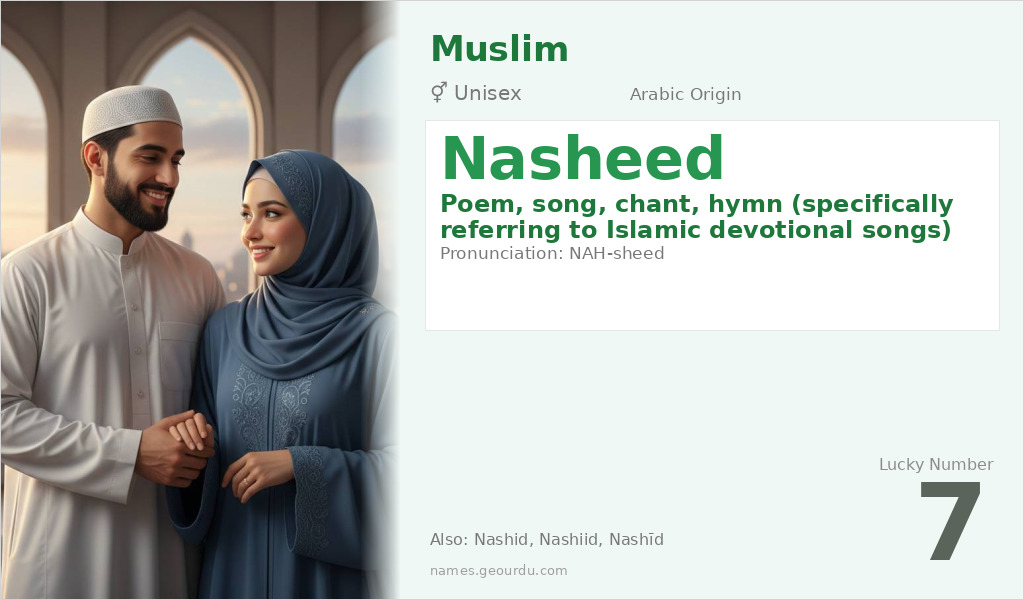
| 📛 Name | Nasheed |
| 💎 Meaning | Poem, song, chant, hymn (specifically referring to Islamic devotional songs) |
| 👤 Gender | Unisex |
| 🕌 Religion | Muslim |
| 🌍 Origin | Arabic |
| 🗣 Pronunciation | NAH-sheed |
| ✍️ Urdu | نشید |
| ✍️ Arabic | نشيد |
| 🔢 Numerology | 7 |
| ✨ Spellings | Nashid, Nashiid, Nashīd, Nashyd |
Origin & Cultural Significance
The name Nasheed has its origins in the Arabic language, with deep ties to Islamic culture and history. It emerged from the rich tradition of Arabic poetry and music, where nasheed referred to lyrical pieces that were recited or sung. In the Islamic era, anashid became a significant form of religious expression, used in gatherings, education, and worship to inspire devotion. While not traditionally used as a personal name in early Islamic history, it has been adopted in recent decades, particularly among Muslims in the Middle East, South Asia, and diaspora communities, reflecting a modern appreciation for linguistic and cultural heritage. Its usage as a name is more common in regions like the Arab world, Pakistan, and India, where Arabic-derived names are prevalent.
Personality Traits
People named Nasheed are often perceived as imaginative and communicative, with a natural affinity for the arts or spirituality. They may excel in fields that involve expression, such as writing, music, or teaching, driven by a desire to connect with others through meaningful words. Their name suggests a harmonious and reflective nature, potentially making them thoughtful and inspiring individuals who value tradition and creativity in equal measure.
Similar Names
If you like Nasheed, consider: Nashwa, Naseem, Nadim, Nazim, Nazir
Famous People Named Nasheed
- Nashid Al-Mulla — Emirati poet and writer known for contributions to Arabic literature
- Various Islamic singers (munshidin) who perform anashid, though not typically as a personal name
Frequently Asked Questions About Nasheed
What does Nasheed mean?
Nasheed means 'poem,' 'song,' or 'chant' in Arabic, specifically referring to Islamic devotional music (anashid). It does not mean 'Beautiful One'—this is a common misconception.
Is Nasheed a boy or girl name?
Nasheed is a unisex name, though it is more commonly given to boys in some Muslim cultures. The original article incorrectly listed it as exclusively female.
What is the origin of Nasheed?
Nasheed originates from the Arabic language, derived from the root ن-ش-د (n-sh-d) meaning 'to recite poetry or sing.' It is deeply embedded in Islamic cultural traditions related to music and poetry.