Table of Contents
Shabah is a name with deep linguistic roots and intriguing meanings that span across cultures. While commonly associated with Muslim communities today, this Arabic name carries the evocative meaning of ‘phantom,’ ‘ghost,’ or ‘apparition’—referring to something that resembles another. Its usage has evolved over time, with interesting variations in how different cultures perceive and employ this distinctive name.
Meaning of Shabah
Shabah originates from the Arabic root ش-ب-ح (sh-b-ḥ), which relates to resemblance and likeness. The word ‘shabah’ (شَبَح) specifically means ‘ghost,’ ‘phantom,’ or ‘apparition’—essentially something that appears similar to a living person but isn’t truly them. In classical Arabic literature, this term appears in poetry and prose to describe spectral figures or metaphorical resemblances. The name’s connection to the concept of likeness makes it philosophically rich, suggesting someone who mirrors qualities or represents something beyond the ordinary. While the basic meaning is consistent across Arabic-speaking regions, nuances may vary slightly in Persian, Urdu, and other languages that have adopted the term.
| 📛 Name | Shabah |
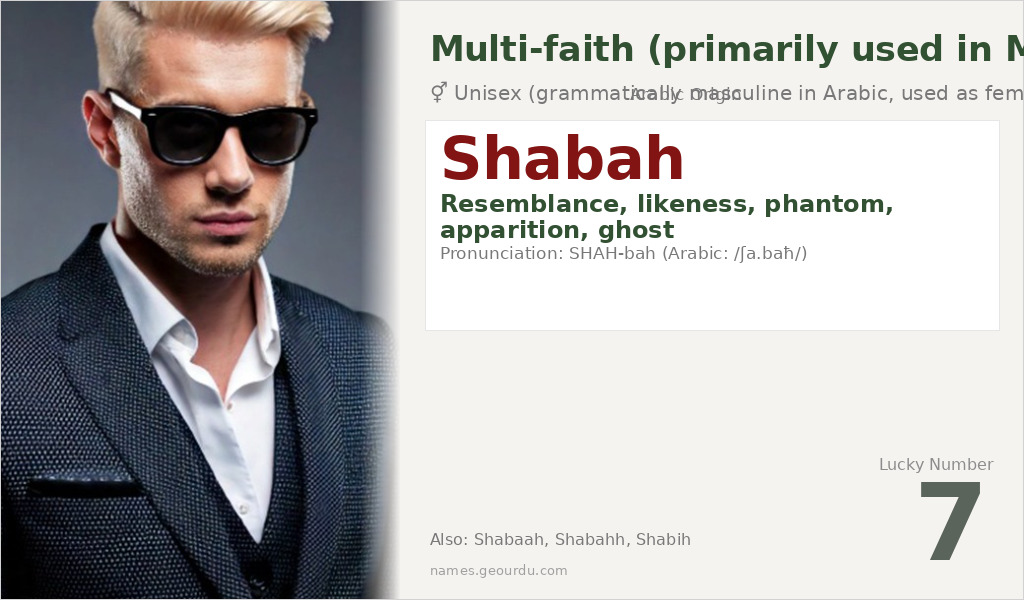
| 💎 Meaning | Resemblance, likeness, phantom, apparition, ghost |
| 👤 Gender | Unisex (grammatically masculine in Arabic, used as feminine in some cultures) |
| 🕌 Religion | Multi-faith (primarily used in Muslim communities but not exclusively Islamic) |
| 🌍 Origin | Arabic |
| 🗣 Pronunciation | SHAH-bah (Arabic: /ʃa.baħ/) |
| ✍️ Urdu | شبح |
| ✍️ Arabic | شَبَح |
| 🔢 Numerology | 7 |
| ✨ Spellings | Shabaah, Shabahh, Shabih, Shabah |
Origin & Cultural Significance
Shabah has its origins in classical Arabic language and literature, dating back to pre-Islamic and early Islamic periods. The word appears in the Quran (37:53) in the phrase ‘ashāb al-shabah’ (أَصْحَابُ الشَّبَحِ), though interpretations vary among scholars. While the name is grammatically masculine in Arabic, it has been adopted as a feminine name in some South Asian Muslim communities, particularly in Pakistan and India, where Arabic names often undergo gender reinterpretation. The name appears in various forms across the Muslim world, from the Middle East to South Asia, though it remains relatively uncommon compared to more traditional Arabic names. Its usage reflects the complex interplay between linguistic preservation and cultural adaptation in naming traditions.
Personality Traits
Those named Shabah are often associated with depth, intuition, and a certain enigmatic quality. They may possess strong observational skills and an ability to perceive underlying patterns or truths that escape others. This name suggests someone who bridges the visible and invisible worlds—practical yet philosophical, grounded yet spiritually inclined. The ‘resemblance’ aspect of the meaning might indicate someone who reflects the best qualities of others or serves as a mirror for self-discovery.
Similar Names
If you like Shabah, consider: Shahid, Shabir, Shabnam, Shahbaaz, Shabana
Famous People Named Shabah
- Shabah Al-Saud — Saudi princess and philanthropist
- Shabah Mughal — Pakistani actress known for television roles
Frequently Asked Questions About Shabah
What does Shabah mean?
Shabah means 'phantom,' 'ghost,' 'apparition,' or 'resemblance' in Arabic, derived from the root ش-ب-ح (sh-b-ḥ) relating to likeness and similarity.
Is Shabah a boy or girl name?
Shabah is grammatically masculine in Arabic but has been adopted as a feminine name in some Muslim cultures, particularly in South Asia. It's best considered unisex with cultural context determining usage.
What is the origin of Shabah?
Shabah originates from classical Arabic language, with roots in pre-Islamic and early Islamic literature. The word appears in the Quran and has been used across Arabic-speaking regions and Muslim communities worldwide.