Table of Contents
Vasia is a charming name with regal origins that has traveled across cultures and languages. While often used as a diminutive, it carries the weight of royal heritage from its Greek and Slavic roots. This name has found popularity in Eastern Europe and among diaspora communities, maintaining its connection to nobility and grace. Understanding its true etymology reveals a rich history quite different from common misconceptions.
Meaning of Vasia
Vasia’s meaning is firmly rooted in concepts of royalty and sovereignty. The name derives from the Greek word ‘basileus’ (βασιλεύς), meaning ‘king’ or ‘monarch’. Through Vasiliki (Βασιλική), the feminine form meaning ‘royal woman’ or ‘queenly’, it entered Slavic languages as Vasilisa. Vasia serves as the affectionate diminutive of these longer forms. In Russian, Bulgarian, and Serbian traditions, Vasilisa was the name given to daughters with hopes they would embody royal qualities of dignity and leadership. The name has maintained this core meaning across centuries of linguistic evolution.
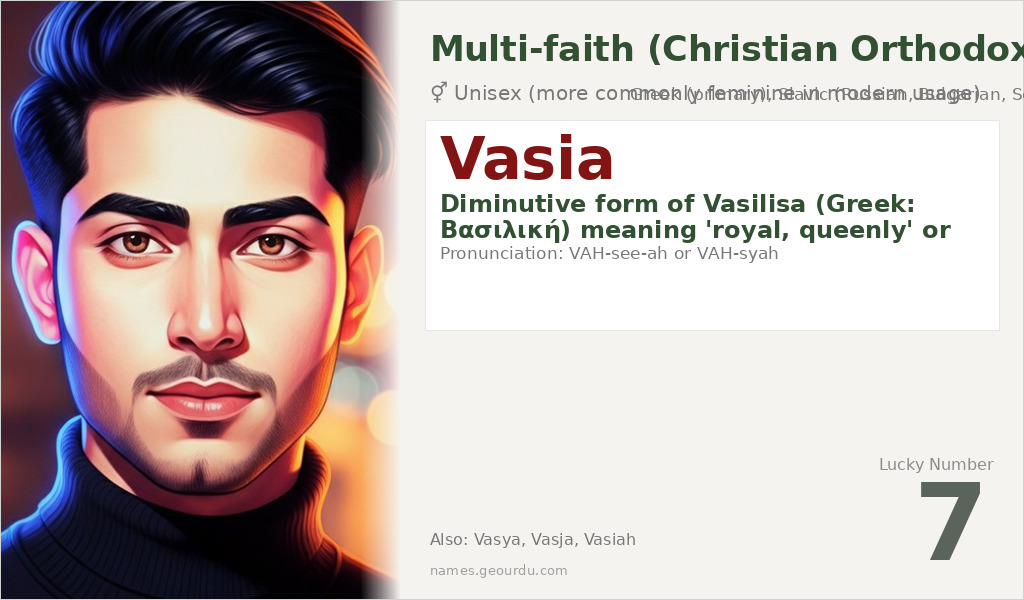
| 📛 Name | Vasia |
| 💎 Meaning | Diminutive form of Vasilisa (Greek: Βασιλική) meaning 'royal, queenly' or from Slavic Vasil meaning 'king, royal' |
| 👤 Gender | Unisex (more commonly feminine in modern usage) |
| 🕌 Religion | Multi-faith (Christian Orthodox, with some Muslim usage in Balkan regions) |
| 🌍 Origin | Greek (primary), Slavic (Russian, Bulgarian, Serbian) |
| 🗣 Pronunciation | VAH-see-ah or VAH-syah |
| ✍️ Urdu | واسیا |
| ✍️ Arabic | فاسيا |
| 🔢 Numerology | 7 |
| ✨ Spellings | Vasya, Vasja, Vasiah, Vasiya |
Origin & Cultural Significance
Vasia originates from Greek Christian traditions, specifically from the name Vasiliki, which honors Saint Basil the Great (4th century CE). As Orthodox Christianity spread through Eastern Europe, the name was adopted into Slavic languages, becoming Vasilisa in Russian and Vasilka in Bulgarian. While primarily associated with Christian Orthodox communities, the name has seen some usage in Muslim-majority Balkan regions like Bosnia and Albania due to cultural exchange. However, it remains fundamentally a name of Greek origin that spread through Christianization rather than having Islamic roots. The name’s popularity peaks in Greece, Russia, Ukraine, and Bulgaria.
Personality Traits
Those named Vasia often exhibit qualities associated with their name’s royal meaning—natural leadership, dignity, and grace. They tend to approach life with thoughtful consideration and strategic thinking. While they may appear reserved initially, they possess strong convictions and the ability to inspire others through quiet confidence rather than overt dominance.
Similar Names
If you like Vasia, consider: Vasilisa, Vasiliki, Vasil, Basil, Vasantha, Vasudha, Vasanti, Vasudev
Famous People Named Vasia
- Vasia Panagopoulou — Greek singer and actress known for her work in Greek cinema
- Vasia — stage name of Ukrainian singer Anastasiya Kvitko
Frequently Asked Questions About Vasia
What does Vasia mean?
Vasia means 'royal' or 'queenly', derived from Greek Vasiliki (Βασιλική), which comes from 'basileus' meaning 'king'. It's a diminutive form used in Greek and Slavic naming traditions.
Is Vasia a boy or girl name?
Vasia is technically unisex but more commonly used for girls in modern times. As a diminutive of Vasiliki (feminine) and Vasilios (masculine), it can serve both, though feminine usage predominates today.
What is the origin of Vasia?
Vasia has Greek origins, specifically from the name Vasiliki meaning 'royal'. It spread to Slavic languages (Russian, Bulgarian, Serbian) through Orthodox Christian influence and is primarily associated with Christian rather than Islamic naming traditions.