Table of Contents
Syeda is a beautiful and deeply meaningful name that carries centuries of Islamic heritage. As an honorific title denoting female descendants of the Prophet Muhammad, this name represents nobility, respect, and spiritual connection. Popular across Muslim communities from South Asia to the Middle East, Syeda embodies both historical significance and contemporary relevance. Understanding its true meaning reveals why it remains a cherished choice for parents seeking a name with profound religious and cultural roots.
Meaning of Syeda
The name Syeda originates from the Arabic word ‘Sayyida’ (سيدة), which literally means ‘lady,’ ‘mistress,’ or ‘noblewoman.’ It is the feminine form of ‘Sayyid’ (سيد), meaning ‘lord’ or ‘master.’ In Islamic context, however, Syeda carries specific religious significance as it refers to women who are direct descendants of the Prophet Muhammad through his daughter Fatima and her husband Ali ibn Abi Talib. This lineage is particularly revered in Shia Islam, where Syedas are respected members of the community. The name’s etymology traces back to the Arabic root ‘s-y-d’ (س-ي-د), conveying concepts of leadership, honor, and elevated status. Unlike ordinary titles, Syeda represents both social respect and spiritual inheritance within Islamic tradition.
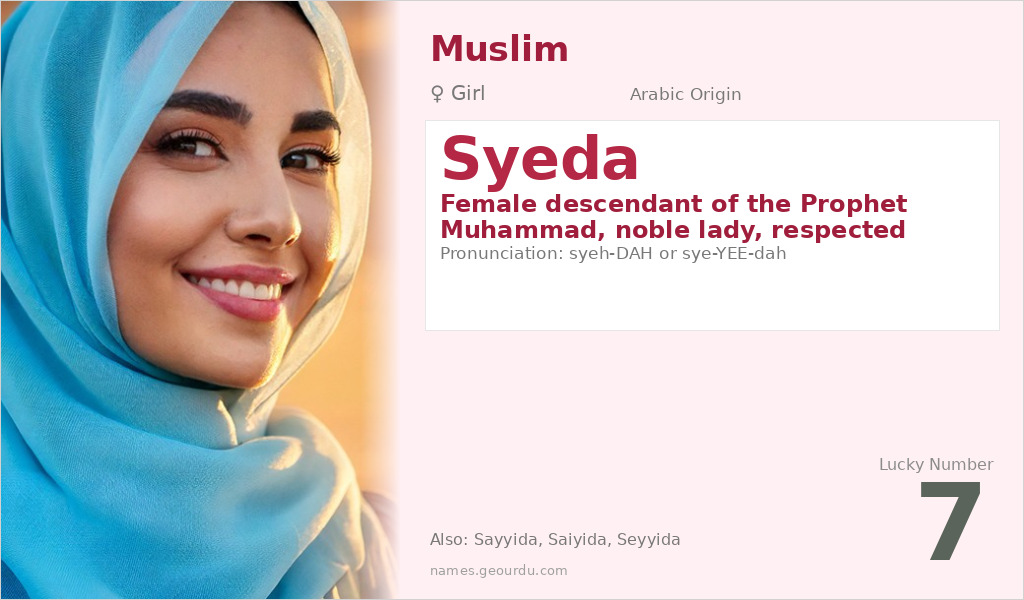
| 📛 Name | Syeda |
| 💎 Meaning | Female descendant of the Prophet Muhammad, noble lady, respected woman |
| 👤 Gender | Girl |
| 🕌 Religion | Muslim |
| 🌍 Origin | Arabic |
| 🗣 Pronunciation | syeh-DAH or sye-YEE-dah |
| ✍️ Urdu | سیدہ |
| ✍️ Arabic | سيدة |
| 🔢 Numerology | 7 |
| ✨ Spellings | Sayyida, Saiyida, Seyyida, Saeeda, Saidah |
Origin & Cultural Significance
Syeda has its origins in classical Arabic and early Islamic history, emerging as an honorific for female members of the Prophet Muhammad’s family. The practice of using ‘Sayyid’ and ‘Sayyida’ titles began among early Muslim communities to distinguish descendants of the Prophet. Over centuries, the name spread throughout the Muslim world via Arabic influence, particularly during the expansion of Islamic empires. In South Asia, it became widely adopted through Persian and Urdu linguistic channels, often used as both a title and a given name. Today, Syeda is most common in countries with significant Muslim populations like Pakistan, India, Bangladesh, Iran, and Arab nations. Its usage reflects both religious devotion and cultural continuity across diverse Muslim societies.
Personality Traits
Those named Syeda often grow into individuals who naturally command respect while maintaining gracious humility. Their connection to prophetic lineage frequently inspires strong ethical foundations and community-oriented values. Many Syedas develop into compassionate leaders who balance tradition with contemporary perspectives, often excelling in fields that allow them to serve others or uphold justice. The name’s historical weight can foster a sense of responsibility to live honorably and contribute positively to society.
Similar Names
If you like Syeda, consider: Fatima, Zainab, Kulsum, Ruqayyah, Umm Kulthum
Famous People Named Syeda
- Syeda Rizwana Hasan — Bangladeshi environmental lawyer and Goldman Environmental Prize winner
- Syeda Ghulam Fatima — Pakistani human rights activist working for bonded laborers
Frequently Asked Questions About Syeda
What does Syeda mean?
Syeda means 'female descendant of the Prophet Muhammad' or 'noble lady' in Arabic. It is an honorific title denoting lineage from the Prophet through his daughter Fatima.
Is Syeda a boy or girl name?
Syeda is exclusively a girl's name. The masculine equivalent is 'Sayyid' or 'Syed,' which refers to male descendants of the Prophet Muhammad.
What is the origin of Syeda?
Syeda originates from Arabic and has deep roots in Islamic tradition. It specifically developed as an honorific for female descendants of Prophet Muhammad and spread throughout Muslim communities worldwide.