Table of Contents
Soophia is an elegant and timeless name that has captivated parents across cultures for centuries. With its roots in ancient Greek philosophy, this name carries the beautiful meaning of ‘wisdom’ and ‘knowledge’. Used by Muslim, Christian, and secular families worldwide, Soophia represents intellectual depth and spiritual insight. The spelling variation reflects phonetic adaptations in languages like Urdu and Persian while preserving the name’s classical heritage.
Meaning of Soophia
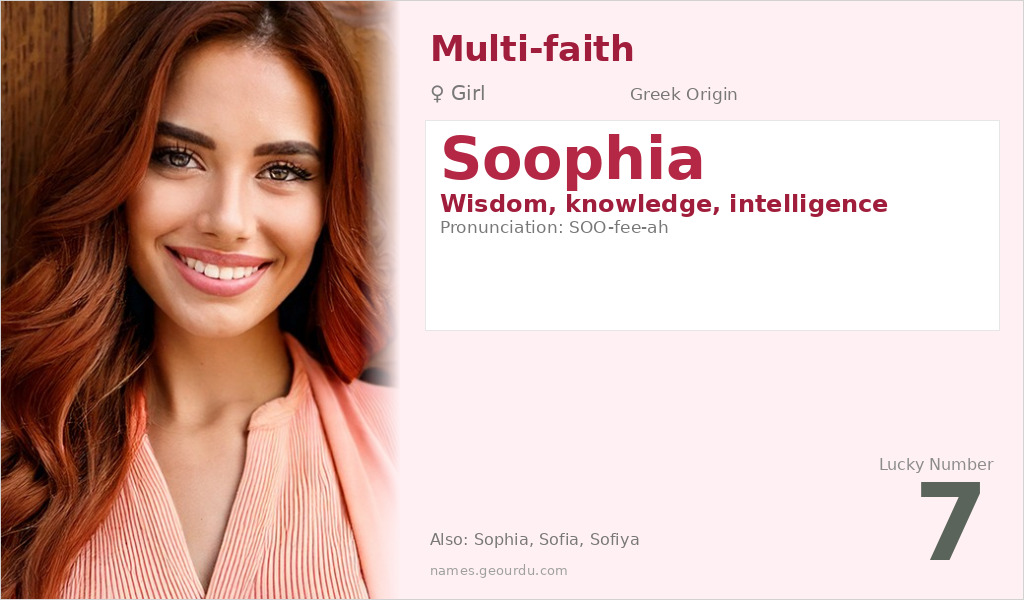
Soophia derives from the Greek word σοφία (sophía), which literally translates to ‘wisdom, knowledge, intelligence’. In ancient Greek philosophy, Sophia represented the highest form of wisdom and was personified as a goddess in Gnostic traditions. The name entered Islamic naming practices through cultural exchange, particularly in regions like Persia, Anatolia, and South Asia where Greek philosophical concepts were studied and adapted. While the spelling ‘Soophia’ with double ‘o’ reflects pronunciation preferences in languages like Urdu and Persian, the core meaning remains consistent with the original Greek etymology. The name appears in various forms across cultures, always retaining its association with intellectual and spiritual insight.
| 📛 Name | Soophia |
| 💎 Meaning | Wisdom, knowledge, intelligence |
| 👤 Gender | Girl |
| 🕌 Religion | Multi-faith |
| 🌍 Origin | Greek |
| 🗣 Pronunciation | SOO-fee-ah |
| ✍️ Urdu | صوفیہ |
| ✍️ Arabic | صوفيا |
| 🔢 Numerology | 7 |
| ✨ Spellings | Sophia, Sofia, Sofiya, Safiya, Sufia |
Origin & Cultural Significance
The name Sophia originated in ancient Greece, where it was both a common noun meaning ‘wisdom’ and eventually became used as a personal name. It gained religious significance in early Christianity through Hagia Sophia (Holy Wisdom) churches and theological concepts. The name spread throughout the Byzantine Empire and entered Islamic cultures through several pathways: Greek philosophical texts translated into Arabic during the Islamic Golden Age, cultural exchange in regions like Anatolia and Persia, and adaptation in South Asian Muslim communities. Today, Soophia/Sophia is truly multi-faith, used by Christian families (particularly Eastern Orthodox and Catholic), Muslim families (especially in South Asia and the Middle East), and secular families worldwide who appreciate its classical beauty and meaningful etymology.
Personality Traits
The name Soophia suggests someone with intellectual curiosity and thoughtful disposition. Historically associated with wisdom and insight, individuals with this name are often perceived as analytical, reflective, and spiritually aware. The name carries an expectation of maturity and depth, encouraging qualities like discernment, learning, and philosophical thinking. While personality varies by individual, the name’s meaning creates cultural associations with wisdom-seeking behavior and intellectual engagement.
Similar Names
If you like Soophia, consider: Sophie, Safiya, Sofia, Sage, Hikma, Aqila, Zahra, Aaliyah, Fatima
Famous People Named Soophia
- Sophia Loren — Italian actress and international film star
- Sophia of Hanover — Electress of Hanover and heiress to the British throne
- Sofia Vergara — Colombian-American actress and television producer
- Sufia Kamal — Bangladeshi poet and feminist activist
Frequently Asked Questions About Soophia
What does Soophia mean?
Soophia means 'wisdom, knowledge, intelligence' and comes from the Greek word σοφία (sophía). It's a variant spelling of Sophia used particularly in Urdu, Persian, and South Asian contexts.
Is Soophia a boy or girl name?
Soophia is exclusively a girl's name across all cultures where it's used. The feminine form Sophia has been used for girls since ancient times, while the masculine equivalent would be Sophos or similar derivatives.
What is the origin of Soophia?
Soophia originates from ancient Greek, specifically from the word σοφία meaning 'wisdom'. The spelling variation with 'oo' represents phonetic adaptation in languages like Urdu and Persian, but the etymology remains Greek.