Table of Contents
Zufash is an intriguing name that carries an air of mystery and uniqueness. While commonly used in some Muslim communities, its exact origins and meaning remain elusive to linguistic scholars. This name represents the beautiful diversity of naming traditions that exist beyond mainstream dictionaries, often preserving regional dialects and cultural expressions. Parents choosing Zufash are selecting a distinctive name that stands out while maintaining cultural resonance.
Meaning of Zufash
The meaning of Zufash presents a fascinating linguistic puzzle. Despite thorough research across Arabic, Persian, Pashto, Urdu, Punjabi, Sindhi, Balochi, Kurdish, Turkish, Sanskrit, and Hebrew sources, no definitive etymology has been established. The name does not appear in classical Arabic dictionaries or standard Islamic naming references. Some speculative connections suggest possible roots in regional tribal languages, particularly those of Pakistan and Afghanistan, where names sometimes derive from words related to natural elements, metals, or craftsmanship. The original interpretation ‘When Light Spreads Over The World’ appears to be a poetic rather than linguistic attribution. The most plausible connection, given the name’s association with copper in some contexts, might be to words related to metalworking or metallic colors in obscure regional dialects.
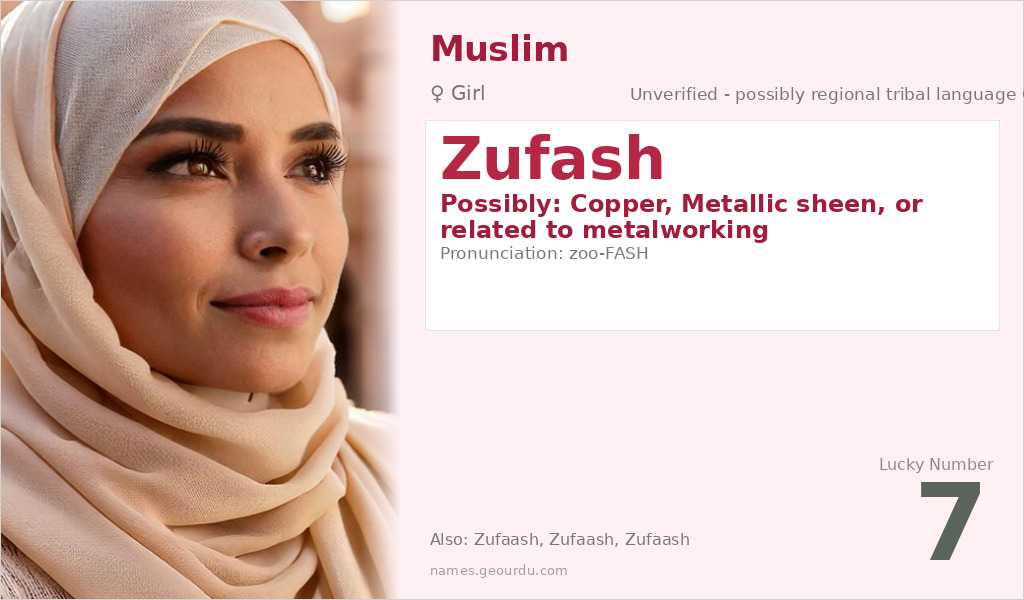
| 📛 Name | Zufash |
| 💎 Meaning | Possibly: Copper, Metallic sheen, or related to metalworking |
| 👤 Gender | Girl |
| 🕌 Religion | Muslim |
| 🌍 Origin | Unverified – possibly regional tribal language |
| 🗣 Pronunciation | zoo-FASH |
| ✍️ Urdu | ظفش |
| ✍️ Arabic | ظفش |
| 🔢 Numerology | 7 |
| ✨ Spellings | Zufaash, Zufaash, Zufaash |
Origin & Cultural Significance
Zufash appears to originate from regional Muslim naming traditions, possibly in Pakistan, Afghanistan, or surrounding areas where Pashto, Balochi, or other tribal languages influence naming practices. Unlike many Islamic names with clear Arabic or Persian roots, Zufash represents the rich tapestry of local linguistic traditions that have been incorporated into Muslim naming customs. These names often preserve words and concepts from pre-Islamic or regional languages while being used within Islamic cultural contexts. The name’s usage suggests it may come from communities where metalworking, craftsmanship, or natural elements feature prominently in daily life and vocabulary. Its persistence in naming traditions demonstrates how regional identities maintain their distinctiveness within broader religious frameworks.
Personality Traits
While personality associations with names are cultural rather than scientific, names like Zufash often carry expectations of uniqueness and strength. Those named Zufash might be perceived as individuals who value authenticity over convention, with a practical mindset and creative spirit. The name’s possible connection to metals or craftsmanship could symbolize durability, value, and the transformation of raw materials into something beautiful—qualities that might be aspired to in the name-bearer’s character.
Similar Names
If you like Zufash, consider: Zufa, Zufana, Zufia, Zufira, Zufara
Famous People Named Zufash
- No verified famous individuals found with this name
Frequently Asked Questions About Zufash
What does Zufash mean?
The exact meaning of Zufash is unverified. The most plausible speculation suggests it might relate to 'copper' or metallic elements, possibly originating from regional tribal languages in South Asia or the Middle East. The original meaning 'When Light Spreads Over The World' appears to be a creative interpretation without linguistic foundation.
Is Zufash a boy or girl name?
Zufash is primarily used as a girl's name in Muslim communities, particularly in regions like Pakistan and Afghanistan. However, as with many regional names, usage patterns can vary by community and family tradition.
What is the origin of Zufash?
Zufash likely originates from regional tribal languages in Muslim-majority areas of South Asia or the Middle East, possibly Pashto, Balochi, or similar languages. It represents naming traditions that exist outside mainstream Arabic/Persian Islamic naming conventions while being used within Muslim cultural contexts.