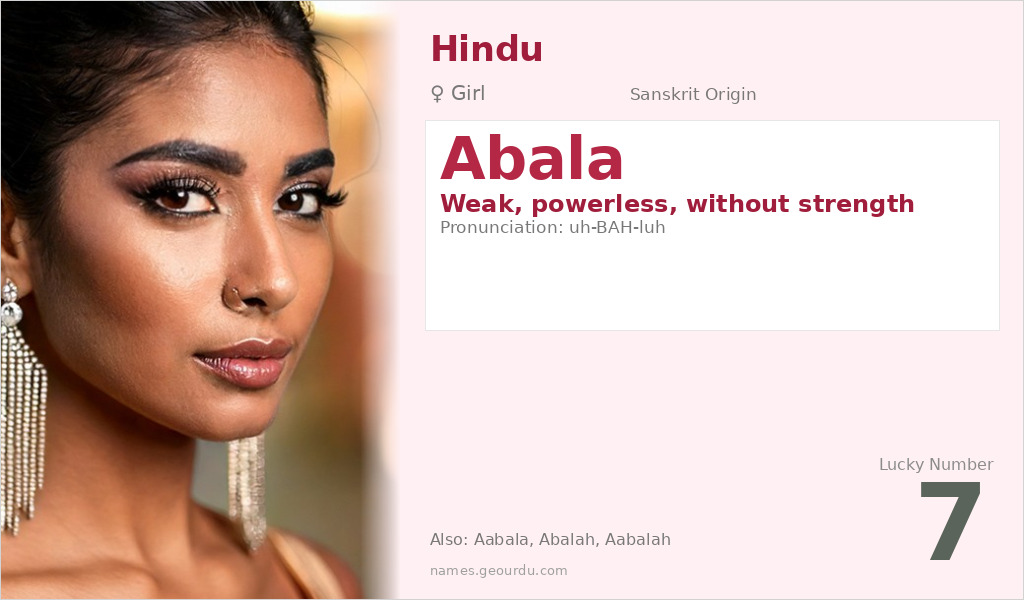
Table of Contents
Abala is a traditional Sanskrit name with deep roots in Indian culture and literature. While its literal meaning might surprise modern parents, the name carries historical significance and has been borne by notable Indian women reformers. This name offers a connection to classical Sanskrit vocabulary and India’s social history.
Meaning of Abala
Abala originates from the Sanskrit word ‘अबला’ (abala), which directly translates to ‘weak’, ‘powerless’, or ‘without strength’. The term is composed of the prefix ‘a-‘ (meaning ‘without’ or ‘not’) and ‘bala’ (meaning ‘strength’ or ‘power’). In ancient Hindu texts, this word frequently appears to describe women or those in vulnerable positions within society. While the literal meaning might seem negative today, in its historical context, it reflected specific social realities rather than personal attributes. The name’s usage in modern times often focuses on its classical linguistic heritage rather than its literal definition.
| 📛 Name | Abala |
| 💎 Meaning | Weak, powerless, without strength |
| 👤 Gender | Girl |
| 🕌 Religion | Hindu |
| 🌍 Origin | Sanskrit |
| 🗣 Pronunciation | uh-BAH-luh |
| ✍️ Urdu | ابالا |
| ✍️ Arabic | أبالا |
| 🔢 Numerology | 7 |
| ✨ Spellings | Aabala, Abalah, Aabalah |
Origin & Cultural Significance
Abala has its origins in classical Sanskrit, the ancient liturgical language of Hinduism. The name appears in significant Hindu scriptures including the Mahabharata, where it’s used in various contexts describing vulnerability or lack of power. Historically, the term was part of a broader vocabulary that categorized social roles in ancient Indian society. Despite its literal meaning, several prominent Indian women have carried this name with distinction, most notably Abala Bose, a pioneering social reformer who worked extensively for women’s education in late 19th and early 20th century India. The name remains primarily used within Hindu communities, particularly in Bengal and other parts of India.
Personality Traits
Those named Abala often develop personality traits that contrast with or transcend the name’s literal meaning. They frequently exhibit quiet determination, emotional intelligence, and a capacity for empathy that comes from understanding vulnerability. Many develop strong inner resilience, proving that strength comes in many forms beyond the physical. Their compassionate nature often makes them natural caregivers and advocates for those in need.
Similar Names
If you like Abala, consider: Abhaya, Amala, Anila, Avani, Aditi
Famous People Named Abala
- Abala Bose (1865-1951) — Indian social reformer and wife of scientist Jagadish Chandra Bose, known for her work in women's education
- Abala Das — 19th century Indian educator and women's rights activist
Frequently Asked Questions About Abala
What does Abala mean?
Abala means 'weak', 'powerless', or 'without strength' in Sanskrit, the ancient Indian language from which it originates.
Is Abala a boy or girl name?
Abala is exclusively a girl's name in Hindu naming traditions, derived from Sanskrit vocabulary traditionally used to describe women.
What is the origin of Abala?
Abala originates from Sanskrit, the classical language of ancient India, and appears in Hindu scriptures like the Mahabharata.