
Table of Contents
Abbasi is a name steeped in Islamic history and Arabic linguistics, evoking the legacy of one of the most influential dynasties in the Muslim world. As a patronymic meaning ‘descendant of Abbas’, it connects bearers to Abbas ibn Abd al-Muttalib, the uncle of Prophet Muhammad. This name is not just a personal identifier but a nod to a rich cultural and historical heritage, often used as a surname across South Asia, the Middle East, and beyond. In this guide, we explore the true meaning, origin, and significance of Abbasi beyond common misconceptions.
Meaning of Abbasi
Abbasi derives from the Arabic root ‘A-B-S’ (ع-ب-س), related to ‘Abbas’, which means ‘lion’ or ‘austere’. The suffix ‘-i’ is a nisba in Arabic grammar, indicating affiliation or descent, thus Abbasi translates to ‘of Abbas’ or ‘belonging to Abbas’. This construction is common in Arabic names, similar to names like Alawi (of Ali) or Hasani (of Hasan). Historically, Abbasi specifically refers to the Abbasid Caliphate, which claimed descent from Abbas ibn Abd al-Muttalib, making it a dynastic and familial marker. In linguistic terms, it is a well-documented patronymic with no alternative meanings in other languages like Persian or Urdu, where it retains the same Arabic derivation.
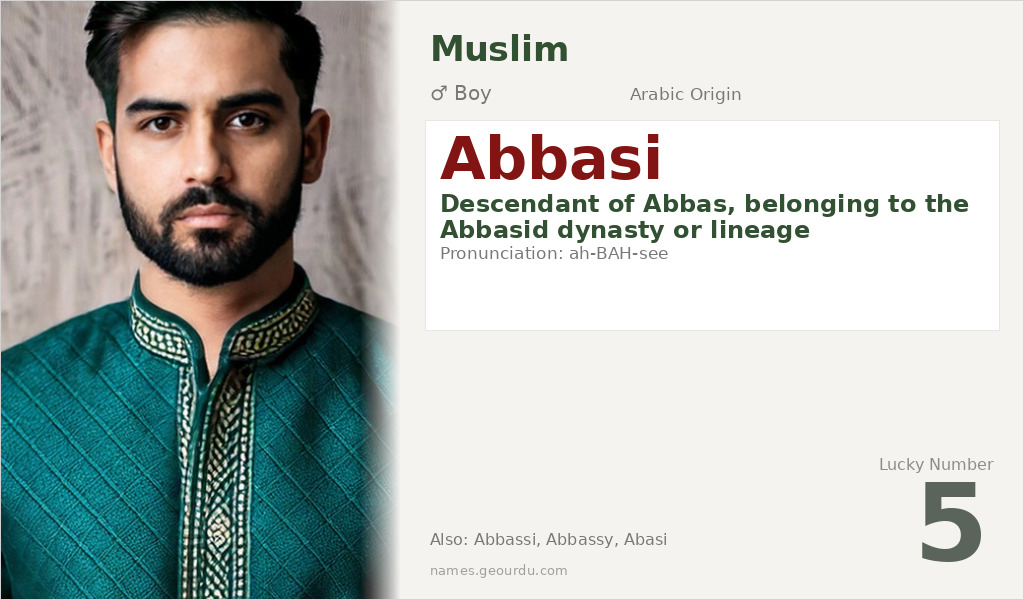
| 📛 Name | Abbasi |
| 💎 Meaning | Descendant of Abbas, belonging to the Abbasid dynasty or lineage |
| 👤 Gender | Boy |
| 🕌 Religion | Muslim |
| 🌍 Origin | Arabic |
| 🗣 Pronunciation | ah-BAH-see |
| ✍️ Urdu | عباسی |
| ✍️ Arabic | العباسي |
| 🔢 Numerology | 5 |
| ✨ Spellings | Abbassi, Abbassy, Abasi, Abbasī |
Origin & Cultural Significance
Originating in Arabic, Abbasi gained prominence with the rise of the Abbasid Caliphate in the 8th century, which established Baghdad as a center of Islamic culture and learning. The name spread across the Muslim world through historical migration and trade, becoming common in regions like Persia, South Asia, and Africa. In cultures such as Persian, Urdu, and Pashto, it is used as a surname to denote lineage from the Abbasids or as a given name in honor of this heritage. Unlike some names with tribal origins in Balochi or Sindhi, Abbasi is firmly rooted in Arabic history, though it may be adopted by various ethnic groups within Muslim communities, reflecting its broad cultural integration.
Personality Traits
Those named Abbasi are often associated with traits of strength, tradition, and intellectual depth, mirroring the historical Abbasid era known for advancements in science and arts. They may carry a sense of responsibility and pride in their heritage, potentially influencing their social and professional roles. While personality is individual, the name’s historical weight can inspire confidence and a connection to communal identity, making it a choice for families valuing lineage and cultural continuity.
Similar Names
If you like Abbasi, consider: Abbas, Abbasid, Abasi, Abboud, Abdul
Famous People Named Abbasi
- Abbasid Caliphate — historical Islamic dynasty ruling from 750 to 1258 CE, founded by Abu al-Abbas al-Saffah
- Mirza Abbas — 19th-century Bengali politician and social reformer in British India
Frequently Asked Questions About Abbasi
What does Abbasi mean?
Abbasi means 'descendant of Abbas' in Arabic, referring to lineage from Abbas ibn Abd al-Muttalib or the Abbasid dynasty, with 'Abbas' meaning 'lion' or 'austere'.
Is Abbasi a boy or girl name?
Abbasi is traditionally a boy name, used as a given name or surname in Muslim cultures, though it is rarely used for girls due to its patronymic and historical masculine associations.
What is the origin of Abbasi?
Abbasi originates from Arabic, specifically as a nisba (affiliation) suffix added to 'Abbas', and is historically tied to the Abbasid Caliphate in the Islamic world.





