
Table of Contents
Abel is a timeless name with profound biblical roots, evoking themes of transience and innocence. As the second son of Adam and Eve, Abel’s story is one of tragedy and moral reflection, making this name resonate across Jewish, Christian, and Islamic traditions. Beyond its religious significance, Abel has been adopted worldwide, appreciated for its soft sound and historical depth. This guide explores the true meaning, origin, and cultural impact of the name Abel.
Meaning of Abel
The name Abel derives from the Hebrew word ‘Hevel’ (הֶבֶל), which translates directly to ‘breath,’ ‘vapor,’ or ‘vanity.’ In Hebrew scripture, this term symbolizes the fleeting, insubstantial nature of life, as highlighted in Ecclesiastes. Biblically, Abel was a shepherd whose life was tragically cut short by his brother Cain, embodying this concept of transitoriness. Linguistically, the name has been transmitted through Greek (Άβελ, Abel), Latin (Abel), and into various languages without significant alteration in meaning. It is not associated with meanings like ‘child’—this is a common misconception—and its core significance remains tied to its Hebrew roots.
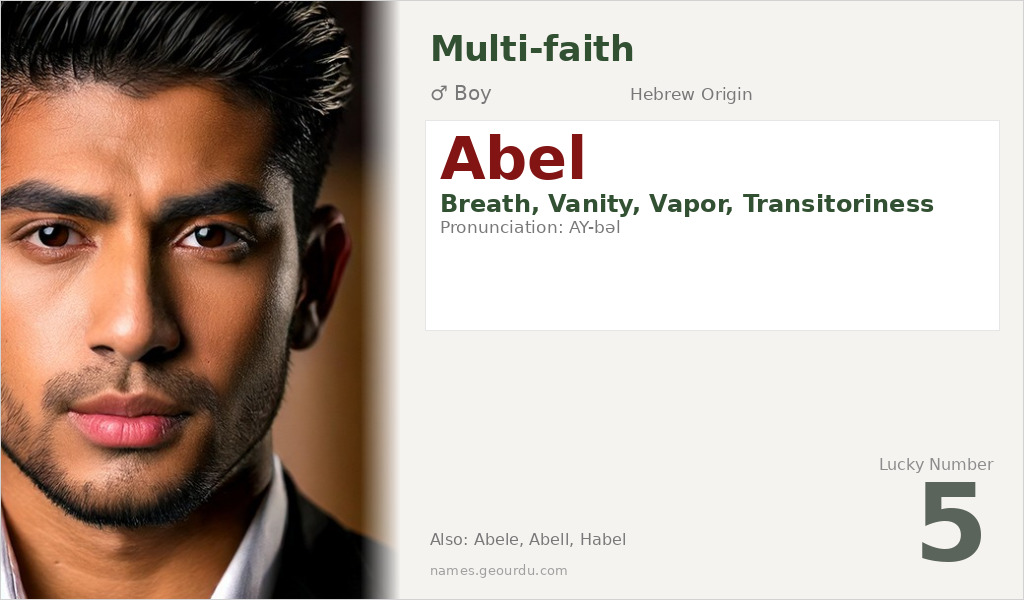
| 📛 Name | Abel |
| 💎 Meaning | Breath, Vanity, Vapor, Transitoriness |
| 👤 Gender | Boy |
| 🕌 Religion | Multi-faith |
| 🌍 Origin | Hebrew |
| 🗣 Pronunciation | AY-bəl |
| ✍️ Urdu | ہابیل |
| ✍️ Arabic | هابيل |
| 🔢 Numerology | 5 |
| ✨ Spellings | Abele, Abell, Habel, Hébel |
Origin & Cultural Significance
Abel originates from the Hebrew Bible (Tanakh) and is central to the Genesis narrative, where he is the son of Adam and Eve and the brother of Cain. This story is shared across Abrahamic faiths: in Judaism, he is seen as a righteous figure; in Christianity, he is often interpreted as a precursor to Christ’s sacrifice; and in Islam, he is known as Hābīl, the pious son of Adam. The name spread through religious texts and translations, entering Western naming traditions via the Vulgate and later Christian usage. It is now used globally, transcending its religious origins to become a popular given name in many cultures, including in secular contexts.
Personality Traits
People named Abel are often described as empathetic and peace-loving, with a strong inner moral compass. They may exhibit artistic or intellectual tendencies, drawn to fields that require creativity and deep thought. Their gentle demeanor can make them effective mediators, though they might also possess a resilient spirit, reflecting the name’s historical narrative of innocence and resilience.
Similar Names
If you like Abel, consider: Cain, Seth, Enoch, Noah, Adam
Famous People Named Abel
- Abel Tasman — Dutch explorer who discovered Tasmania and New Zealand
- Abel Ferrara — American film director known for 'Bad Lieutenant'
- Abel Gance — French film director of the silent era
- Niels Henrik Abel — Norwegian mathematician, namesake of the Abel Prize
Frequently Asked Questions About Abel
What does Abel mean?
Abel means 'breath,' 'vapor,' or 'vanity' in Hebrew, reflecting the transitory nature of life as depicted in the Bible.
Is Abel a boy or girl name?
Abel is traditionally a boy's name, stemming from the male biblical figure. It is rarely used for girls, though unisex usage is extremely uncommon.
What is the origin of Abel?
Abel originates from Hebrew, specifically from the biblical name Hevel, and is rooted in the Book of Genesis. It has since been adopted in Christian, Islamic, and secular naming traditions worldwide.





