
Table of Contents
Abou is a meaningful Arabic name that carries centuries of cultural tradition. Derived from the Arabic word for ‘father’, this name reflects values of protection, guidance, and family leadership. While commonly used in Muslim communities, it transcends religious boundaries in Arabic-speaking regions. Understanding Abou requires exploring its function in Arabic naming conventions and its deep roots in Semitic languages.
Meaning of Abou
Abou (أبو) is fundamentally an Arabic term meaning ‘father of’ or ‘possessor of’, originating from the triliteral root أ-ب-و (a-b-w) which relates to fatherhood, ancestry, and paternal relationships. In Arabic linguistics, it functions primarily as a kunya—an honorific naming pattern where ‘Abou [name]’ means ‘father of [child’s name]’. This naming tradition dates to pre-Islamic Arabia and continues today across the Arab world. The name can stand alone as a given name, particularly in North African regions like Morocco and Algeria. Related forms appear in other Semitic languages: Aramaic ‘Abba’ and Hebrew ‘Av’ both share the paternal meaning, demonstrating the root’s ancient linguistic heritage.
| 📛 Name | Abou |
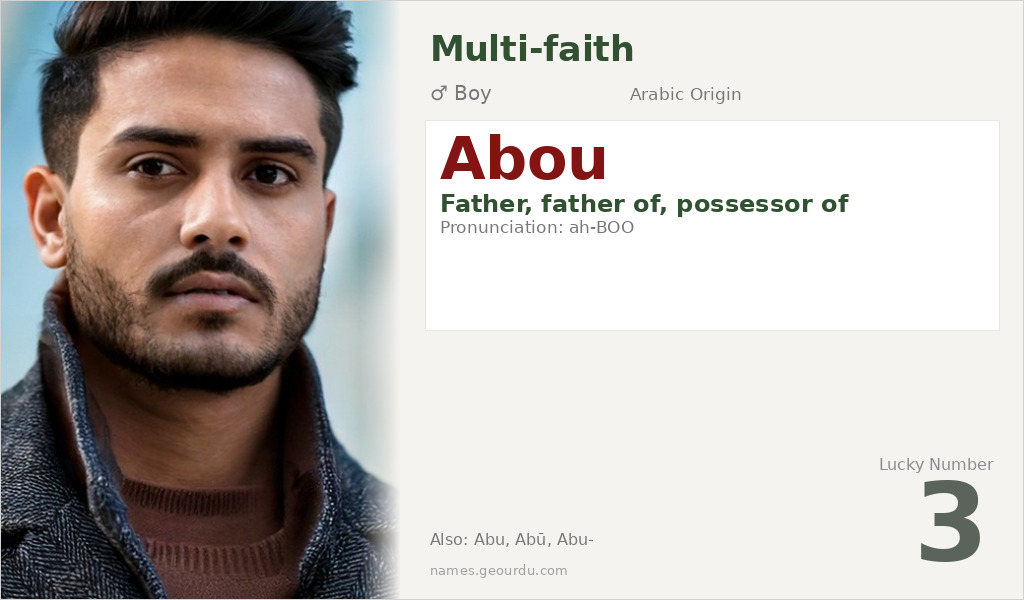
| 💎 Meaning | Father, father of, possessor of |
| 👤 Gender | Boy |
| 🕌 Religion | Multi-faith |
| 🌍 Origin | Arabic |
| 🗣 Pronunciation | ah-BOO |
| ✍️ Urdu | ابو |
| ✍️ Arabic | أبو |
| 🔢 Numerology | 3 |
| ✨ Spellings | Abu, Abū, Abu-, Abou- |
Origin & Cultural Significance
Abou originates from Classical Arabic and has been used for millennia across the Arabian Peninsula and wider Middle East. Its usage expanded with the spread of Islam, becoming common in Muslim communities from West Africa to Southeast Asia. However, the name predates Islam and appears in pre-Islamic poetry and historical records. In contemporary usage, it’s particularly popular in Maghreb countries (Morocco, Algeria, Tunisia) as a standalone given name, while in Gulf countries it’s more commonly used as a kunya prefix. The name appears in various forms across languages influenced by Arabic, including Persian (ابو), Urdu (ابو), and Turkish (Ebu in historical contexts).
Personality Traits
Those named Abou are often associated with paternal qualities—protection, wisdom, and responsibility. Cultural perceptions suggest individuals with this name naturally assume leadership roles within families and communities. The name’s meaning influences how bearers are viewed, with expectations of reliability and guidance. While personality varies individually, the name carries cultural connotations of maturity and caretaking.
Similar Names
If you like Abou, consider: Abu Bakr, Abu Talib, Abu Huraira, Abul, Abbas, Abid, Abdul
Famous People Named Abou
- Abou Diaby — French professional footballer of Ivorian descent
- Abou Treika — Egyptian former professional footballer and sports commentator
Frequently Asked Questions About Abou
What does Abou mean?
Abou means 'father' or 'father of' in Arabic. It comes from the Arabic root أ-ب-و (a-b-w) related to fatherhood and is commonly used as a prefix in kunya naming traditions.
Is Abou a boy or girl name?
Abou is exclusively a masculine name. It derives from the Arabic word for 'father' and is used only for boys across all cultures where it appears.
What is the origin of Abou?
Abou originates from Classical Arabic and has been used for centuries across the Arab world. While popular in Muslim communities, it predates Islam and appears in various Semitic languages with similar paternal meanings.





