
Table of Contents
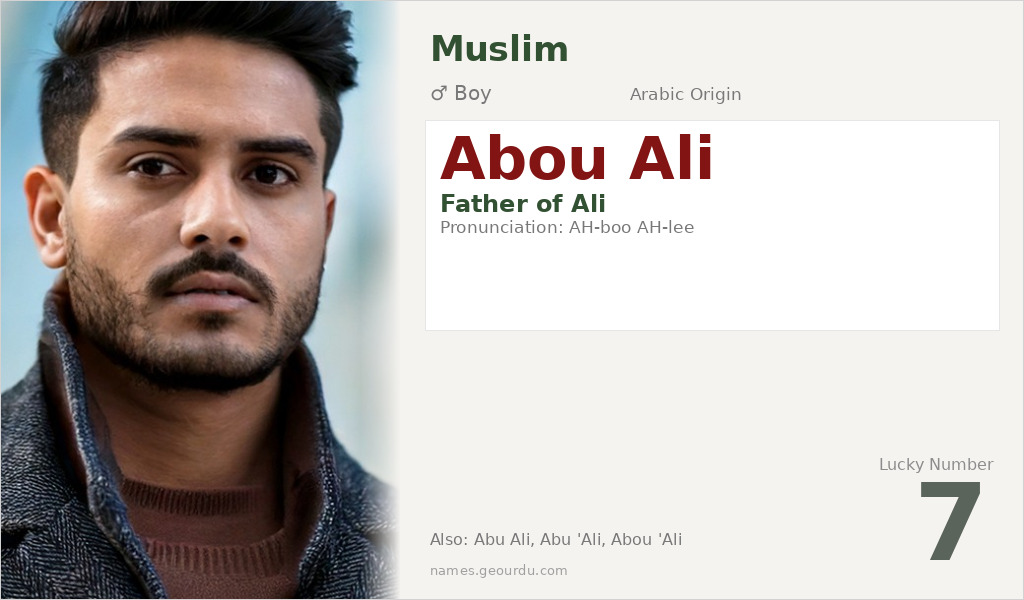
Abou Ali is a distinguished Arabic name with deep cultural and religious significance in Muslim communities worldwide. Meaning ‘Father of Ali’, this name combines the honorific ‘Abou’ with the revered name ‘Ali’, creating a powerful patronymic expression. Historically used both as a given name and an honorific title, Abou Ali carries connotations of wisdom, protection, and nobility. Its usage spans centuries and continues to be popular in Arabic-speaking regions and beyond.
Meaning of Abou Ali
Abou Ali is a compound Arabic name with clear etymological components. The first element ‘Abou’ (أبو) literally means ‘father of’ and functions as a kunya—an Arabic honorific naming convention that identifies someone through their relationship to their child, typically their eldest son. The second element ‘Ali’ (علي) derives from the Arabic root ‘ع-ل-ي’ (ayn-lam-ya), which conveys meanings of elevation, excellence, and superiority. When combined, Abou Ali translates directly to ‘Father of Ali’, though it’s important to note that in practice, this name can be given to boys regardless of whether they actually have a son named Ali. The name reflects the high regard for the name Ali in Islamic tradition, particularly through Ali ibn Abi Talib, the cousin and son-in-law of Prophet Muhammad.
| 📛 Name | Abou Ali |
| 💎 Meaning | Father of Ali |
| 👤 Gender | Boy |
| 🕌 Religion | Muslim |
| 🌍 Origin | Arabic |
| 🗣 Pronunciation | AH-boo AH-lee |
| ✍️ Urdu | ابو علی |
| ✍️ Arabic | أبو علي |
| 🔢 Numerology | 7 |
| ✨ Spellings | Abu Ali, Abu 'Ali, Abou 'Ali, Abu-Ali |
Origin & Cultural Significance
Abou Ali originates from classical Arabic naming traditions that have been practiced for over a millennium. The use of ‘Abou’ as a prefix in names dates back to pre-Islamic Arabia and became formalized in Islamic culture, where it serves both as an actual indicator of parenthood and as an honorific title. The name gained particular prominence during the Islamic Golden Age when several notable scholars and scientists bore variations of this name. While primarily associated with Arabic-speaking Muslim communities, the name has spread to Persian, Turkish, Urdu, and other languages influenced by Islamic culture. It remains particularly common in the Middle East, North Africa, and South Asia, where Arabic naming conventions have been adopted and adapted.
Personality Traits
Those named Abou Ali are often associated with paternal qualities of protection, guidance, and wisdom. The name suggests someone who takes responsibility seriously, particularly in family and community roles. Culturally, the name carries expectations of dignity and respectability, with an implicit connection to the noble characteristics associated with the name Ali. While personality traits vary by individual, the name’s meaning often influences how bearers are perceived within their communities—as figures of stability and authority.
Similar Names
If you like Abou Ali, consider: Abu Bakr, Abu Huraira, Abu Talib, Ali, Hasan, Husayn
Famous People Named Abou Ali
- Abu Ali al-Hasan ibn al-Haytham — 10th-11th century Arab mathematician, astronomer, and physicist known as the 'father of modern optics'
- Abu Ali al-Husayn ibn Abdullah ibn Sina — Known as Avicenna, 10th-11th century Persian polymath and physician, author of 'The Canon of Medicine'
Frequently Asked Questions About Abou Ali
What does Abou Ali mean?
Abou Ali means 'Father of Ali' in Arabic. It is a compound name where 'Abou' means 'father of' and 'Ali' means 'exalted, noble, or sublime'.
Is Abou Ali a boy or girl name?
Abou Ali is exclusively a boy's name in Arabic and Islamic naming traditions. The 'Abou' prefix specifically indicates fatherhood, which in these cultures is inherently masculine.
What is the origin of Abou Ali?
Abou Ali originates from Arabic language and culture. It follows classical Arabic naming conventions where 'Abou' (father of) is combined with a personal name, in this case 'Ali', to create an honorific or given name.





