Table of Contents
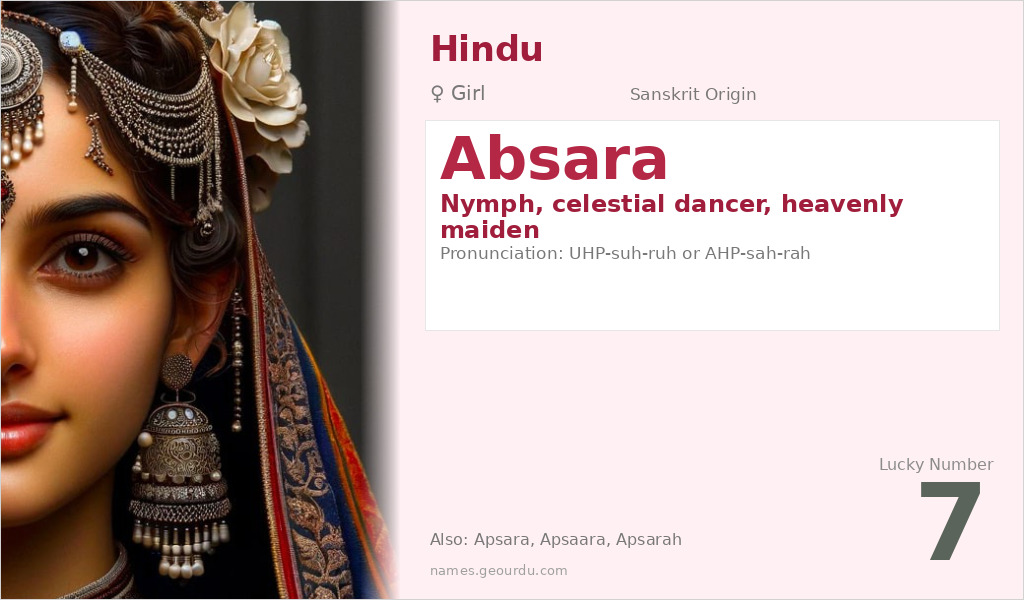
Absara is a beautiful and mystical name with deep roots in ancient Indian mythology. Derived from the Sanskrit word for celestial nymphs, this name carries connotations of grace, beauty, and divine artistry. In Hindu tradition, Apsaras are supernatural female spirits known for their exquisite dancing in the courts of gods. Choosing Absara for your daughter connects her to this rich cultural heritage of celestial femininity and artistic expression.
Meaning of Absara
The name Absara originates from the Sanskrit term ‘Apsara’ (अप्सरा), which refers to celestial nymphs or dancers in Hindu and Buddhist mythology. Etymologically, it combines ‘ap’ meaning ‘water’ and ‘sara’ meaning ‘moving’ or ‘going’, literally translating to ‘moving in the waters’ or ‘between the waters of the clouds’. This reflects the mythological association of Apsaras with clouds, water bodies, and fertility. In ancient texts like the Rigveda and Mahabharata, Apsaras are described as beautiful supernatural beings who entertain gods with their dance and music. The name thus carries meanings of celestial beauty, artistic grace, and divine femininity that have been celebrated in South Asian cultures for millennia.
| 📛 Name | Absara |
| 💎 Meaning | Nymph, celestial dancer, heavenly maiden |
| 👤 Gender | Girl |
| 🕌 Religion | Hindu |
| 🌍 Origin | Sanskrit |
| 🗣 Pronunciation | UHP-suh-ruh or AHP-sah-rah |
| ✍️ Urdu | اپسرا |
| ✍️ Arabic | أبسارا |
| 🔢 Numerology | 7 |
| ✨ Spellings | Apsara, Apsaara, Apsarah, Apsarā |
Origin & Cultural Significance
Absara has its origins in ancient Sanskrit literature and Hindu mythology, dating back to Vedic times around 1500-500 BCE. The concept of Apsaras appears in some of India’s oldest texts, including the Rigveda, where they are mentioned as water nymphs. In later Hindu epics like the Mahabharata and Ramayana, Apsaras play significant roles as celestial dancers in Indra’s court and as agents who test the devotion of sages. The name spread through South Asian cultures including India, Nepal, Sri Lanka, and Southeast Asian countries influenced by Hindu-Buddhist traditions. While primarily a Hindu name, it also appears in Buddhist mythology and has been adopted in various modern contexts while maintaining its mythological roots.
Personality Traits
Those named Absara often embody the graceful and artistic qualities of their mythological namesakes. They tend to be creative individuals with a natural affinity for expressive arts like dance, music, or visual arts. Their connection to celestial mythology suggests a spiritual dimension to their personality, often accompanied by elegance, charm, and an ability to inspire others. Like the Apsaras who moved between celestial and earthly realms, people with this name may display versatility and adaptability in different situations.
Similar Names
If you like Absara, consider: Urvashi, Rambha, Menaka, Tilottama, Ghritachi
Famous People Named Absara
- Apsara Reddy — Indian politician and transgender rights activist
- Apsara Iyer — Indian classical dancer and choreographer
Frequently Asked Questions About Absara
What does Absara mean?
Absara means 'celestial nymph', 'heavenly dancer', or 'celestial maiden' in Sanskrit. It refers to the mythological female spirits in Hindu tradition known for their beauty and dancing skills in the courts of gods.
Is Absara a boy or girl name?
Absara is exclusively a girl's name. In its source mythology, Apsaras are always female celestial beings, and the name has been used traditionally for girls in Hindu cultures.
What is the origin of Absara?
Absara originates from Sanskrit and Hindu mythology. It comes from the word 'Apsara' which appears in ancient Indian texts like the Rigveda and Mahabharata, referring to celestial nymphs or dancers in Hindu and Buddhist traditions.