
Table of Contents
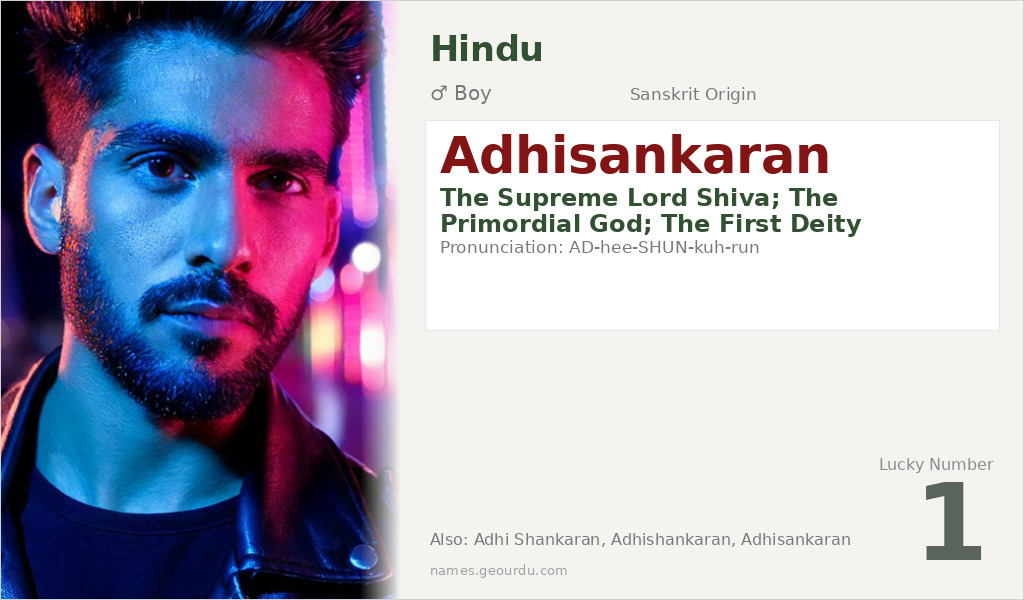
Adhisankaran is a profound Sanskrit name that carries deep spiritual significance in Hindu tradition. Meaning ‘The Supreme Lord Shiva’ or ‘The Primordial God’, this name embodies the highest philosophical concepts of Shaivism. Primarily used in South Indian Hindu communities, particularly among Tamil and Malayalam speakers, Adhisankaran represents devotion to Shiva as the ultimate reality. This name connects the bearer to ancient Vedic and Agamic traditions that revere Shiva as the first principle of existence.
Meaning of Adhisankaran
Adhisankaran is a compound Sanskrit name with precise theological meaning. The first component ‘Adhi’ (अधि) comes from the Sanskrit root meaning ‘above’, ‘over’, ‘supreme’, or ‘primordial’, indicating something that is first or fundamental. The second component ‘Sankaran’ derives from ‘Shankara’ (शंकर), one of Shiva’s primary names meaning ‘the auspicious one’ or ‘giver of happiness’. When combined, Adhisankaran literally translates to ‘The Supreme Shankara’ or ‘The Primordial Shiva’. This name appears in various Hindu philosophical texts, particularly in Shaiva Siddhanta literature, where it denotes Shiva’s absolute supremacy over all creation. The name emphasizes Shiva’s role as the ultimate reality (Parashiva) from which everything emanates.
| 📛 Name | Adhisankaran |
| 💎 Meaning | The Supreme Lord Shiva; The Primordial God; The First Deity |
| 👤 Gender | Boy |
| 🕌 Religion | Hindu |
| 🌍 Origin | Sanskrit |
| 🗣 Pronunciation | AD-hee-SHUN-kuh-run |
| ✍️ Urdu | ادھی شنکرن |
| ✍️ Arabic | أدهي شانكاران |
| 🔢 Numerology | 1 |
| ✨ Spellings | Adhi Shankaran, Adhishankaran, Adhisankaran, Adhi Sankaran |
Origin & Cultural Significance
Adhisankaran originates from classical Sanskrit, the liturgical language of Hinduism, with strong roots in South Indian Shaiva traditions. The name gained prominence through Tamil and Malayalam Hindu communities where Shiva worship has deep historical roots dating back to the Sangam period. It reflects the philosophical developments of Shaiva Siddhanta, a school of thought that systematized Shiva theology in medieval South India. The name continues to be used primarily in Tamil Nadu, Kerala, and among diaspora communities, maintaining its religious and cultural significance. While less common in North India, it remains an important name within specific Shaiva lineages and scholarly traditions.
Personality Traits
Those named Adhisankaran are often associated with spiritual depth, intellectual curiosity, and traditional values. They may exhibit natural leadership abilities combined with a contemplative disposition. Many bearers of this name develop strong connections to their cultural heritage and religious practices. The name’s association with Lord Shiva suggests qualities of transformation, wisdom, and inner strength.
Similar Names
If you like Adhisankaran, consider: Adhish, Shankara, Adhishvara, Shiva, Adhiraj, Sankaranarayanan, Adhikeshava, Shankaran, Adhishakti, Shankari
Famous People Named Adhisankaran
- Adhisankaran — Notable Hindu spiritual figure and scholar from South India known for commentaries on Shaiva Siddhanta texts
- Adhisankaran Pillai — 19th century Tamil poet and devotee of Lord Shiva from Kerala
Frequently Asked Questions About Adhisankaran
What does Adhisankaran mean?
Adhisankaran means 'The Supreme Lord Shiva' or 'The Primordial God' in Sanskrit. It's a compound name combining 'Adhi' (supreme/first) and 'Sankaran' (a form of Shiva's name Shankara).
Is Adhisankaran a boy or girl name?
Adhisankaran is exclusively a boy's name in Hindu tradition. It carries masculine grammatical forms in Sanskrit and is associated with Lord Shiva, who is male in Hindu theology.
What is the origin of Adhisankaran?
Adhisankaran originates from Sanskrit, the classical language of Hinduism, with particular prevalence in South Indian Shaiva traditions. It's most commonly used in Tamil and Malayalam speaking Hindu communities.





