
Table of Contents
Abu Al Ala is a distinguished Arabic name with deep historical roots in Islamic culture. Meaning ‘Father of the Exalted’, this name carries connotations of wisdom, elevation, and paternal guidance. While traditionally used as an honorific kunya, it has been adopted as a given name in some Muslim communities. The name is most famously associated with the great 11th-century poet and philosopher Abu al-Ala al-Ma’arri.
Meaning of Abu Al Ala
Abu Al Ala is a compound Arabic name with clear etymological components. ‘Abu’ (أبو) is a common Arabic prefix meaning ‘father of’, used both literally and honorifically. ‘Al’ (ال) is the definite article ‘the’. ‘Ala’ (على) derives from the triliteral root ع-ل-و, which conveys meanings of height, elevation, exaltation, and sublimity. The complete name therefore translates precisely to ‘Father of the Exalted’ or ‘Father of the High One’. This construction follows classical Arabic naming patterns where ‘Abu’ + attribute creates an honorific indicating the bearer possesses or is associated with that quality. The name suggests someone who fathers or embodies exalted characteristics.
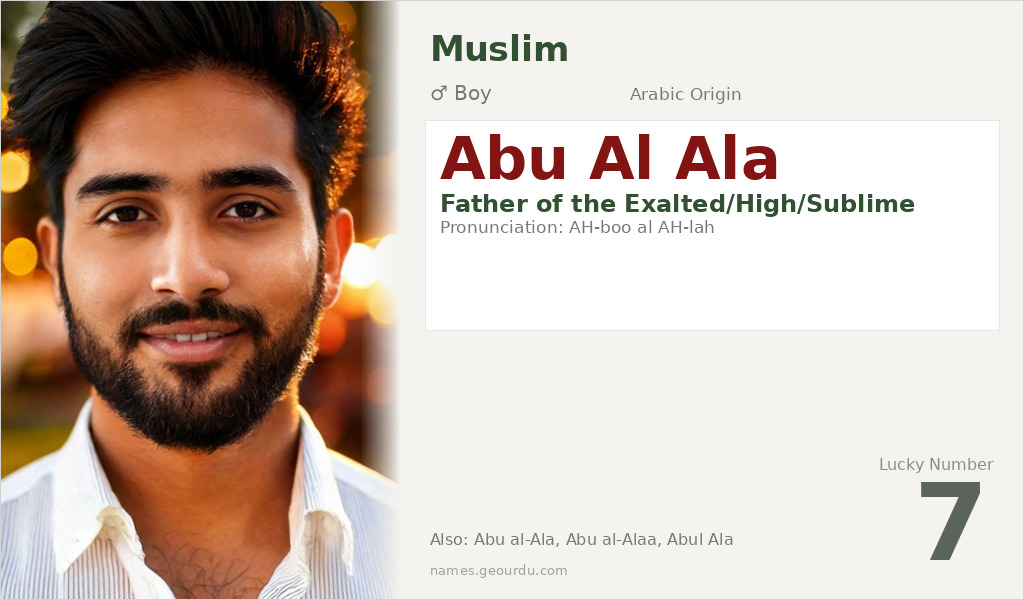
| 📛 Name | Abu Al Ala |
| 💎 Meaning | Father of the Exalted/High/Sublime |
| 👤 Gender | Boy |
| 🕌 Religion | Muslim |
| 🌍 Origin | Arabic |
| 🗣 Pronunciation | AH-boo al AH-lah |
| ✍️ Urdu | ابو العلی |
| ✍️ Arabic | أبو العلى |
| 🔢 Numerology | 7 |
| ✨ Spellings | Abu al-Ala, Abu al-Alaa, Abul Ala, Abu'l Ala |
Origin & Cultural Significance
Abu Al Ala originates from classical Arabic and has been used for centuries across the Arab world and Muslim societies. It follows the traditional kunya system in Arabic culture, where individuals are often referred to as ‘father of’ their eldest son or an admirable quality. Historically, the name gained prominence through notable figures like Abu al-Ala al-Ma’arri (973-1057 CE), the blind Syrian poet-philosopher whose works influenced Arabic literature for centuries. The name reflects Islamic cultural values that honor wisdom, spiritual elevation, and paternal guidance. While primarily Arabic in origin, the name has been adopted in various Muslim communities including Persian, Urdu, and Turkish-speaking regions.
Personality Traits
The name Abu Al Ala suggests a personality characterized by wisdom, dignity, and intellectual or spiritual elevation. Those bearing this name are often perceived as paternal figures who provide guidance and moral leadership. The ‘exalted’ component implies someone with high principles, refined character, and possibly philosophical or spiritual depth. Such individuals might be seen as mentors who help others reach higher understanding or achievement.
Similar Names
If you like Abu Al Ala, consider: Abu Bakr, Abu Talib, Alauddin, Ali, Abdul Ala, Ala ud-Din, Alauddin, Ala al-Din, Alauddin
Famous People Named Abu Al Ala
- Abu al-Ala al-Ma'arri — 11th-century blind Arab philosopher, poet, and writer from Syria, known for his skeptical poetry and rationalist philosophy
- Abu al-Ala ibn Zuhr — 12th-century Andalusian physician and surgeon from Seville, member of the prominent Banu Zuhr medical family
Frequently Asked Questions About Abu Al Ala
What does Abu Al Ala mean?
Abu Al Ala means 'Father of the Exalted' or 'Father of the High One' in Arabic. It is a compound name where 'Abu' means 'father of', 'Al' means 'the', and 'Ala' means 'exalted, high, sublime'.
Is Abu Al Ala a boy or girl name?
Abu Al Ala is exclusively a boy's name in Arabic and Muslim naming traditions. The 'Abu' (father) prefix makes it masculine by construction, and it has only been used historically for males.
What is the origin of Abu Al Ala?
Abu Al Ala originates from classical Arabic language and culture. It follows the traditional Arabic kunya (honorific) naming pattern and has been used for centuries across Arab and Muslim societies, most famously by the 11th-century poet-philosopher Abu al-Ala al-Ma'arri.





