Table of Contents
Abu Abdullah is a distinguished Arabic name with deep roots in Islamic tradition. Unlike typical given names, it functions as a kunya—an honorific title denoting ‘Father of Abdullah.’ This name carries profound religious significance, combining the parental honorific ‘Abu’ with one of Islam’s most revered names. Understanding Abu Abdullah requires exploring both its linguistic components and its cultural context within Muslim societies.
Meaning of Abu Abdullah
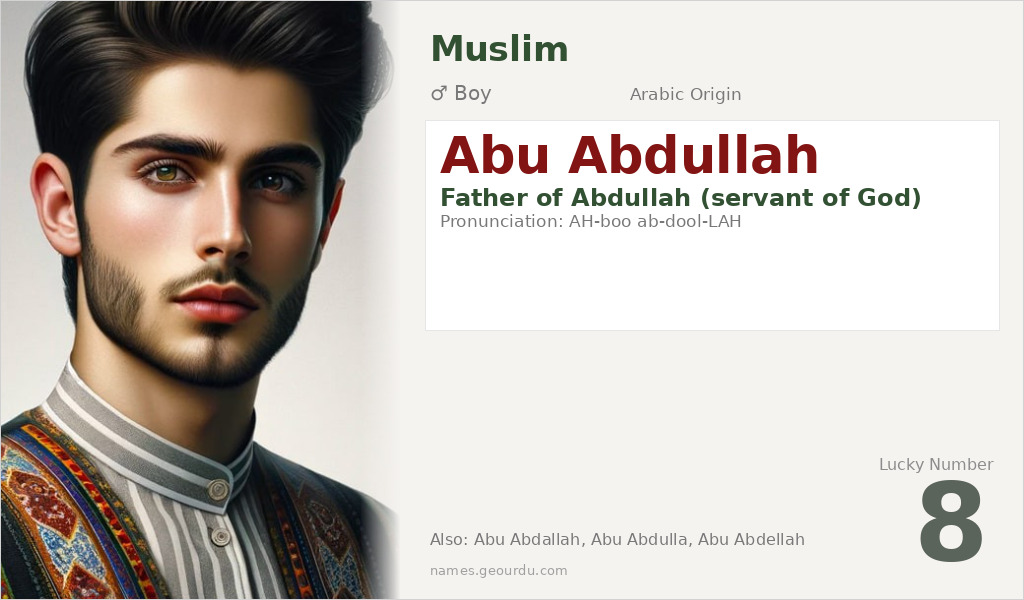
Abu Abdullah is a compound Arabic name with precise etymological components. The first part, ‘Abu’ (أبو), literally means ‘father of’ and serves as a kunya—a traditional Arabic honorific that indicates parenthood, often used as a respectful form of address regardless of actual biological fatherhood. The second component, ‘Abdullah’ (عبد الله), breaks down to ‘abd’ meaning ‘servant’ or ‘worshipper’ and ‘Allah’ meaning ‘God.’ Thus, the complete name translates to ‘Father of the Servant of God.’ This construction follows classical Arabic naming patterns where kunyas express respect, social status, and religious devotion simultaneously. The name appears in early Islamic history and continues in usage today, particularly in Arab and Muslim communities worldwide.
| 📛 Name | Abu Abdullah |
| 💎 Meaning | Father of Abdullah (servant of God) |
| 👤 Gender | Boy |
| 🕌 Religion | Muslim |
| 🌍 Origin | Arabic |
| 🗣 Pronunciation | AH-boo ab-dool-LAH |
| ✍️ Urdu | ابو عبداللہ |
| ✍️ Arabic | أبو عبد الله |
| 🔢 Numerology | 8 |
| ✨ Spellings | Abu Abdallah, Abu Abdulla, Abu Abdellah, Abu Abd Allah |
Origin & Cultural Significance
Abu Abdullah originates from classical Arabic and Islamic naming traditions dating to the 7th century CE. In pre-Islamic and early Islamic Arabia, kunyas like Abu Abdullah were used to show respect, denote maturity, and establish social identity. The practice continues strongly in Arab cultures and has spread throughout the Muslim world. Historically, many prominent Islamic scholars, leaders, and companions of Prophet Muhammad bore this kunya, including Abu Abdullah al-Shafi’i, founder of one of Sunni Islam’s four major legal schools. The name reflects the importance of both familial honor and religious devotion in Islamic culture, where being called ‘father of’ someone with a pious name like Abdullah carries spiritual weight. While primarily Arabic in origin, the name has been adopted in various Muslim cultures with slight phonetic adaptations.
Personality Traits
The name Abu Abdullah suggests someone with protective, responsible, and spiritually grounded characteristics. The ‘father’ element implies leadership, guidance, and nurturing qualities, while ‘servant of God’ indicates humility, devotion, and ethical grounding. This combination often results in individuals who balance authority with compassion, showing strength in caring for others while maintaining religious principles. Such names are believed to influence personality development within cultural contexts where names carry aspirational meanings.
Similar Names
If you like Abu Abdullah, consider: Abdullah, Abdul Rahman, Abdul Qadir, Abu Bakr, Abu Talib
Famous People Named Abu Abdullah
- Abu Abdullah al-Shafi'i (767-820 CE) — Founder of the Shafi'i school of Islamic jurisprudence, one of the four major Sunni schools
- Abu Abdullah Muhammad al-Idrisi (1100-1165 CE) — Renowned Arab geographer and cartographer who created the Tabula Rogeriana, one of the most advanced medieval world maps
Frequently Asked Questions About Abu Abdullah
What does Abu Abdullah mean?
Abu Abdullah means 'Father of Abdullah' in Arabic, with Abdullah meaning 'servant of God.' It's a compound name where 'Abu' is an honorific meaning 'father of' and 'Abdullah' means 'servant/worshipper of God.'
Is Abu Abdullah a boy or girl name?
Abu Abdullah is exclusively a male name in Arabic and Islamic naming traditions. The 'Abu' (father) component makes it inherently masculine, as kunyas indicating fatherhood are only used for men.
What is the origin of Abu Abdullah?
Abu Abdullah originates from classical Arabic and Islamic culture. It follows the traditional Arabic kunya system of honorific titles and has been used since early Islamic history, particularly among Arab and Muslim communities.