
Table of Contents
Abu Bakr is one of the most historically significant names in the Islamic world, carrying centuries of cultural and religious heritage. As the name of the first Caliph of Islam, it represents leadership, faithfulness, and early Islamic history. This Arabic name combines two meaningful elements that reflect traditional Bedouin values while transcending its literal meaning through profound historical association. Understanding Abu Bakr requires exploring both its linguistic roots and its monumental place in Muslim tradition.
Meaning of Abu Bakr
The name Abu Bakr derives from classical Arabic, where ‘Abu’ (أبو) is a common prefix meaning ‘father of’ or ‘possessor of’, and ‘Bakr’ (بكر) specifically denotes a young male camel. In pre-Islamic Arabia, camels were essential for transportation, milk, and wealth, making ‘Bakr’ a name with positive economic connotations. Linguistically, ‘Bakr’ shares roots with words for ‘early’ and ‘firstborn’, adding layers of meaning about precedence and new beginnings. The compound structure follows common Arabic naming patterns where ‘Abu’ indicates a characteristic or relationship. While literally ‘father of the young camel’, the name’s significance transformed through its association with Abu Bakr al-Siddiq, whose leadership established it as symbolic of trustworthiness and foundational Islamic values.
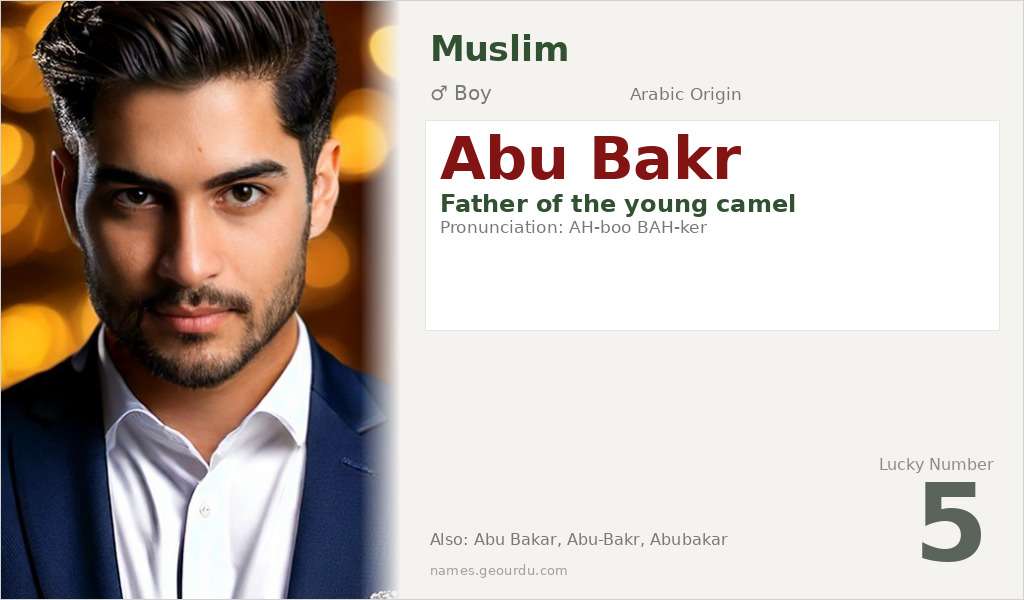
| 📛 Name | Abu Bakr |
| 💎 Meaning | Father of the young camel |
| 👤 Gender | Boy |
| 🕌 Religion | Muslim |
| 🌍 Origin | Arabic |
| 🗣 Pronunciation | AH-boo BAH-ker |
| ✍️ Urdu | ابو بکر |
| ✍️ Arabic | أبو بكر |
| 🔢 Numerology | 5 |
| ✨ Spellings | Abu Bakar, Abu-Bakr, Abubakar, Abubakr |
Origin & Cultural Significance
Abu Bakr originated in the Arabian Peninsula before Islam, reflecting the pastoral nomadic culture where camels were central to survival and status. The name gained monumental importance in the 7th century when Abu Bakr al-Siddiq (born Abdullah ibn Abi Quhafa) became the first male convert to Islam and later the first Caliph after Prophet Muhammad’s death. His reign (632-634 CE) established the Rashidun Caliphate and preserved the Quran in written form. This historical association made the name particularly revered among Muslims worldwide, especially in Arabic-speaking regions, South Asia, Africa, and among diaspora communities. While primarily an Arabic name, it has been adopted with variations in Persian, Urdu, Turkish, and other languages influenced by Islamic civilization.
Personality Traits
The personality traits associated with Abu Bakr are deeply influenced by the historical figure’s legacy. Those bearing this name are often expected to demonstrate integrity, wisdom, and steadfastness. The ‘al-Siddiq’ (Truthful) title attached to the first Caliph emphasizes qualities of honesty and reliability. Culturally, the name suggests someone who is a natural leader, thoughtful in decision-making, and committed to their principles. While individual personalities vary, the name carries expectations of moral strength and the ability to guide others through challenging situations.
Similar Names
If you like Abu Bakr, consider: Abdullah, Umar, Usman, Ali, Hamza
Famous People Named Abu Bakr
- Abu Bakr al-Siddiq — First Caliph of Islam (632-634 CE), known as 'al-Siddiq' (the Truthful), close companion and father-in-law of Prophet Muhammad
- Abu Bakr Muhammad ibn Zakariya al-Razi — Persian polymath, physician, alchemist and philosopher (854-925 CE), known as Rhazes in Latin Europe
Frequently Asked Questions About Abu Bakr
What does Abu Bakr mean?
Abu Bakr means 'father of the young camel' in Arabic, from 'Abu' (father of) and 'Bakr' (young camel).
Is Abu Bakr a boy or girl name?
Abu Bakr is exclusively a masculine name in all cultural contexts where it is used, particularly in Muslim communities.
What is the origin of Abu Bakr?
Abu Bakr originates from classical Arabic language and pre-Islamic Arabian culture, but gained its primary significance through Abu Bakr al-Siddiq, the first Caliph of Islam in the 7th century.





