
Table of Contents
Abu Hurairah is one of the most recognizable names in Islamic history, though it is often misunderstood as a conventional given name. This Arabic kunya, meaning ‘Father of a kitten,’ belongs to one of Prophet Muhammad’s most devoted companions and the most prolific narrator of Hadith. Understanding this name requires exploring its unique place in Islamic tradition rather than treating it as a typical baby name. The story behind Abu Hurairah reveals fascinating aspects of Arabic naming conventions and early Islamic history.
Meaning of Abu Hurairah
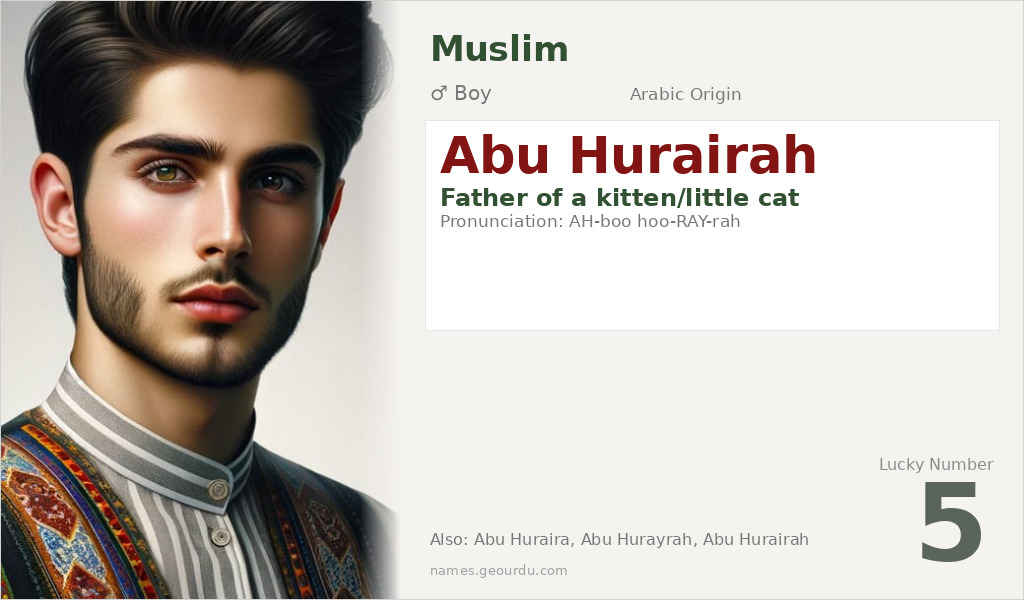
The name Abu Hurairah has a clear and well-documented meaning in Arabic. It is a compound name consisting of ‘Abu’ (أبو), meaning ‘father of,’ and ‘Hurairah’ (هريرة), meaning ‘kitten’ or ‘little cat.’ This forms the complete meaning ‘Father of a kitten.’ In Arabic linguistics, ‘Hurairah’ is the diminutive form of ‘hirrah’ (هرة), meaning cat. The name follows the common Arabic kunya pattern, where ‘Abu’ is prefixed to a characteristic, often relating to a child, pet, or notable trait. Unlike many Arabic names derived from religious concepts or virtues, Abu Hurairah’s meaning is descriptive and personal, reflecting the individual’s affection for cats.
| 📛 Name | Abu Hurairah |
| 💎 Meaning | Father of a kitten/little cat |
| 👤 Gender | Boy |
| 🕌 Religion | Muslim |
| 🌍 Origin | Arabic |
| 🗣 Pronunciation | AH-boo hoo-RAY-rah |
| ✍️ Urdu | ابو ہریرہ |
| ✍️ Arabic | أبو هريرة |
| 🔢 Numerology | 5 |
| ✨ Spellings | Abu Huraira, Abu Hurayrah, Abu Hurairah |
Origin & Cultural Significance
Abu Hurairah originates from 7th century Arabia as the kunya (honorific nickname) of Abd al-Rahman ibn Sakhr al-Dawsi, a companion of Prophet Muhammad from the Daws tribe. He earned this nickname due to his fondness for cats, often carrying a kitten with him. In pre-Islamic and early Islamic Arabia, kunyas like Abu Hurairah served as respectful forms of address and were commonly adopted based on personal characteristics or relationships. While the name has deep historical significance in Islamic tradition, it is not typically used as a contemporary given name for children, as it specifically refers to this historical figure. The name appears extensively in Hadith collections and Islamic historical texts.
Personality Traits
The personality associated with Abu Hurairah is primarily drawn from historical accounts of the companion who bore this name. He is remembered for his exceptional memory, having narrated more Hadith than any other companion. Historical sources describe him as humble, devoted, compassionate, and deeply committed to Islamic scholarship. His nickname itself suggests a gentle, caring nature toward animals. While modern individuals do not typically bear this name, the historical figure exemplifies qualities of dedication, perseverance in learning, and service to religious tradition.
Similar Names
If you like Abu Hurairah, consider: Abdul Rahman, Abu Bakr, Abu Talib, Abu Dhar, Abu Sufyan
Famous People Named Abu Hurairah
- Abu Hurairah (Abd al-Rahman ibn Sakhr al-Dawsi) — One of the most important companions of Prophet Muhammad and the most prolific narrator of Hadith, transmitting over 5,000 traditions
- Abu Hurairah is not commonly used as a contemporary personal name, but appears in historical Islamic texts referring to this companion
Frequently Asked Questions About Abu Hurairah
What does Abu Hurairah mean?
Abu Hurairah means 'Father of a kitten' in Arabic. It is composed of 'Abu' (father of) and 'Hurairah' (kitten/little cat).
Is Abu Hurairah a boy or girl name?
Abu Hurairah is exclusively masculine as it follows the Arabic kunya pattern 'Abu' (father of), which is inherently male. In Islamic history, it refers specifically to a male companion of Prophet Muhammad.
What is the origin of Abu Hurairah?
Abu Hurairah originates from 7th century Arabic culture as the kunya (honorific nickname) of Abd al-Rahman ibn Sakhr al-Dawsi, a companion of Prophet Muhammad known for his affection for cats and his extensive Hadith narration.





