Table of Contents
Adimata is a profoundly meaningful Sanskrit name that carries the weight of cosmic origins within its syllables. Meaning ‘The Primal Mother’ or ‘The First Mother’, this name connects directly to Hindu cosmological concepts of divine femininity. While not commonly used as a personal name in modern times, it holds significant theological importance in Shakta traditions. Exploring Adimata reveals layers of linguistic beauty and spiritual depth that span millennia of Indian thought.
Meaning of Adimata
Adimata derives from classical Sanskrit, combining ‘Adi’ (आदि) meaning ‘first, primal, original’ with ‘Mata’ (माता) meaning ‘mother’. The component ‘Adi’ originates from the Sanskrit root √ad, which carries connotations of consumption and primacy—suggesting that which comes before all else. ‘Mata’ stems from the root √mā, relating to measurement, formation, and motherhood. Together, they form a compound that literally translates to ‘The Primal Mother’ but carries deeper philosophical implications of being the source of all existence. In Hindu cosmology, this refers to the primordial feminine energy from which the universe manifests. The name appears in various Shakta texts as an epithet for goddesses representing the ultimate creative principle.
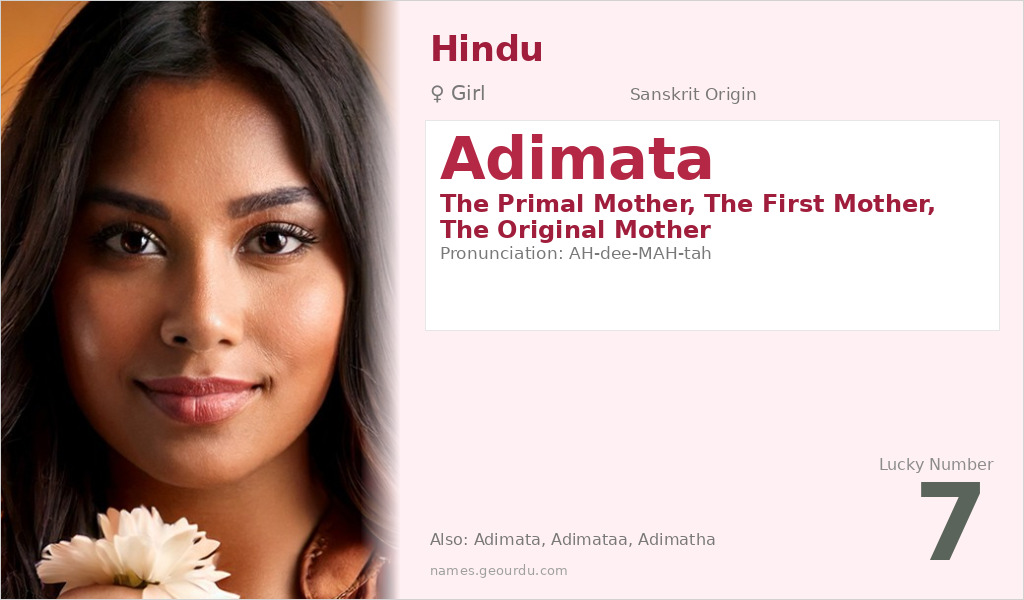
| 📛 Name | Adimata |
| 💎 Meaning | The Primal Mother, The First Mother, The Original Mother |
| 👤 Gender | Girl |
| 🕌 Religion | Hindu |
| 🌍 Origin | Sanskrit |
| 🗣 Pronunciation | AH-dee-MAH-tah |
| ✍️ Urdu | ادی ماتا |
| ✍️ Arabic | أدي ماتا |
| 🔢 Numerology | 7 |
| ✨ Spellings | Adimata, Adimataa, Adimatha, Aadimata |
Origin & Cultural Significance
Adimata originates from ancient Sanskrit language and Hindu religious tradition, specifically within Shakta and Tantric philosophical systems that venerate the divine feminine. The concept appears in texts like the Devi Mahatmya and various Puranas where goddesses are described as the original mother of creation. While primarily a theological term rather than a common personal name, it reflects the deep reverence for motherhood in Indian culture. The name’s usage spans temple inscriptions, ritual invocations, and philosophical discourse about cosmic origins. Its cultural context places it within the broader Indian tradition of compound Sanskrit names that express spiritual concepts through linguistic precision.
Personality Traits
Those named Adimata are often associated with foundational, nurturing qualities that mirror the name’s meaning. They may exhibit strong protective instincts, wisdom beyond their years, and a natural inclination toward caregiving roles. The name suggests someone who creates stability and serves as an emotional anchor for others. Their personality might blend traditional values with creative expression, embodying both the strength and compassion implied by the ‘Primal Mother’ concept.
Similar Names
If you like Adimata, consider: Aditi, Adya, Matangi, Ambika, Prakriti
Famous People Named Adimata
- Adimata (mythological) — In Hindu mythology, Adimata refers to the primordial mother goddess, often identified with Adi Parashakti, the supreme feminine power from which all creation emanates
- Adimata (historical) — While not a common personal name historically, the term appears in medieval Shakta texts and temple inscriptions across India as an honorific for mother goddesses
Frequently Asked Questions About Adimata
What does Adimata mean?
Adimata means 'The Primal Mother' or 'The First Mother' in Sanskrit. It is a compound of 'Adi' (first/original) and 'Mata' (mother), referring to the primordial mother goddess in Hindu tradition.
Is Adimata a boy or girl name?
Adimata is exclusively a girl's name in Hindu tradition, as it refers to the divine feminine principle and mother goddesses. The 'Mata' component specifically means 'mother', making it inherently feminine.
What is the origin of Adimata?
Adimata originates from Sanskrit language and Hindu religious tradition, specifically from Shakta philosophy that venerates the goddess as supreme reality. It appears in ancient Indian texts as an epithet for primordial mother goddesses.