
Table of Contents
Ahab is a name steeped in ancient history and literary fame. Originating from Hebrew scripture as a royal name, it gained modern recognition through one of literature’s most iconic characters. This name carries weighty associations—from Biblical kings to epic sea captains—making it a compelling choice for those interested in names with profound historical and cultural layers.
Meaning of Ahab
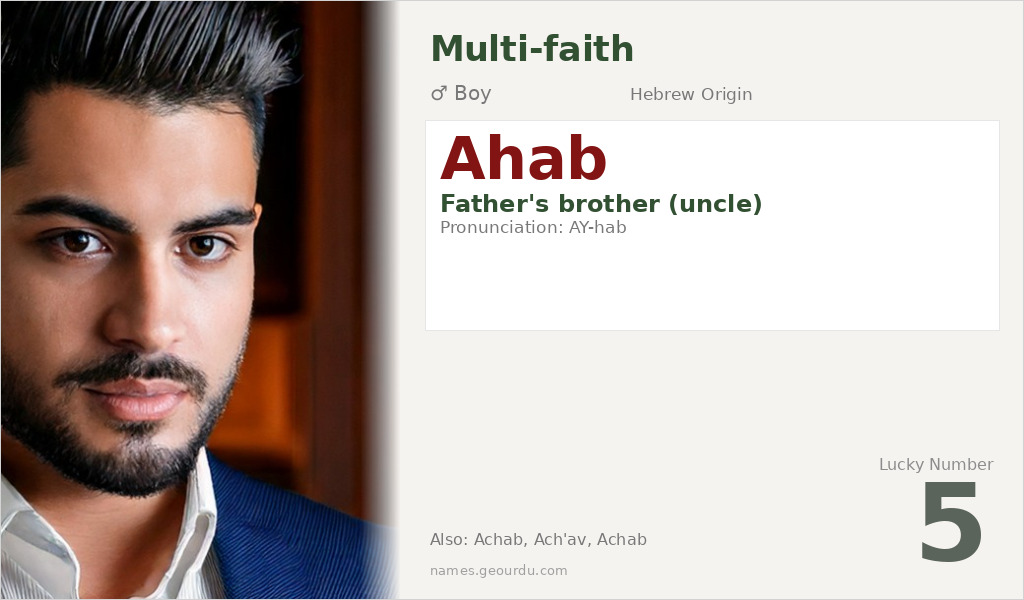
Ahab derives from the Hebrew language, specifically from the components ‘ach’ (אָח) meaning ‘brother’ and ‘av’ (אָב) meaning ‘father’. Combined as אַחְאָב (Ach’av), it literally translates to ‘brother of the father’, which is the Hebrew term for ‘uncle’. This etymological construction is transparent and well-documented in Biblical Hebrew. The name appears in the Tanakh (Hebrew Bible) as the name of the seventh king of the northern kingdom of Israel, establishing its primary historical and linguistic context. No verified meanings exist for Ahab in Arabic, Persian, Pashto, Balochi, Sindhi, or other regional languages—it remains distinctly Hebrew in origin and meaning.
| 📛 Name | Ahab |
| 💎 Meaning | Father's brother (uncle) |
| 👤 Gender | Boy |
| 🕌 Religion | Multi-faith |
| 🌍 Origin | Hebrew |
| 🗣 Pronunciation | AY-hab |
| ✍️ Urdu | اہاب |
| ✍️ Arabic | أخاب |
| 🔢 Numerology | 5 |
| ✨ Spellings | Achab, Ach'av, Achab |
Origin & Cultural Significance
Ahab originates from ancient Hebrew culture and appears in the Biblical books of 1 and 2 Kings (c. 9th century BCE). King Ahab of Israel ruled during a period of significant religious conflict between Yahwism and Baal worship. The name entered Western consciousness primarily through the Hebrew Bible/Old Testament and later through Christian scriptures. In Islamic tradition, Ahab (Arabic: أخاب) is referenced in Quranic commentary as a corrupt ruler. The name’s modern prominence owes much to Herman Melville’s 1851 novel ‘Moby-Dick’, where Captain Ahab became an archetype of obsessive pursuit. Despite its Biblical roots, the name is not exclusively Christian—it holds significance in Jewish, Christian, and Islamic textual traditions.
Personality Traits
The name Ahab evokes personalities marked by determination, intensity, and often controversial leadership. Historically, King Ahab is depicted as a politically capable but religiously conflicted ruler. In literature, Captain Ahab represents the tragic hero consumed by an impossible quest. These associations suggest someone with strong convictions, potential charisma, and a tendency toward single-minded focus. Parents choosing this name might envision a child with leadership potential and depth of character, though the name’s complex legacy invites reflection on ambition and consequence.
Similar Names
If you like Ahab, consider: Ahaz, Ahasuerus, Abijah, Ahaziah, Achish
Famous People Named Ahab
- Ahab — Biblical king of Israel (9th century BCE), son of Omri, husband of Jezebel, depicted in the Books of Kings as a ruler who led Israel into idolatry
- Captain Ahab — Fictional character in Herman Melville's novel 'Moby-Dick' (1851), the monomaniacal captain of the whaling ship Pequod obsessed with hunting the white whale
Frequently Asked Questions About Ahab
What does Ahab mean?
Ahab means 'uncle' in Hebrew, derived from 'ach' (brother) and 'av' (father), literally 'brother of the father'.
Is Ahab a boy or girl name?
Ahab is exclusively a masculine name, used for boys in all historical and cultural contexts where it appears.
What is the origin of Ahab?
Ahab originates from Hebrew language and culture, first appearing as the name of a Biblical king of Israel in the 9th century BCE.





