
Table of Contents
Abdul Kafi is a meaningful Arabic name with deep religious significance in the Muslim world. As a compound name combining ‘Abdul’ (servant of) with one of Allah’s divine attributes, it carries profound spiritual weight. This name has been cherished for generations across diverse Muslim communities, from the Middle East to South Asia and beyond. Understanding its etymology reveals insights into Islamic theology and naming traditions.
Meaning of Abdul Kafi
Abdul Kafi derives from classical Arabic, where ‘Abdul’ (عبد ال) means ‘servant of the’ and ‘Kafi’ (كافي) translates to ‘All-Sufficient’ or ‘Self-Sufficient.’ In Islamic tradition, Al-Kafi is one of the 99 Beautiful Names of Allah (Asma ul-Husna), describing God’s attribute of complete independence and sufficiency. The name literally means ‘Servant of the All-Sufficient One,’ emphasizing the bearer’s relationship with the divine. This naming pattern of ‘Abdul + [Divine Attribute]’ has been used since early Islamic history. The root K-F-Y in Arabic conveys meanings of sufficiency, adequacy, and completeness. Unlike some names that have evolved secular meanings, Abdul Kafi retains exclusively religious significance in all Muslim cultures where it’s used.
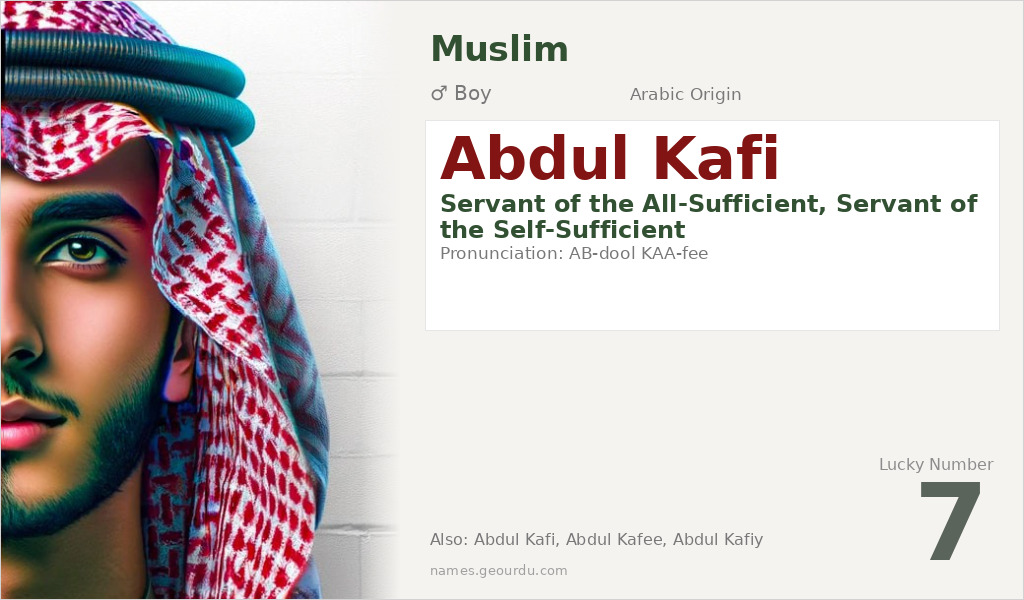
| 📛 Name | Abdul Kafi |
| 💎 Meaning | Servant of the All-Sufficient, Servant of the Self-Sufficient |
| 👤 Gender | Boy |
| 🕌 Religion | Muslim |
| 🌍 Origin | Arabic |
| 🗣 Pronunciation | AB-dool KAA-fee |
| ✍️ Urdu | عبدالکافی |
| ✍️ Arabic | عبد الكافي |
| 🔢 Numerology | 7 |
| ✨ Spellings | Abdul Kafi, Abdul Kafee, Abdul Kafiy, Abdul Kafy, Abdul Kafie |
Origin & Cultural Significance
Abdul Kafi originates from Arabic language and Islamic religious tradition, emerging as part of the widespread practice of naming children with ‘Abdul’ compounds. This naming convention dates back to the early Islamic period in the Arabian Peninsula and spread with the expansion of Islam across Asia, Africa, and beyond. The name is particularly common in Arabic-speaking countries like Saudi Arabia, Egypt, and Syria, as well as in Muslim communities in South Asia including Pakistan, India, and Bangladesh. While the name follows Arabic linguistic structure, it has been adopted by diverse Muslim cultures without significant phonetic or semantic changes. Historical records show usage of this name among Islamic scholars and religious figures for centuries, maintaining its theological purity across different regions.
Personality Traits
The name Abdul Kafi suggests qualities of self-reliance, spiritual depth, and inner strength. Those bearing this name are often associated with resilience and the ability to find contentment through faith rather than external circumstances. The connection to the divine attribute of self-sufficiency may influence perceptions of the name-bearer as someone who approaches challenges with confidence and trust in higher guidance. While personality traits cannot be definitively linked to names, the meaning of Abdul Kafi carries positive connotations of spiritual maturity and independence.
Similar Names
If you like Abdul Kafi, consider: Abdul Karim, Abdul Qadir, Abdul Rahim, Abdul Samad, Abdul Wahid
Famous People Named Abdul Kafi
- Abdul Kafi Khan — 18th century Islamic scholar from the Indian subcontinent known for his theological works
- Abdul Kafi al-Suri — Contemporary Syrian Islamic scholar and author
Frequently Asked Questions About Abdul Kafi
What does Abdul Kafi mean?
Abdul Kafi means 'Servant of the All-Sufficient' or 'Servant of the Self-Sufficient One' in Arabic. It combines 'Abdul' (servant of) with 'Kafi,' one of the 99 names of Allah in Islamic tradition.
Is Abdul Kafi a boy or girl name?
Abdul Kafi is exclusively a boy's name in all Muslim cultures where it's used. The 'Abdul' prefix in Arabic names is traditionally masculine, with feminine equivalents using different constructions.
What is the origin of Abdul Kafi?
Abdul Kafi originates from Arabic language and Islamic religious tradition. It follows the common Arabic naming pattern of 'Abdul + [Divine Attribute]' that has been used since early Islamic history across the Muslim world.





