
Table of Contents
Abdul is one of the most recognizable name elements in the Islamic world, but it’s often misunderstood as a complete name. In reality, this Arabic prefix carries profound spiritual meaning as it forms the beginning of countless Muslim names. Understanding its proper usage reveals deep connections to Islamic theology and naming traditions that span centuries and continents.
Meaning of Abdul
The name element ‘Abdul’ (عبد ال) comes from Classical Arabic, where ‘abd’ (عبد) means ‘servant’, ‘slave’, or ‘worshipper’, and the definite article ‘al’ (ال) means ‘the’. Combined as ‘Abdul’, it literally translates to ‘servant of the’ and must be followed by one of the 99 names of Allah in Islam. For example, Abdul-Rahman means ‘Servant of the Most Merciful’, and Abdul-Aziz means ‘Servant of the Mighty’. This construction reflects the Islamic concept of complete submission to God (tawhid). The prefix appears in numerous languages influenced by Arabic, including Persian, Urdu, Turkish, and various African languages, always maintaining its religious significance.
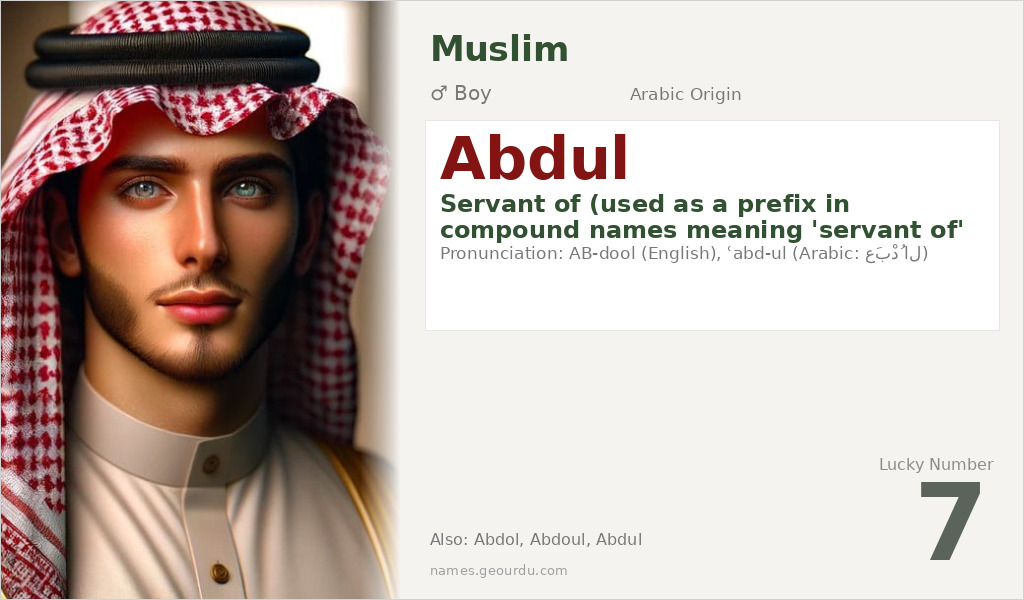
| 📛 Name | Abdul |
| 💎 Meaning | Servant of (used as a prefix in compound names meaning 'servant of' followed by one of the 99 names of Allah) |
| 👤 Gender | Boy |
| 🕌 Religion | Muslim |
| 🌍 Origin | Arabic |
| 🗣 Pronunciation | AB-dool (English), ʿabd-ul (Arabic: عَبْدُ ال) |
| ✍️ Urdu | عبدال |
| ✍️ Arabic | عبد ال |
| 🔢 Numerology | 7 |
| ✨ Spellings | Abdol, Abdoul, Abdul, Abdool |
Origin & Cultural Significance
Abdul originates from pre-Islamic Arabic where ‘abd’ referred to a servant or slave, but it gained profound religious significance with the advent of Islam in the 7th century. The Quran emphasizes that all humans are ‘abd’ (servants) of Allah, making this prefix central to Islamic identity. It became customary to name children with this prefix followed by one of Allah’s attributes, expressing devotion and humility. This naming tradition spread with Islamic expansion across the Middle East, North Africa, South Asia, and Southeast Asia, becoming particularly common in Arabic, Persian, Turkish, Urdu, and Malay-speaking communities. The prefix maintains consistent usage across diverse cultures while adapting to local linguistic patterns.
Personality Traits
While personality traits aren’t determined by names, the prefix ‘Abdul’ carries cultural associations with devotion, humility, and spiritual connection. In many Muslim societies, names beginning with this prefix are seen as reflecting Islamic values of submission to God and service to others. Those named with ‘Abdul’ compounds might be perceived as having a strong moral compass, dedication to their faith, and a sense of purpose rooted in their relationship with the divine. The name suggests someone who values tradition while maintaining personal integrity.
Similar Names
If you like Abdul, consider: Abdullah, Abdurrahman, Abdulaziz, Abdulmalik, Abdulqadir
Famous People Named Abdul
- Abdul Sattar Edhi — Pakistani philanthropist and humanitarian
- Abdul Kalam — 11th President of India and aerospace scientist
Frequently Asked Questions About Abdul
What does Abdul mean?
Abdul is an Arabic prefix meaning 'servant of'. It must be combined with one of the 99 names of Allah to form a complete name (e.g., Abdul-Rahman = Servant of the Most Merciful).
Is Abdul a boy or girl name?
Abdul is exclusively a masculine name prefix in Arabic and Islamic naming traditions. The feminine equivalent would be 'Amatul' or 'Amatal' followed by one of Allah's names.
What is the origin of Abdul?
Abdul originates from Classical Arabic and has been used in Islamic naming traditions since the 7th century. It spread through Islamic expansion to Persian, Turkish, Urdu, and many other languages.





