
Table of Contents
Abdul Wahaab is a profoundly meaningful Arabic name with deep roots in Islamic tradition. As a compound name combining ‘Abdul’ (servant of) with one of Allah’s 99 names, it carries significant spiritual weight for Muslim families. This name has been cherished for centuries across the Muslim world, from the Middle East to South Asia and beyond. Understanding its etymology reveals why it remains a popular choice for boys in Muslim communities worldwide.
Meaning of Abdul Wahaab
Abdul Wahaab is a theophoric Arabic name composed of two distinct elements. The first part, ‘Abdul’ (عبد ال), literally means ‘servant of’ or ‘slave of’ and is a common prefix in Arabic names expressing devotion to God. The second part, ‘Al-Wahaab’ (الوهاب), is one of the 99 names of Allah in Islamic theology, derived from the Arabic root w-h-b (و-ه-ب) meaning ‘to give’, ‘to grant’, or ‘to bestow’. Al-Wahaab specifically refers to Allah as ‘The Bestower’ or ‘The Giver’ who grants gifts and blessings generously and unconditionally. When combined, the name means ‘Servant of the Bestower’, expressing humility before God’s attribute of generosity. This name structure follows a common pattern in Arabic naming traditions where ‘Abdul’ is paired with one of Allah’s attributes.
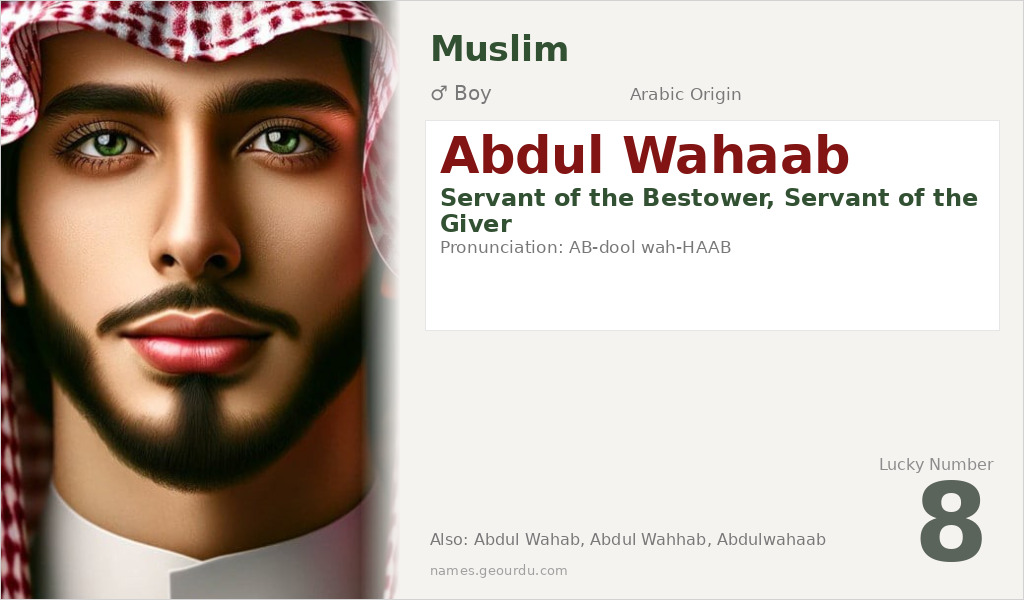
| 📛 Name | Abdul Wahaab |
| 💎 Meaning | Servant of the Bestower, Servant of the Giver |
| 👤 Gender | Boy |
| 🕌 Religion | Muslim |
| 🌍 Origin | Arabic |
| 🗣 Pronunciation | AB-dool wah-HAAB |
| ✍️ Urdu | عبد الوہاب |
| ✍️ Arabic | عبد الوهاب |
| 🔢 Numerology | 8 |
| ✨ Spellings | Abdul Wahab, Abdul Wahhab, Abdulwahaab, Abdul Wahhaab, Abdul Wahāb |
Origin & Cultural Significance
Abdul Wahaab originates from classical Arabic and Islamic naming traditions that date back to the early Islamic period. The practice of using ‘Abdul’ combined with one of Allah’s 99 names became widespread as Islam spread across the Arabian Peninsula and beyond. This name specifically references Surah 3:8 of the Quran where Allah is described as ‘Al-Wahaab’. The name gained particular prominence in the 18th century with Muhammad ibn Abdul-Wahhab, whose teachings influenced Islamic reform movements. Today, Abdul Wahaab remains popular across the Muslim world, especially in Arabic-speaking countries, Pakistan, India, Bangladesh, and Muslim communities in Southeast Asia and Africa.
Personality Traits
While personality traits associated with names are cultural rather than scientific, names like Abdul Wahaab often carry expectations of character. The meaning ‘Servant of the Bestower’ suggests someone who values generosity, humility, and spiritual devotion. In many Muslim cultures, such names are believed to influence the bearer to embody the qualities of the divine attribute referenced. Parents choosing this name often hope their child will grow to be giving, thoughtful, and connected to their faith.
Similar Names
If you like Abdul Wahaab, consider: Abdul Rahman, Abdul Karim, Abdul Aziz, Abdul Qadir, Abdul Malik
Famous People Named Abdul Wahaab
- Abdul Wahab Khan — Former President of Pakistan (1956-1958)
- Muhammad ibn Abdul-Wahhab — 18th century Islamic scholar and theologian from Najd, founder of the Wahhabi movement
Frequently Asked Questions About Abdul Wahaab
What does Abdul Wahaab mean?
Abdul Wahaab means 'Servant of the Bestower' or 'Servant of the Giver' in Arabic. It combines 'Abdul' (servant of) with 'Al-Wahaab', one of the 99 names of Allah meaning 'The Bestower'.
Is Abdul Wahaab a boy or girl name?
Abdul Wahaab is exclusively a boy's name in Muslim naming traditions. The 'Abdul' prefix is traditionally masculine in Arabic, though some modern variations exist for girls with different prefixes.
What is the origin of Abdul Wahaab?
Abdul Wahaab originates from Arabic and Islamic tradition. It follows the common Arabic naming pattern of combining 'Abdul' (servant of) with one of Allah's 99 names, specifically Al-Wahaab (The Bestower).





