
Table of Contents
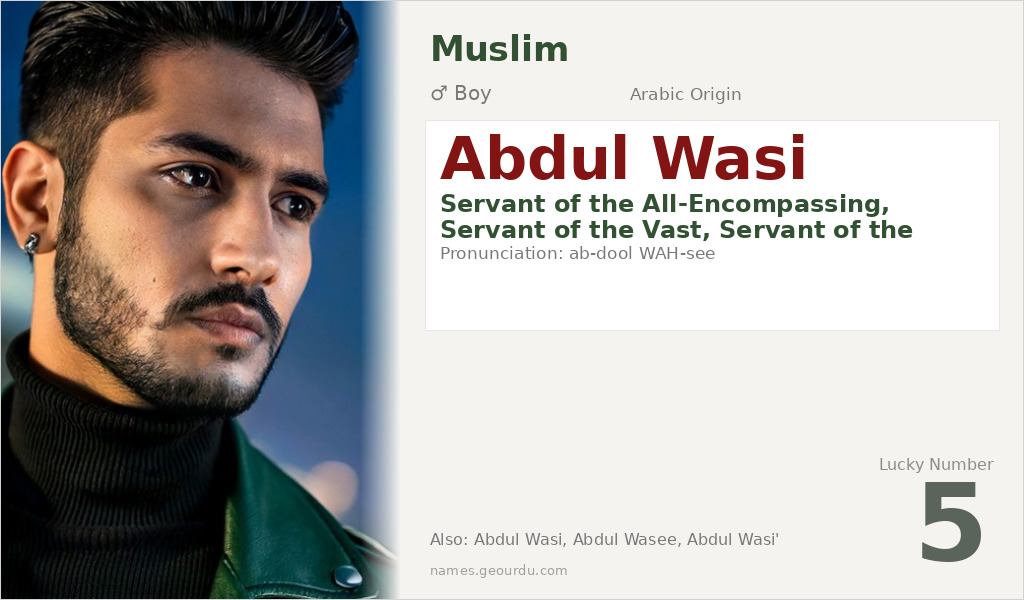
Abdul Wasi is a profound Arabic name with deep Islamic significance, combining devotion with one of Allah’s most encompassing attributes. This traditional boy’s name has been cherished across Muslim communities for centuries, reflecting a spiritual connection to divine vastness and mercy. As a compound name, it carries both religious reverence and linguistic elegance that continues to resonate with parents today.
Meaning of Abdul Wasi
Abdul Wasi is a classical Arabic compound name with precise theological meaning. The first component ‘Abdul’ (عبد ال) means ‘servant of’ or ‘worshipper of’, forming the beginning of many Islamic names that express devotion to God. The second component ‘Wasi’ (واسع) is directly derived from one of the 99 Names of Allah (Asma ul-Husna), specifically Al-Wasi, which translates to ‘the All-Encompassing’, ‘the Vast’, or ‘the All-Embracing’. Linguistically, ‘Wasi’ comes from the Arabic root w-s-ʿ (و-س-ع) meaning ‘to be spacious, wide, or comprehensive’. In Islamic context, this refers to Allah’s attribute of having boundless knowledge that encompasses everything, infinite mercy that embraces all creation, and provision that reaches every being. Thus, the complete name Abdul Wasi means ‘Servant of the All-Encompassing’, expressing humility before divine infinity.
| 📛 Name | Abdul Wasi |
| 💎 Meaning | Servant of the All-Encompassing, Servant of the Vast, Servant of the All-Embracing |
| 👤 Gender | Boy |
| 🕌 Religion | Muslim |
| 🌍 Origin | Arabic |
| 🗣 Pronunciation | ab-dool WAH-see |
| ✍️ Urdu | عبدالواسع |
| ✍️ Arabic | عبد الواسع |
| 🔢 Numerology | 5 |
| ✨ Spellings | Abdul Wasi, Abdul Wasee, Abdul Wasi', Abdul Wasee', Abdul Wasiy |
Origin & Cultural Significance
Abdul Wasi originates from classical Arabic and Islamic tradition, specifically from the Quranic and theological concept of Allah’s attributes. The name emerged as part of the widespread Muslim practice of creating compound names with ‘Abdul’ followed by one of the 99 Names of Allah, a tradition dating back to early Islamic history. While primarily Arabic in origin, the name has been adopted across various Muslim cultures including Persian, Urdu, Pashto, Turkish, and Bengali-speaking communities, though its form remains essentially Arabic. Unlike some names that have evolved different meanings across regions, Abdul Wasi maintains its original theological meaning consistently throughout the Islamic world. The name is particularly common in South Asia, the Middle East, and among diaspora Muslim communities globally.
Personality Traits
While personality traits associated with names are cultural interpretations rather than definitive characteristics, Abdul Wasi is often linked to qualities reflecting its meaning. The ‘All-Encompassing’ aspect suggests someone with broad-mindedness, generosity, and inclusive attitudes. Such individuals might be perceived as adaptable to different situations and people, with a capacity for understanding diverse perspectives. The devotional element of ‘servant’ implies humility, spiritual awareness, and a sense of purpose beyond oneself.
Similar Names
If you like Abdul Wasi, consider: Abdul Wahid, Abdul Qadir, Abdul Rahim, Abdul Aziz, Abdul Samad
Famous People Named Abdul Wasi
- Abdul Wasi Qureshi — Pakistani Islamic scholar and former Vice Chancellor of Jamia Darul Uloom Karachi
- Abdul Wasi — Afghan cricketer who played for the Afghanistan national cricket team
Frequently Asked Questions About Abdul Wasi
What does Abdul Wasi mean?
Abdul Wasi means 'Servant of the All-Encompassing' or 'Servant of the Vast' in Arabic. It is a compound Islamic name where 'Abdul' means 'servant of' and 'Wasi' refers to one of Allah's 99 names meaning 'the All-Encompassing'.
Is Abdul Wasi a boy or girl name?
Abdul Wasi is exclusively a boy's name in all Muslim cultures. The 'Abdul' component is masculine in Arabic grammar, and all traditional 'Abdul + [Name of Allah]' combinations are male names in Islamic naming conventions.
What is the origin of Abdul Wasi?
Abdul Wasi originates from classical Arabic and Islamic theology. It follows the pattern of combining 'Abdul' (servant of) with one of the 99 Names of Allah, specifically Al-Wasi (the All-Encompassing), a practice rooted in Quranic tradition and early Islamic history.





