
Table of Contents
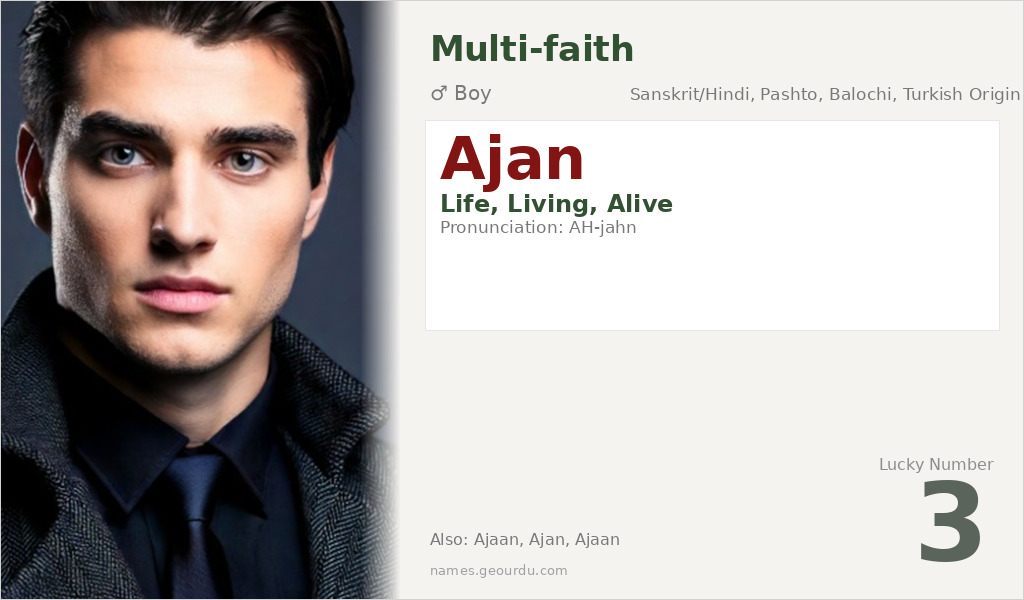
Ajan is a culturally rich name with fascinating dual meanings that span different languages and traditions. While commonly associated with Hindu philosophy as ‘the unborn’, it carries the vibrant meaning of ‘life’ and ‘living’ in Pashto and Balochi cultures. This name bridges spiritual concepts of existence across South Asian and Middle Eastern communities. Understanding Ajan requires exploring its diverse linguistic roots and cultural significance.
Meaning of Ajan
The name Ajan possesses distinct meanings in different linguistic contexts. In Sanskrit and Hindi, ‘Ajan’ (अजन) literally means ‘unborn’ or ‘not born’, often used in philosophical and spiritual contexts to describe the eternal or divine. In Pashto and Balochi languages, Ajan (اجان) carries the beautiful meaning of ‘life’, ‘living’, or ‘alive’, making it a popular masculine name among Pashtun and Baloch communities. The Turkish meaning of ‘agent’ or ‘representative’ comes from a different etymological root. These diverse meanings reflect the name’s journey across cultures, with the Pashto/Balochi meaning being particularly significant in regions like Afghanistan, Pakistan, and Iran where these languages are spoken.
| 📛 Name | Ajan |
| 💎 Meaning | Life, Living, Alive |
| 👤 Gender | Boy |
| 🕌 Religion | Multi-faith |
| 🌍 Origin | Sanskrit/Hindi, Pashto, Balochi, Turkish |
| 🗣 Pronunciation | AH-jahn |
| ✍️ Urdu | اجان |
| ✍️ Arabic | أجان |
| 🔢 Numerology | 3 |
| ✨ Spellings | Ajaan, Ajan, Ajaan, Ajan |
Origin & Cultural Significance
Ajan originates from multiple language families with distinct cultural contexts. The Sanskrit/Hindi version has roots in ancient Indian philosophy and Hindu traditions, where it appears in spiritual texts. The Pashto and Balochi versions are indigenous to the Pashtun and Baloch peoples, with strong cultural significance in Afghanistan, Pakistan, and Iran. These are not dialectical variations but separate linguistic traditions with their own rich histories. The name’s usage spans religious boundaries, appearing among Hindus, Muslims, and Buddhists, reflecting the cultural exchanges across South and Central Asia. Historical records show the name appearing in various forms across these regions for centuries.
Personality Traits
People named Ajan often embody qualities related to their name’s meanings. Those with the Sanskrit meaning tend to be philosophical and spiritually oriented, while those with the Pashto/Balochi meaning often exhibit vitality and appreciation for life. Common traits include thoughtfulness, resilience, and a deep connection to cultural or spiritual roots. The name suggests someone who values existence in its many forms, whether contemplating the eternal or celebrating the living.
Similar Names
If you like Ajan, consider: Ayan, Arjan, Ajay, Aman, Aryan
Famous People Named Ajan
- Ajan Brahm — Australian Buddhist monk and author
- Ajan Chah — Thai Buddhist monk of the Thai Forest Tradition
Frequently Asked Questions About Ajan
What does Ajan mean?
Ajan has multiple meanings: 'Life' or 'Living' in Pashto and Balochi languages, and 'The Unborn' in Sanskrit/Hindi. The Pashto/Balochi meaning is particularly common in Afghanistan, Pakistan, and Iran.
Is Ajan a boy or girl name?
Ajan is primarily a masculine name across all its cultural contexts, including Hindu, Muslim Pashtun/Baloch communities, and Buddhist traditions.
What is the origin of Ajan?
Ajan has multiple origins: from Sanskrit/Hindi meaning 'unborn', from Pashto/Balochi meaning 'life/living', and from Turkish meaning 'agent'. The Pashto/Balochi origin is particularly significant in regional naming traditions.





