
Table of Contents
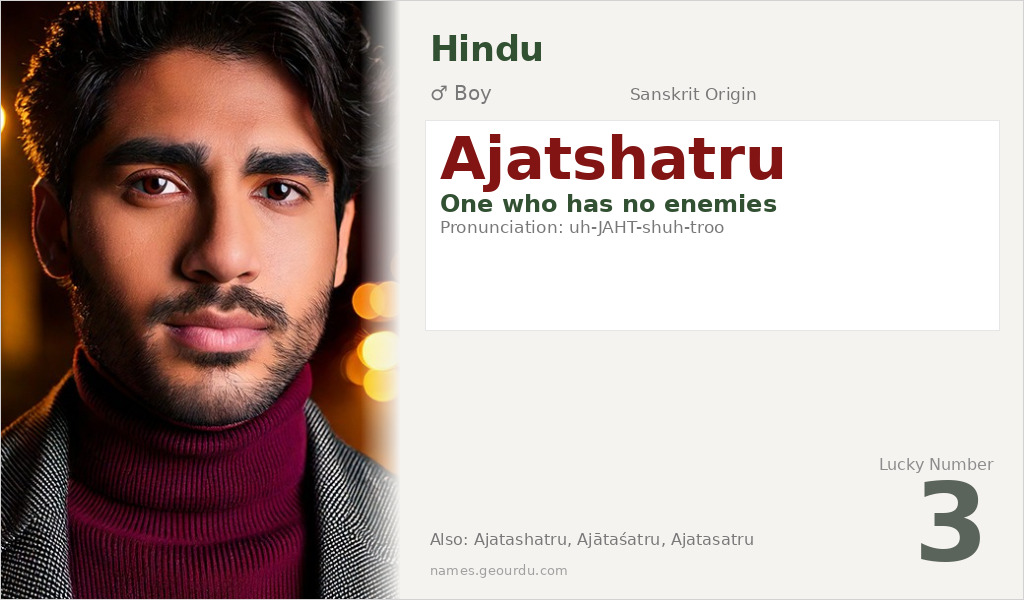
Ajatshatru is a powerful Sanskrit name with deep roots in ancient Indian history and philosophy. Meaning ‘one who has no enemies,’ this name carries the weight of royal lineage and spiritual ideals. From the courts of Magadha to modern times, Ajatshatru represents a timeless aspiration for peace and conflict resolution. Discover the rich cultural heritage behind this distinctive name.
Meaning of Ajatshatru
Ajatshatru is a compound Sanskrit name with profound philosophical implications. Breaking it down etymologically, ‘Ajāta’ (अजात) comes from the prefix ‘a-‘ (meaning ‘not’ or ‘without’) and ‘jāta’ (meaning ‘born’), creating the sense of ‘unborn’ or ‘non-existent.’ Combined with ‘Śatru’ (शत्रु), meaning ‘enemy’ or ‘foe,’ the name literally translates to ‘one whose enemies are unborn’—essentially, someone who has no enemies. This concept appears in multiple Indian traditions, including Hinduism and Buddhism, where it represents an ideal state of being free from opposition and conflict. The name suggests not just the absence of enemies, but the cultivation of such harmony that enemies cannot arise.
| 📛 Name | Ajatshatru |
| 💎 Meaning | One who has no enemies |
| 👤 Gender | Boy |
| 🕌 Religion | Hindu |
| 🌍 Origin | Sanskrit |
| 🗣 Pronunciation | uh-JAHT-shuh-troo |
| ✍️ Urdu | اجات شترو |
| ✍️ Arabic | أجاتشاتر |
| 🔢 Numerology | 3 |
| ✨ Spellings | Ajatashatru, Ajātaśatru, Ajatasatru |
Origin & Cultural Significance
Ajatshatru originates from classical Sanskrit and has significant historical presence in ancient Indian texts. Most notably, Ajatashatru was a king of the Magadha empire (approximately 492–460 BCE) who appears in both Hindu epics like the Mahabharata and Buddhist scriptures including the Digha Nikaya. His reign marked an important period in early Indian state formation and religious development. The name reflects the cultural values of ancient Indian royalty, where names often carried philosophical weight and aspirational qualities. While primarily associated with Hindu tradition due to its Sanskrit roots, the name also appears in Buddhist historical contexts, showing its cross-cultural significance in ancient India.
Personality Traits
Those named Ajatshatru are often associated with diplomatic skills and a peaceful disposition. The meaning ‘one who has no enemies’ suggests someone who navigates relationships with care and wisdom, avoiding unnecessary conflicts while standing firm in their convictions. This name implies a strategic thinker who prefers resolution over confrontation, embodying the ideal of creating harmony in their personal and professional circles. While gentle in approach, they possess the strength to protect what matters without creating adversaries.
Similar Names
If you like Ajatshatru, consider: Abhimanyu, Arjuna, Yudhishthira, Bharata, Dhruva
Famous People Named Ajatshatru
- Ajatashatru — Ancient Indian king of Magadha (c. 492–460 BCE) who appears in both Hindu and Buddhist texts, known for his complex relationship with his father Bimbisara and his role in early Indian history
- Ajatashatru Singh — Modern Indian politician and member of the Bharatiya Janata Party
Frequently Asked Questions About Ajatshatru
What does Ajatshatru mean?
Ajatshatru means 'one who has no enemies' in Sanskrit. It's a compound name from 'Ajāta' (unborn/non-existent) and 'Śatru' (enemy), literally translating to 'one whose enemies are unborn.'
Is Ajatshatru a boy or girl name?
Ajatshatru is exclusively a boy's name in Indian naming traditions. It has historical usage as a male name dating back to ancient kings and appears in masculine contexts in all historical records.
What is the origin of Ajatshatru?
Ajatshatru originates from Sanskrit, the classical language of ancient India. It has significant historical presence as the name of King Ajatashatru of Magadha (c. 492–460 BCE) who appears in both Hindu and Buddhist texts.





