
Table of Contents
Ajmer is a distinctive name with deep roots in Indian geography and history. While commonly recognized as a major city in Rajasthan, it also serves as a meaningful personal name, particularly in South Asian communities. This name carries the weight of centuries of cultural heritage, connecting bearers to a place of historical significance. Understanding Ajmer requires exploring its linguistic origins and regional importance beyond mere astrological associations.
Meaning of Ajmer
The name Ajmer derives from the Sanskrit compound ‘Ajayameru,’ combining ‘Ajaya’ (अजय) meaning ‘invincible’ or ‘unconquerable’ and ‘Meru’ (मेरु) referring to the mythical mountain central to Hindu, Jain, and Buddhist cosmologies. This etymology reflects the geographical reality of Ajmer’s location near the Aravalli Range hills. Historical records, including inscriptions from the 7th century CE, confirm the original form ‘Ajayameru.’ Through linguistic evolution in Prakrit and later languages, the name simplified to ‘Ajmer,’ maintaining its connection to strength and elevation. Unlike many personal names with abstract meanings, Ajmer’s meaning is concretely tied to a specific place with documented historical transformation.
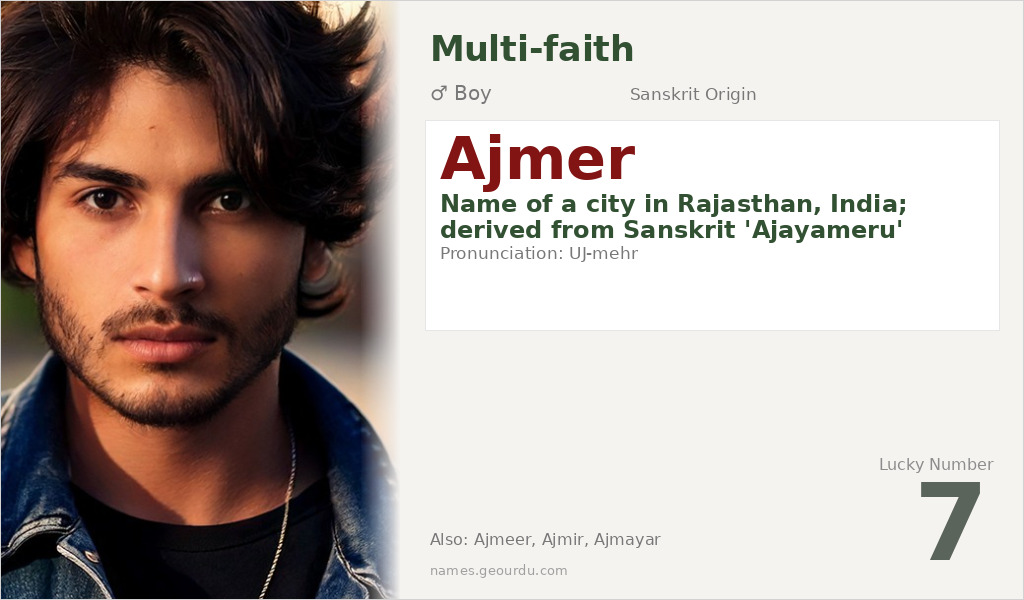
| 📛 Name | Ajmer |
| 💎 Meaning | Name of a city in Rajasthan, India; derived from Sanskrit 'Ajayameru' meaning 'invincible hill' |
| 👤 Gender | Boy |
| 🕌 Religion | Multi-faith |
| 🌍 Origin | Sanskrit |
| 🗣 Pronunciation | UJ-mehr |
| ✍️ Urdu | اجمیر |
| ✍️ Arabic | أجمير |
| 🔢 Numerology | 7 |
| ✨ Spellings | Ajmeer, Ajmir, Ajmayar |
Origin & Cultural Significance
Ajmer originated as a toponym for the city in Rajasthan, India, founded in the late 7th century by Ajayaraja I of the Chauhan dynasty. The name spread as a personal name among communities connected to this region, transcending religious boundaries. While used by Hindus, Muslims, and Sikhs in South Asia, it doesn’t belong exclusively to any one religion. The city’s importance as a cultural and pilgrimage center—home to the Ajmer Sharif Dargah (Sufi shrine) and Ajaymeru Fort—contributed to the name’s adoption. Unlike names with purely religious connotations, Ajmer’s usage reflects geographical pride and historical continuity rather than specific doctrinal associations.
Personality Traits
Names often influence perceived personality traits, and Ajmer suggests stability and resilience. Bearers might be seen as dependable and strong-willed, mirroring the enduring nature of the geographical feature it references. This name evokes a sense of heritage and connection to history, potentially inspiring a practical and grounded character. While personality varies individually, the name’s connotations of invincibility and elevation can symbolize aspirational qualities.
Similar Names
If you like Ajmer, consider: Ajay, Amer, Amar, Ajit, Meru
Famous People Named Ajmer
- Ajmer Singh — Indian track and field athlete who won gold in 400m at 1982 Asian Games
- Ajmer Aulakh — prominent Punjabi playwright and writer from India
Frequently Asked Questions About Ajmer
What does Ajmer mean?
Ajmer means 'invincible hill,' derived from the Sanskrit 'Ajayameru' (Ajaya = invincible, Meru = mountain/hill). It primarily refers to the city in Rajasthan, India.
Is Ajmer a boy or girl name?
Ajmer is predominantly used as a boy's name in South Asian naming traditions, though as a geographical term it's gender-neutral.
What is the origin of Ajmer?
Ajmer originates from Sanskrit as a toponym for the city in Rajasthan, India, with historical usage dating to the 7th century CE.





