
Table of Contents
Anaadi is a profound Sanskrit name that carries deep philosophical weight in Hindu and Buddhist traditions. Meaning ‘without beginning’ or ‘eternal,’ this name represents one of the most fundamental concepts in Eastern spirituality – the timeless nature of ultimate reality. Unlike many names that describe physical qualities or virtues, Anaadi points directly to metaphysical truth. Its usage spans both genders and appeals to parents seeking a name with spiritual depth and philosophical resonance.
Meaning of Anaadi
Anaadi derives from the Sanskrit language, specifically from the compound ‘an-‘ (अन्) meaning ‘without’ or ‘not,’ and ‘aadi’ (आदि) meaning ‘beginning,’ ‘origin,’ or ‘commencement.’ This creates the literal meaning ‘without beginning’ or ‘that which has no origin.’ In Sanskrit grammar, it functions as a bahuvrihi compound (possessive compound) indicating possession of the quality of having no beginning. The term appears extensively in Hindu philosophical texts including the Upanishads, where it describes Brahman (the ultimate reality) and Atman (the individual soul) as beginningless and endless. In Buddhist philosophy, particularly in Madhyamaka thought, it describes the beginningless cycle of samsara. The concept challenges ordinary temporal understanding, pointing to realities that transcend linear time.
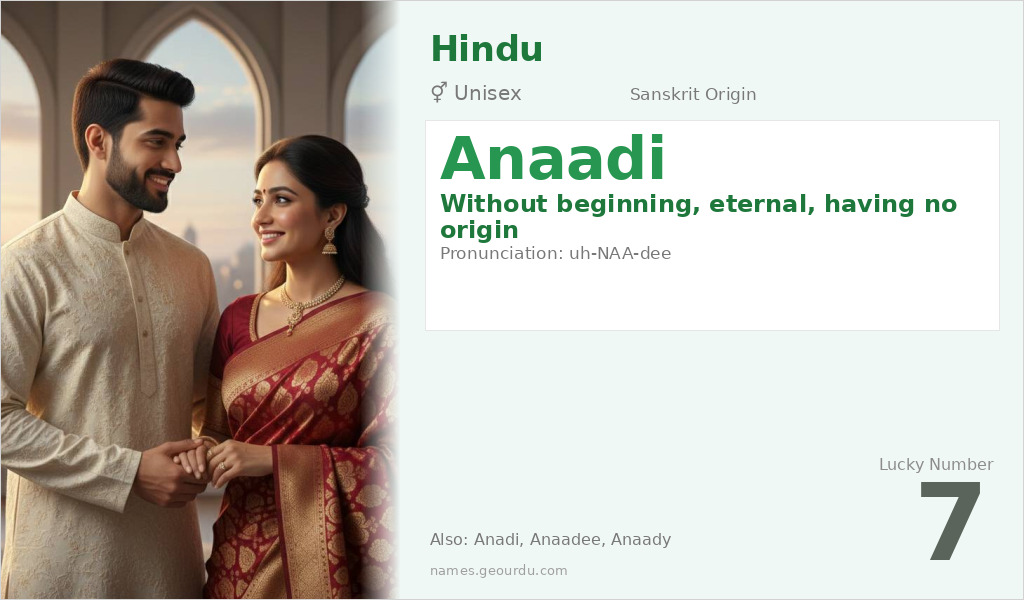
| 📛 Name | Anaadi |
| 💎 Meaning | Without beginning, eternal, having no origin |
| 👤 Gender | Unisex |
| 🕌 Religion | Hindu |
| 🌍 Origin | Sanskrit |
| 🗣 Pronunciation | uh-NAA-dee |
| ✍️ Urdu | انادی |
| ✍️ Arabic | أنادي |
| 🔢 Numerology | 7 |
| ✨ Spellings | Anadi, Anaadee, Anaady |
Origin & Cultural Significance
Anaadi originates from ancient Sanskrit, the classical language of India that dates back to at least 1500 BCE. Its first documented usage appears in the Upanishads (circa 800-500 BCE), the philosophical portions of the Vedas that form the foundation of Hindu thought. The name gained prominence through Advaita Vedanta philosophy, where Adi Shankara (8th century CE) extensively used the term to describe the nature of Brahman. While primarily a Sanskrit philosophical term, it has been adopted as a personal name across various Indian languages including Hindi, Bengali, Marathi, and Gujarati. In contemporary usage, it’s chosen by parents interested in spiritual or philosophical names, particularly within Hindu communities but also by those from Buddhist or Jain backgrounds who appreciate its metaphysical significance.
Personality Traits
Those named Anaadi often embody the philosophical depth suggested by their name. They tend to be contemplative individuals who think deeply about life’s fundamental questions. Their perspective frequently transcends immediate concerns, reflecting the eternal quality their name signifies. While they may appear reserved or introspective, they often possess a stable, grounded presence that others find comforting. The name suggests someone who understands that true value lies beyond temporary circumstances, giving them resilience and wisdom in facing life’s challenges.
Similar Names
If you like Anaadi, consider: Ananta, Avyaya, Akshaya, Nitya, Shashvata
Famous People Named Anaadi
- Anaadi (character) — A spiritual seeker in Hindu philosophical texts and commentaries
- Various spiritual teachers and philosophers in Indian tradition who have used 'Anaadi' as a title or epithet for the eternal self
Frequently Asked Questions About Anaadi
What does Anaadi mean?
Anaadi means 'without beginning,' 'eternal,' or 'having no origin' in Sanskrit. It's a profound philosophical term describing realities that transcend temporal limitations.
Is Anaadi a boy or girl name?
Anaadi is a unisex name used for both boys and girls, though it's more commonly given to boys in contemporary Indian naming practices. Its philosophical nature makes it suitable for any gender.
What is the origin of Anaadi?
Anaadi originates from Sanskrit, the ancient classical language of India. It first appears in Hindu philosophical texts like the Upanishads (circa 800-500 BCE) and has been used for millennia in Indian spiritual and philosophical discourse.