
Table of Contents
Alexander is one of history’s most enduring and influential names, carried by kings, conquerors, and innovators across centuries. With roots in ancient Greece, this powerful name means ‘defender of men’ and has spread to virtually every culture and language. From Alexander the Great to modern-day bearers, this name symbolizes leadership, protection, and strength. Its timeless appeal makes it a popular choice for parents seeking a name with historical weight and positive meaning.
Meaning of Alexander
The name Alexander derives from the Greek Ἀλέξανδρος (Alexandros), which breaks down into two components: ἀλέξω (alexō) meaning ‘to defend, protect, or ward off’ and ἀνήρ (anēr) meaning ‘man’ (with the genitive form ἀνδρός, andros). Thus, the literal translation is ‘defender of men’ or ‘protector of mankind.’ This meaning has remained consistent through the name’s journey into Latin (Alexander), Arabic (الإسكندر, al-Iskandar), Persian (اسکندر, Eskandar), and numerous other languages. The name’s protective connotation made it particularly suitable for military leaders and rulers throughout history, most notably Alexander III of Macedon, whose conquests cemented the name’s association with greatness and expansion.
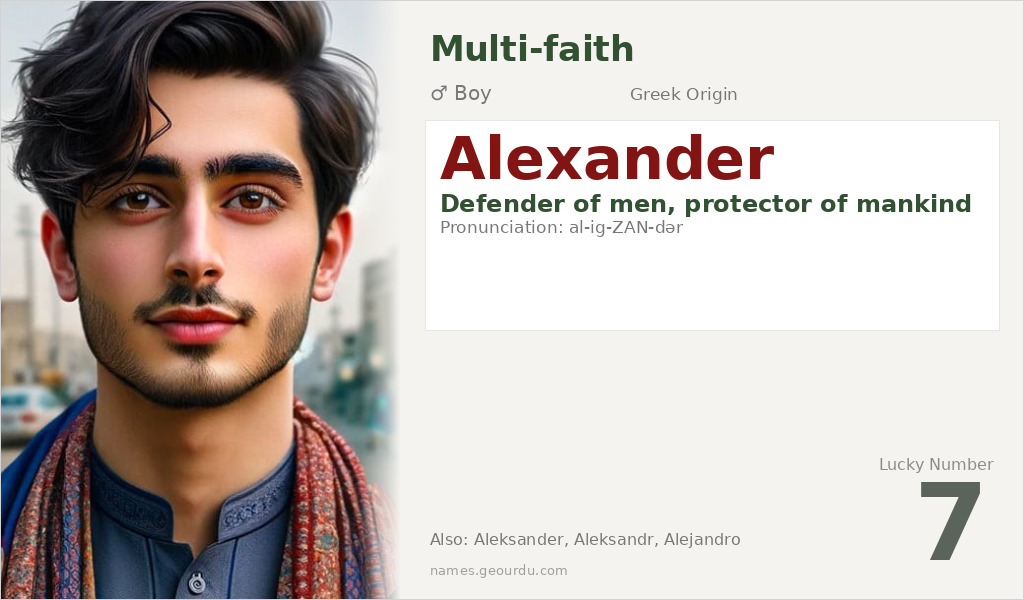
| 📛 Name | Alexander |
| 💎 Meaning | Defender of men, protector of mankind |
| 👤 Gender | Boy |
| 🕌 Religion | Multi-faith |
| 🌍 Origin | Greek |
| 🗣 Pronunciation | al-ig-ZAN-dər |
| ✍️ Urdu | الیکزنڈر |
| ✍️ Arabic | الإسكندر |
| 🔢 Numerology | 7 |
| ✨ Spellings | Aleksander, Aleksandr, Alejandro, Alessandro, Alexandre, Iskandar |
Origin & Cultural Significance
Alexander originated in ancient Greece, where it was composed from Greek elements to create a name meaning ‘defender of men.’ Its popularity surged due to Alexander the Great (356-323 BCE), whose empire stretched from Greece to India, spreading the name throughout the Hellenistic world and beyond. The name entered Islamic cultures through the Arabic form al-Iskandar, often associated with the legendary figure Dhul-Qarnayn mentioned in the Quran. In South Asia, variations like Sikandar became common through Persian influence. While the name is used globally by people of various faiths including Christians, Muslims, Hindus, and others, it has no inherent religious affiliation and is considered a multi-faith name with purely linguistic and historical origins.
Personality Traits
People named Alexander often embody the protective and leadership qualities suggested by their name’s meaning. They tend to be confident, ambitious individuals who take responsibility seriously and have a natural inclination to defend others. Historically associated with great conquerors and innovators, Alexanders often display determination, courage, and strategic thinking. While individual personalities vary, the name carries connotations of strength, reliability, and the capacity to achieve significant accomplishments.
Similar Names
If you like Alexander, consider: Alex, Alexis, Alexandre, Alessandro, Alejandro, Sander, Xander, Iskandar, Alistair, Leander
Famous People Named Alexander
- Alexander the Great — King of Macedon who created one of the largest empires in ancient history
- Alexander Graham Bell — Scottish-born inventor credited with patenting the first practical telephone
Frequently Asked Questions About Alexander
What does Alexander mean?
Alexander means 'defender of men' or 'protector of mankind.' It comes from the Greek elements ἀλέξω (alexō, 'to defend') and ἀνήρ (anēr, 'man').
Is Alexander a boy or girl name?
Alexander is traditionally and overwhelmingly a masculine name. While feminine variants like Alexandra exist, Alexander itself is used almost exclusively for boys across all cultures where it appears.
What is the origin of Alexander?
Alexander originates from ancient Greek, specifically from the name Ἀλέξανδρος (Alexandros). It spread globally through the influence of Alexander the Great and subsequent cultural exchanges, appearing in Latin, Arabic, Persian, and numerous other languages with adapted forms.





