
Table of Contents
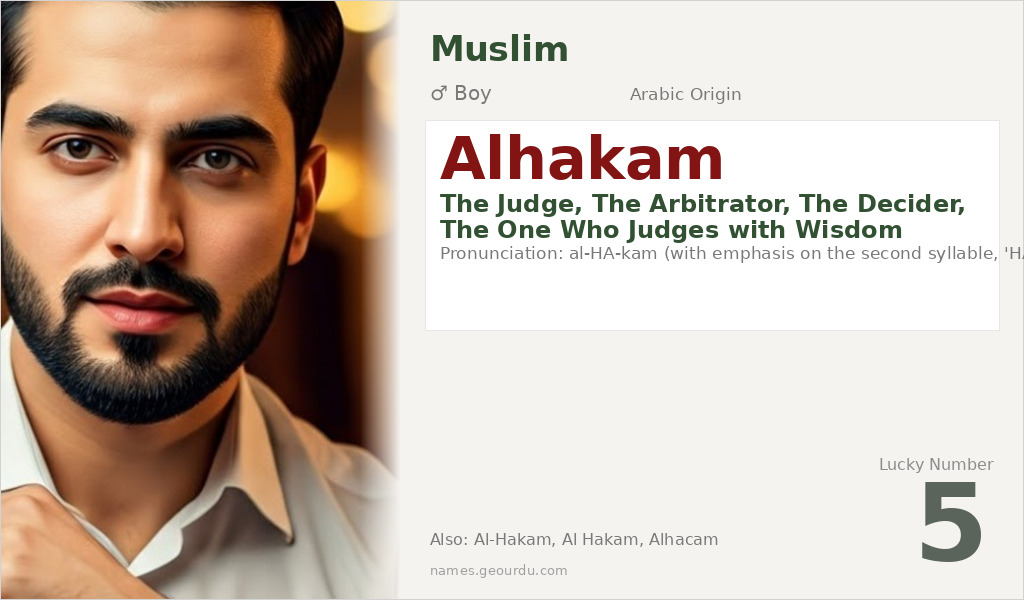
Alhakam is a distinguished Arabic name with deep roots in Islamic culture, meaning ‘The Judge’ or ‘The Arbitrator.’ As one of the 99 Names of Allah, it carries spiritual significance and is chosen for boys to embody qualities of wisdom and fairness. This name has been borne by historical figures in the Muslim world, reflecting its enduring appeal. In this guide, we explore the meaning, origin, and cultural context of Alhakam.
Meaning of Alhakam
Alhakam is derived from the Arabic root ‘ḥ-k-m’ (ح-ك-م), which conveys concepts of judging, ruling, and exercising wisdom. In Islamic theology, ‘Al-Hakam’ is one of the divine attributes, referring to Allah as the ultimate judge who decrees with perfect justice. As a personal name, Alhakam signifies a person who judges fairly or makes decisions with insight, often used to inspire moral integrity. The name emphasizes the importance of justice in Arabic and Muslim traditions, with historical usage dating back to the early Islamic period. Linguistically, it is a definite form (‘Al-‘ meaning ‘the’) combined with ‘Hakam,’ making it a compound name that highlights its authoritative meaning.
| 📛 Name | Alhakam |
| 💎 Meaning | The Judge, The Arbitrator, The Decider, The One Who Judges with Wisdom |
| 👤 Gender | Boy |
| 🕌 Religion | Muslim |
| 🌍 Origin | Arabic |
| 🗣 Pronunciation | al-HA-kam (with emphasis on the second syllable, 'HA') |
| ✍️ Urdu | الحکم |
| ✍️ Arabic | الحكم |
| 🔢 Numerology | 5 |
| ✨ Spellings | Al-Hakam, Al Hakam, Alhacam, Alhakem |
Origin & Cultural Significance
Alhakam originates from Classical Arabic and is deeply embedded in Islamic culture, primarily used among Muslim communities globally. It gained prominence through its inclusion in the Asma ul-Husna (the 99 Names of Allah), which has influenced naming practices since the early days of Islam. Historically, the name was adopted by several Umayyad rulers in Al-Andalus (Islamic Spain), such as Al-Hakam I and Al-Hakam II, linking it to leadership and scholarly patronage. While most common in Arabic-speaking regions, it has spread to other Muslim cultures, including Persian, Urdu, and Turkish contexts, though its meaning remains consistent. The name is not typically found in non-Arabic or non-Islamic traditions, as its etymology and religious connotations are specific to Arabic and Islam.
Personality Traits
Those named Alhakam are often associated with traits of fairness, wisdom, and decisiveness, reflecting the name’s meaning as ‘The Judge.’ They may be seen as natural leaders who approach situations with a balanced and thoughtful perspective, valuing justice and integrity. In social settings, they might exhibit a calm and authoritative demeanor, inspired by the name’s connection to divine judgment in Islam. These personality attributions are cultural interpretations rather than deterministic, but they highlight the aspirational qualities embedded in the name.
Similar Names
If you like Alhakam, consider: Hakim, Hakam, Muhakam, Hukam, Hikmat
Famous People Named Alhakam
- Al-Hakam I — Umayyad Emir of Córdoba (ruled 796–822 CE) in Al-Andalus (Islamic Spain)
- Al-Hakam II — Umayyad Caliph of Córdoba (ruled 961–976 CE), known for his patronage of learning and expansion of the Great Mosque of Córdoba
Frequently Asked Questions About Alhakam
What does Alhakam mean?
Alhakam means 'The Judge,' 'The Arbitrator,' or 'The Decider' in Arabic, derived from the root 'ḥ-k-m' and associated with one of the 99 Names of Allah in Islam.
Is Alhakam a boy or girl name?
Alhakam is exclusively a boy's name in Arabic and Islamic naming traditions, reflecting masculine grammatical forms and historical usage.
What is the origin of Alhakam?
Alhakam originates from Arabic, with deep roots in Islamic culture as a name inspired by the divine attribute 'Al-Hakam,' and has been used historically by Muslim rulers and communities.





