Table of Contents
Amethyst is a beautiful and unique name that draws directly from the natural world. Unlike many names with ancient roots, Amethyst maintains a clear connection to its source—the violet quartz gemstone prized for centuries. This name carries with it a fascinating mythological history and a meaning that speaks to clarity and protection. While relatively uncommon as a given name, it has gained popularity in recent decades as parents seek distinctive yet meaningful options.
Meaning of Amethyst
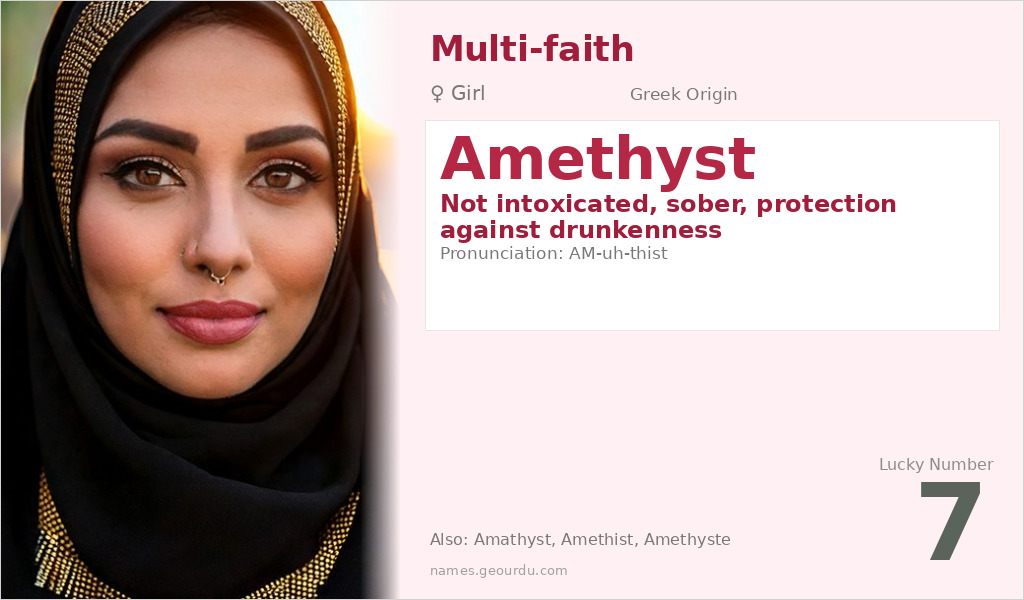
The name Amethyst has one of the most transparent and well-documented etymologies of any modern name. It derives from the Ancient Greek word ‘amethystos’ (ἀμέθυστος), which combines the negative prefix ‘a-‘ with ‘methyein,’ meaning ‘to be drunk.’ Thus, the literal translation is ‘not intoxicated’ or ‘sober.’ This meaning originates from the ancient belief that amethyst gemstones could prevent drunkenness when worn or used in drinking vessels. Greek mythology tells of Dionysus, the god of wine, pursuing a maiden named Amethystos who prayed to Artemis for protection and was turned into a clear quartz statue; when Dionysus poured wine over it, the stone turned purple, creating the first amethyst. The name traveled through Latin ‘amethystus’ and Old French ‘amethyste’ before entering English, preserving its original Greek meaning throughout this linguistic journey.
| 📛 Name | Amethyst |
| 💎 Meaning | Not intoxicated, sober, protection against drunkenness |
| 👤 Gender | Girl |
| 🕌 Religion | Multi-faith |
| 🌍 Origin | Greek |
| 🗣 Pronunciation | AM-uh-thist |
| ✍️ Urdu | ایمیتھسٹ |
| ✍️ Arabic | أميثيست |
| 🔢 Numerology | 7 |
| ✨ Spellings | Amathyst, Amethist, Amethyste |
Origin & Cultural Significance
Amethyst originates from Ancient Greek culture and language, specifically from the word for the violet variety of quartz. While the gemstone itself has been valued since antiquity across multiple civilizations including Egyptian, Roman, and Byzantine cultures, the name as a personal given name is a relatively modern development. It emerged in English-speaking countries during the 19th century Victorian era when gemstone names became fashionable. Unlike names with religious origins, Amethyst has no inherent connection to Christianity or any specific faith tradition—it is a secular name derived from mineralogy and mythology. The name gained broader popularity in the late 20th and early 21st centuries as part of the trend toward nature-inspired and unique names.
Personality Traits
Those named Amethyst often embody qualities associated with their namesake gemstone: clarity, calmness, and spiritual depth. They may possess an intuitive nature and appreciation for beauty in all forms. The name’s meaning of ‘not intoxicated’ suggests individuals who value sobriety of mind, wisdom, and self-control. While personality traits vary by individual, the name carries connotations of uniqueness, creativity, and a connection to the natural world.
Similar Names
If you like Amethyst, consider: Amber, Emerald, Ruby, Jade, Crystal
Famous People Named Amethyst
- Amethyst Amelia Kelly (stage name Iggy Azalea) — Australian rapper and model
- Amethyst — American singer-songwriter and actress known for her work in the 1990s
Frequently Asked Questions About Amethyst
What does Amethyst mean?
Amethyst means 'not intoxicated' or 'sober,' originating from the Ancient Greek word 'amethystos' (ἀμέθυστος).
Is Amethyst a boy or girl name?
Amethyst is almost exclusively used as a girl's name in modern English-speaking cultures, though gemstone names are generally gender-neutral in origin.
What is the origin of Amethyst?
Amethyst originates from Ancient Greek language and mythology, specifically from the word for the violet quartz gemstone believed to prevent intoxication.