Table of Contents
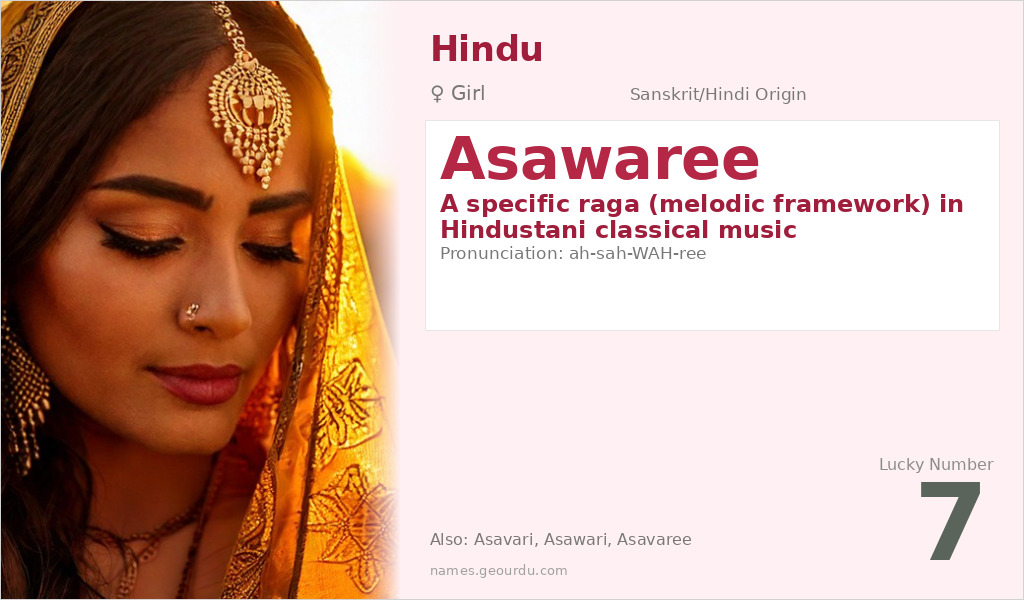
Asawaree is a beautiful and culturally rich name with deep roots in Indian classical music traditions. Unlike many names with literal translations, Asawaree derives from the world of Hindustani classical music, specifically referring to a morning raga. This name carries the elegance and artistic heritage of India’s musical legacy, making it a meaningful choice for parents who appreciate cultural depth. While primarily used in Hindu communities, the name’s musical origins give it universal artistic appeal.
Meaning of Asawaree
Asawaree originates from Sanskrit and Hindi musical terminology, specifically referring to the Asavari raga in Hindustani classical music. The name comes from the musical term ‘Asavari’ or ‘Asawari,’ which denotes a particular melodic framework with specific notes (komal dha and komal ni) and emotional qualities. In Indian classical tradition, ragas like Asavari are associated with specific times of day, with Asavari traditionally performed during the morning hours. The raga is known for its contemplative and devotional mood, often described as expressing pathos or longing. Unlike names with direct translations, Asawaree’s meaning is entirely tied to this musical tradition, representing a specific artistic expression rather than a concrete object or concept.
| 📛 Name | Asawaree |
| 💎 Meaning | A specific raga (melodic framework) in Hindustani classical music |
| 👤 Gender | Girl |
| 🕌 Religion | Hindu |
| 🌍 Origin | Sanskrit/Hindi |
| 🗣 Pronunciation | ah-sah-WAH-ree |
| ✍️ Urdu | اسواری |
| ✍️ Arabic | أسافاري |
| 🔢 Numerology | 7 |
| ✨ Spellings | Asavari, Asawari, Asavaree, Aasavari |
Origin & Cultural Significance
The name Asawaree has its origins in Indian classical music traditions, specifically within the Hindustani (North Indian) musical system. It emerges from Sanskrit and Hindi terminology used to classify ragas, the melodic frameworks that form the foundation of Indian classical music. While the exact etymology of the musical term ‘Asavari’ is debated among musicologists, it has been part of Indian musical theory for centuries, documented in ancient texts on musicology. The name’s usage as a personal name is relatively modern, reflecting the trend of using artistic and cultural references for naming children in Indian communities. It remains primarily associated with Hindu cultural contexts, though its musical origins give it broader artistic significance beyond religious boundaries.
Personality Traits
Those named Asawaree often embody the artistic and emotional qualities associated with their musical namesake. They tend to be creative, sensitive individuals with an appreciation for beauty and cultural traditions. Like the morning raga they’re named after, they may have a contemplative nature and express emotions deeply, whether through artistic pursuits or personal relationships. Their connection to this classical art form often gives them a refined aesthetic sense and cultural awareness.
Similar Names
If you like Asawaree, consider: Malhar, Bhairavi, Todi, Malkauns, Darbari
Famous People Named Asawaree
- Asavari (fictional) — A character in Indian television and literature sometimes named after the raga
- Various Indian classical musicians — Many musicians have compositions based on the Asavari raga, though it's less common as a personal name
Frequently Asked Questions About Asawaree
What does Asawaree mean?
Asawaree specifically refers to the Asavari raga in Hindustani classical music, a morning melodic framework with particular notes and emotional qualities. It comes from Sanskrit/Hindi musical terminology rather than having a literal translation.
Is Asawaree a boy or girl name?
Asawaree is almost exclusively used as a girl's name in Indian naming traditions. Its musical origin and ending vowel sound make it feminine in most usage contexts.
What is the origin of Asawaree?
Asawaree originates from Sanskrit and Hindi musical terminology within Indian classical music traditions. It specifically refers to the Asavari raga in Hindustani classical music and has been adopted as a personal name in modern Indian naming practices.