Table of Contents
Annika is a charming name that has traveled across continents while maintaining its core meaning of ‘grace’ and ‘favor.’ Originally a Swedish diminutive of Anna, this name combines traditional roots with contemporary appeal. Its soft yet distinctive sound has made it popular in various cultures worldwide, from Europe to South Asia. Let’s explore the fascinating journey of this name from its ancient Hebrew origins to modern global usage.
Meaning of Annika
Annika’s meaning traces back to the Hebrew name Hannah (חַנָּה), which means ‘grace,’ ‘favor,’ or ‘mercy.’ This entered Greek as Ἄννα (Anna) and Latin as Anna before spreading throughout Europe. In Swedish and other Germanic languages, Annika developed as a diminutive or pet form of Anna, essentially meaning ‘little Anna’ or ‘graceful one.’ The name carries the same theological connotation of divine grace found in its source, though in secular contexts it simply denotes elegance and favor. Unlike some claims, it does not mean ‘Goddess Durga’ or have inherent connections to specific metals or numbers—these are cultural additions in regions where the name has been adopted.
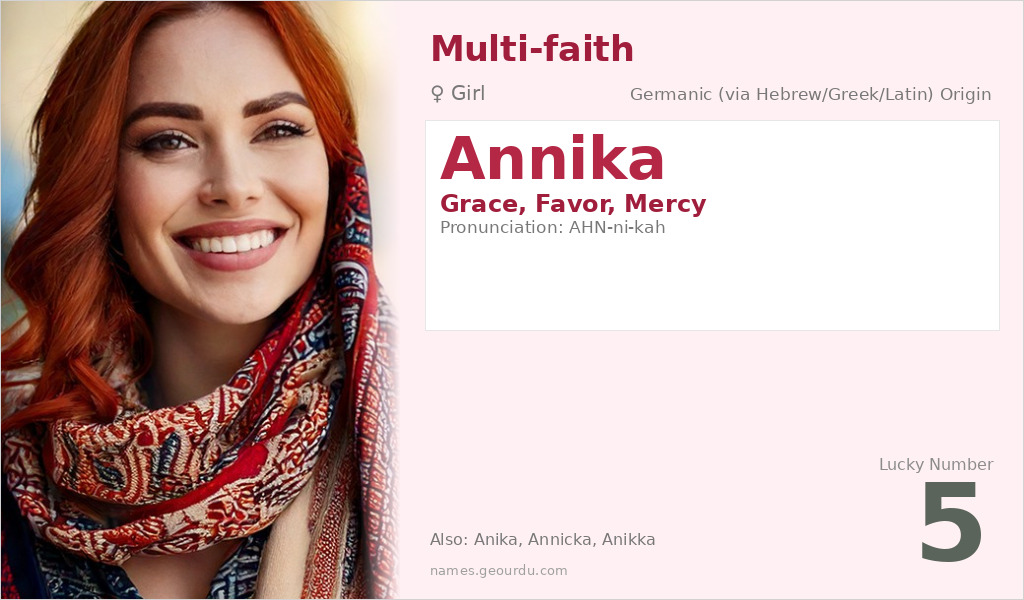
| 📛 Name | Annika |
| 💎 Meaning | Grace, Favor, Mercy |
| 👤 Gender | Girl |
| 🕌 Religion | Multi-faith |
| 🌍 Origin | Germanic (via Hebrew/Greek/Latin) |
| 🗣 Pronunciation | AHN-ni-kah |
| ✍️ Urdu | انیکا |
| ✍️ Arabic | أنيكا |
| 🔢 Numerology | 5 |
| ✨ Spellings | Anika, Annicka, Anikka, Annick |
Origin & Cultural Significance
Annika originated as a Swedish diminutive of Anna, which itself comes from the Hebrew Hannah via Greek and Latin transmission. The name became popular in Scandinavia and German-speaking regions before spreading globally. In the 20th century, Annika gained international recognition through literature and media, including Pippi Longstocking’s friend Annika in Astrid Lindgren’s stories. While commonly used in Hindu communities today, this represents cultural adoption rather than etymological origin—similar to how many European names have been embraced in South Asia. The name’s appeal lies in its melodic quality and positive meaning across religious boundaries.
Personality Traits
Those named Annika are often perceived as graceful, compassionate, and socially adept individuals. The name’s meaning of ‘favor’ and ‘grace’ suggests someone who navigates life with elegance and diplomacy. Annikas tend to be adaptable and curious, embracing new experiences while maintaining their core values. Their personality often blends traditional warmth with modern independence, making them well-liked in diverse social circles.
Similar Names
If you like Annika, consider: Anna, Anya, Ann, Hannah, Anne
Famous People Named Annika
- Annika Sörenstam — Swedish professional golfer, considered one of the greatest female golfers in history
- Annika Noelle — American actress known for her role in The Bold and the Beautiful
Frequently Asked Questions About Annika
What does Annika mean?
Annika means 'grace,' 'favor,' or 'mercy.' It's a Swedish diminutive of Anna, which originates from the Hebrew name Hannah (חַנָּה).
Is Annika a boy or girl name?
Annika is exclusively a girl's name in all cultures where it's used, from its Swedish origins to global adaptations.
What is the origin of Annika?
Annika originated as a Swedish/Germanic diminutive of Anna, with ultimate roots in Hebrew Hannah. It's not originally Hindu despite being used in Hindu communities today.