Table of Contents
Anika is a beautifully melodic name that crosses cultural boundaries with grace and elegance. With roots in multiple languages and traditions, this name carries meanings of favor, splendor, and sweetness across different civilizations. From ancient Sanskrit texts to modern Scandinavian usage, Anika has maintained its appeal through centuries of cultural exchange.
Meaning of Anika
The name Anika derives from several distinct linguistic traditions, each contributing to its rich semantic tapestry. In Sanskrit, the classical language of India, ‘anika’ means ‘splendor’ or ‘face,’ often interpreted as ‘sweet-faced’ or connected to the goddess Durga. In Germanic languages, particularly Swedish and German, it developed as a diminutive of Anna, carrying the Hebrew-derived meaning of ‘grace’ or ‘favor.’ Additionally, in West African Akan languages spoken in Ghana, Anika means ‘sweet-faced,’ showing remarkable semantic convergence with the Sanskrit interpretation. This cross-cultural consistency in meaning—centering on grace, beauty, and favor—makes Anika particularly special among international names.
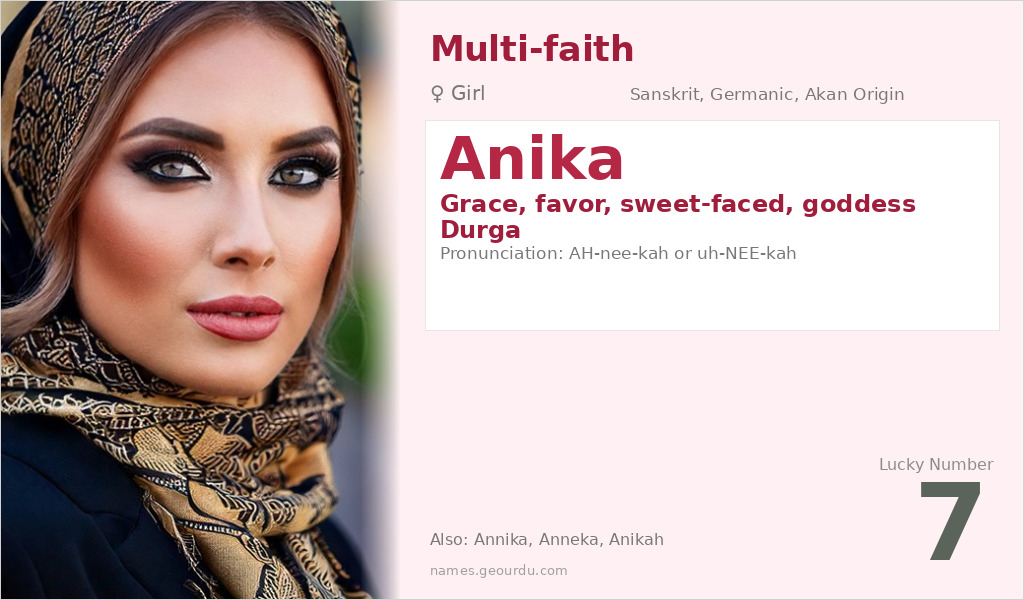
| 📛 Name | Anika |
| 💎 Meaning | Grace, favor, sweet-faced, goddess Durga |
| 👤 Gender | Girl |
| 🕌 Religion | Multi-faith |
| 🌍 Origin | Sanskrit, Germanic, Akan |
| 🗣 Pronunciation | AH-nee-kah or uh-NEE-kah |
| ✍️ Urdu | انیکا |
| ✍️ Arabic | أنيكا |
| 🔢 Numerology | 7 |
| ✨ Spellings | Annika, Anneka, Anikah, Aneeka |
Origin & Cultural Significance
Anika’s origins span three major cultural spheres: South Asian, European, and African. In India, the name appears in Sanskrit literature and Hindu tradition, where it’s associated with feminine beauty and divine grace. In Northern Europe, particularly Sweden and Germany, Annika/Anika emerged as a popular diminutive of Anna during the 20th century, gaining international recognition through children’s literature. Simultaneously, in Ghana and other West African regions, Anika exists as a traditional Akan name meaning ‘sweet-faced.’ The name’s presence in these geographically distant cultures demonstrates how similar phonetic constructions can develop independently with related meanings, though some scholars suggest possible historical connections through trade and cultural exchange routes.
Personality Traits
Those named Anika often embody the grace and favor suggested by their name’s meanings. They typically exhibit a balanced personality combining creativity with practicality, intuition with intelligence. Many Anikas display artistic talents, emotional depth, and a natural elegance in their interactions. Their multicultural name heritage often translates to open-mindedness and adaptability in personal and professional spheres.
Similar Names
If you like Anika, consider: Annika, Anya, Anita, Anjali, Anaya
Famous People Named Anika
- Anika Noni Rose — American actress and singer known for voicing Tiana in Disney's 'The Princess and the Frog'
- Anika Moa — New Zealand singer-songwriter of Māori descent
Frequently Asked Questions About Anika
What does Anika mean?
Anika means 'grace,' 'favor,' 'sweet-faced,' or 'goddess Durga' depending on cultural context. It has verified meanings in Sanskrit (splendor/face), Germanic languages (grace/favor as diminutive of Anna), and Akan (sweet-faced).
Is Anika a boy or girl name?
Anika is predominantly a feminine name across all its cultural origins—Hindu/Indian, European, and African traditions. There are no documented mainstream uses as a masculine name.
What is the origin of Anika?
Anika has multiple verified origins: Sanskrit (Indian), Germanic (Scandinavian/German), and Akan (West African). It is truly multi-cultural rather than belonging to a single tradition.