
Table of Contents
Art is a compact, powerful name with surprisingly diverse origins spanning Celtic legends, Persian philosophy, and Arthurian romance. Far from being just a nickname for Arthur, it carries independent meanings of ‘bear,’ ‘stone,’ ‘righteous,’ and ‘noble’ across different cultures. This cross-cultural name has been borne by Irish kings, Persian philosophers, and modern artists alike. Let’s explore the rich tapestry behind this deceptively simple name.
Meaning of Art
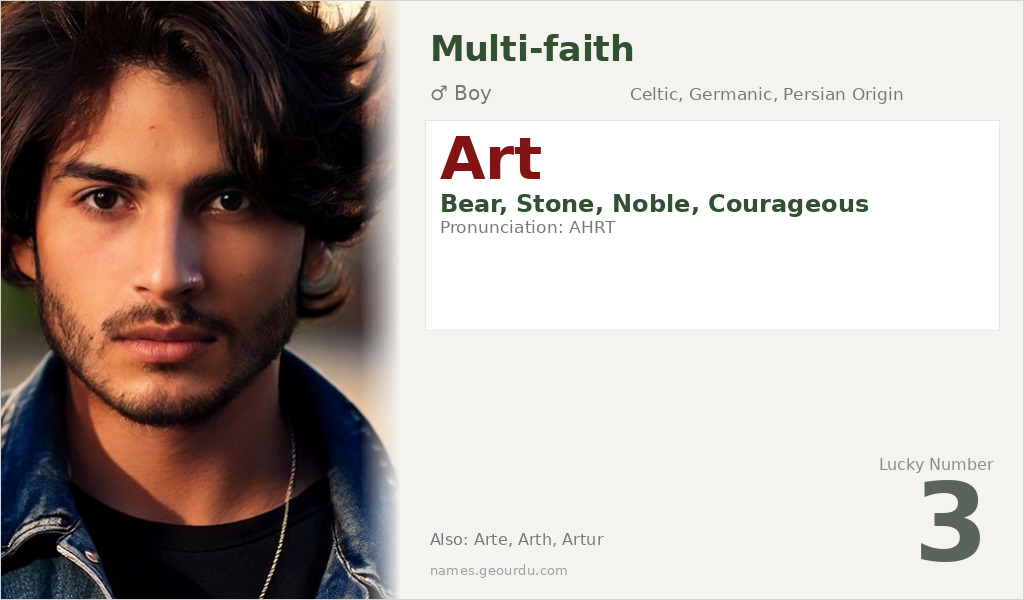
The name Art holds distinct meanings in different linguistic traditions. In Celtic languages, particularly Old Irish and Scottish Gaelic, Art (pronounced ‘ahrt’) literally means ‘bear’ or sometimes ‘stone,’ connecting to ancient animal symbolism and strength. This is evident in legendary figures like Art mac Cuinn, a High King of Ireland. In Persian, Art (آرت) derives from the concept of ‘asha’ or ‘arta’ meaning ‘truth, righteousness, cosmic order,’ representing moral virtue. The ‘noble, courageous’ association comes primarily through Latin ‘Artorius,’ which influenced the Arthurian tradition where Art became a diminutive. These multiple meanings—bear, stone, righteous, noble—coexist rather than contradict, reflecting the name’s journey through cultures.
| 📛 Name | Art |
| 💎 Meaning | Bear, Stone, Noble, Courageous |
| 👤 Gender | Boy |
| 🕌 Religion | Multi-faith |
| 🌍 Origin | Celtic, Germanic, Persian |
| 🗣 Pronunciation | AHRT |
| ✍️ Urdu | آرٹ |
| ✍️ Arabic | آرت |
| 🔢 Numerology | 3 |
| ✨ Spellings | Arte, Arth, Artur, Artair |
Origin & Cultural Significance
Art originates from three primary cultural streams. Celtic origins trace back to ancient Ireland and Scotland, where it was a royal name among High Kings and appears in mythological cycles. The Germanic/English tradition adopted it as a short form of Arthur, popularized through medieval romances. Persian usage comes from Zoroastrian concepts of moral order, with Art appearing in names like Artaxerxes. Unlike many names confined to one region, Art demonstrates remarkable cross-cultural adoption, appearing in Irish annals, Persian texts, and European nobility records. Its simplicity has allowed it to transcend linguistic barriers while maintaining distinct meanings in each culture.
Personality Traits
Those named Art often embody the symbolic qualities of their name’s meanings. The Celtic ‘bear’ association suggests strength, protection, and groundedness, while the Persian ‘righteous’ connection implies moral integrity and principle. Historically, bearers of this name have been leaders, artists, and thinkers who combine creativity with substance. Modern Arts tend to be perceived as authentic, reliable individuals with both practical and philosophical dimensions to their character.
Similar Names
If you like Art, consider: Arthur, Artair, Artur, Artemas, Artemus
Famous People Named Art
- Art Garfunkel — American singer-songwriter and poet, half of Simon & Garfunkel
- Art Spiegelman — Pulitzer Prize-winning cartoonist and author of 'Maus'
Frequently Asked Questions About Art
What does Art mean?
Art has multiple meanings: 'bear' or 'stone' in Celtic languages, 'righteous/virtuous' in Persian, and 'noble/courageous' through Latin influences on Arthurian tradition.
Is Art a boy or girl name?
Art is predominantly masculine across all its cultural origins—Celtic, Persian, and European traditions. While nicknames can be unisex, the full name Art is historically male.
What is the origin of Art?
Art has three main origins: Celtic (Irish/Scottish Gaelic meaning 'bear'), Persian (from 'arta' meaning 'righteous'), and as a diminutive of Arthur from Latin 'Artorius' in European tradition.





