
Table of Contents
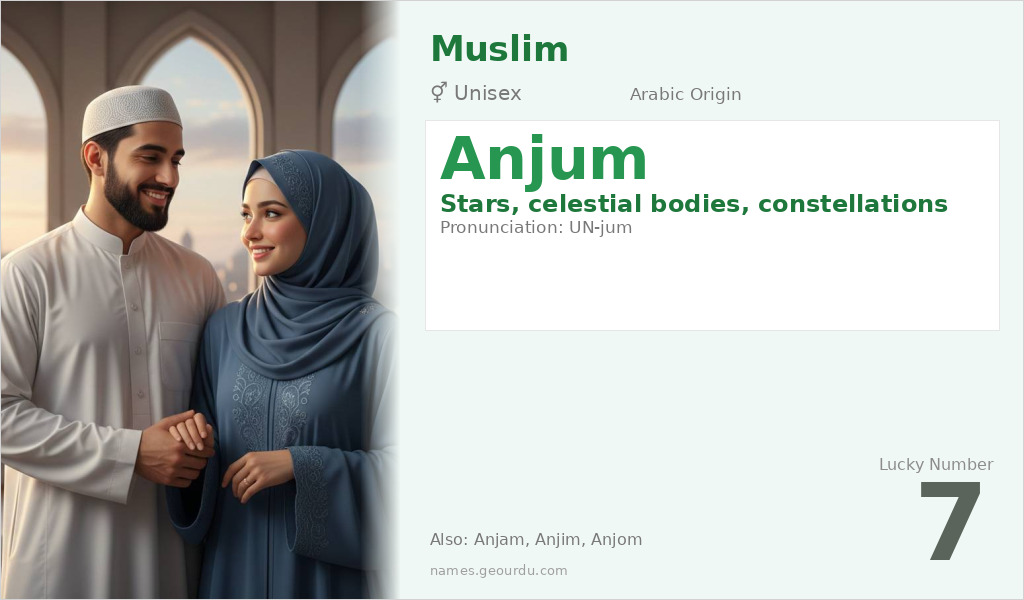
Anjum is a celestial name that literally means ‘stars’ in Arabic. Used across Muslim cultures for both boys and girls, this name carries poetic and spiritual significance, evoking images of guidance, light, and cosmic beauty. From South Asia to the Middle East, Anjum has been a popular choice for parents seeking a name with deep linguistic roots and elegant meaning. Discover the rich history and modern usage of this stellar name.
Meaning of Anjum
Anjum derives from the Arabic root n-j-m (ن-ج-م), which relates to stars and celestial bodies. The singular form ‘najm’ (نجم) means ‘star’, while ‘Anjum’ (انجم) is its plural form, translating directly to ‘stars’. This etymology connects to the Quranic concept of stars as signs and guides, mentioned in verses like ‘And He it is Who has made the stars for you that you might follow the right way thereby in the darkness of the land and the sea’ (Quran 6:97). The name has been adopted into Persian, Urdu, Turkish, and other languages influenced by Arabic, maintaining its stellar meaning across cultures. In classical Islamic poetry, stars often symbolize guidance, destiny, and divine light, adding layers of metaphorical meaning to the name.
| 📛 Name | Anjum |
| 💎 Meaning | Stars, celestial bodies, constellations |
| 👤 Gender | Unisex |
| 🕌 Religion | Muslim |
| 🌍 Origin | Arabic |
| 🗣 Pronunciation | UN-jum |
| ✍️ Urdu | انجم |
| ✍️ Arabic | أنجم |
| 🔢 Numerology | 7 |
| ✨ Spellings | Anjam, Anjim, Anjom, Anjuma |
Origin & Cultural Significance
Anjum originates from classical Arabic and spread through Islamic civilization as Arabic became the language of religion, science, and literature. The name gained particular popularity in South Asia (Pakistan, India, Bangladesh) through Persian and Urdu literary traditions, where it appears in poetry by figures like Mirza Ghalib and Allama Iqbal. While primarily used in Muslim communities, the name has also been adopted by some non-Muslims in multicultural regions. Historically, names related to celestial bodies were common in Arabic naming traditions, reflecting Bedouin knowledge of astronomy and navigation. Today, Anjum remains a popular choice in countries with significant Muslim populations, though its usage has declined somewhat in Arabic-speaking regions in favor of other star-related names like Najma.
Personality Traits
Those named Anjum often embody qualities associated with stars—they may be seen as guiding lights in their communities, with calm, steady personalities. Their celestial namesake suggests individuals who are observant, thoughtful, and inclined toward introspection. Many Anjums excel in fields requiring precision and analysis, from sciences to arts, reflecting the orderly beauty of the night sky. While personality varies by individual, the name’s meaning often inspires expectations of brilliance, guidance, and spiritual depth.
Similar Names
If you like Anjum, consider: Najma, Najm, Najwa, Najib, Najla, Najah, Najmuddin, Najmul, Najiba, Najmi
Famous People Named Anjum
- Anjum Chopra — Indian cricketer and sports commentator
- Anjum Anand — British-Indian chef and television presenter
- Anjum Fakih — Indian television actress
- Anjum Moudgil — Indian sport shooter and Olympian
Frequently Asked Questions About Anjum
What does Anjum mean?
Anjum means 'stars' in Arabic. It is the plural form of 'najm' (star) and has been used for centuries in Muslim cultures to signify celestial beauty and guidance.
Is Anjum a boy or girl name?
Anjum is a unisex name used for both boys and girls, though historically it has been more common for boys in some regions and for girls in others. In modern usage, it remains gender-neutral across Muslim communities.
What is the origin of Anjum?
Anjum originates from Arabic and spread through Persian and Urdu literary traditions. It is fundamentally an Arabic word meaning 'stars' that became a popular given name across the Islamic world, particularly in South Asia.