
Table of Contents
Ankit is a popular boy’s name with deep roots in Sanskrit and Hindu culture, symbolizing distinction and destiny. Often chosen for its meaningful connotation of being ‘marked’ or ‘engraved,’ it reflects a sense of uniqueness and purpose. This name has gained widespread usage across India and among Hindu communities worldwide, appreciated for its phonetic appeal and spiritual resonance. In this guide, we explore the etymology, cultural context, and modern relevance of the name Ankit.
Meaning of Ankit
The name Ankit originates from the Sanskrit term ‘ankita,’ derived from the root ‘ank,’ which means ‘to mark, inscribe, or engrave.’ In linguistic terms, it signifies something that has been imprinted or designated, often used metaphorically to denote a person with notable qualities or a destined path. This etymology is well-documented in Sanskrit dictionaries and Hindu texts, where similar words appear in contexts of symbolism and recognition. The meaning extends to concepts like ‘signed,’ ‘symbolic,’ or ‘distinguished,’ emphasizing individuality and significance. Unlike some speculative interpretations, Ankit does not mean ‘naughty’ or ‘conquered’; these are incorrect associations. Its primary sense remains firmly tied to marking and inscription, reflecting a tradition of naming that highlights personal attributes.
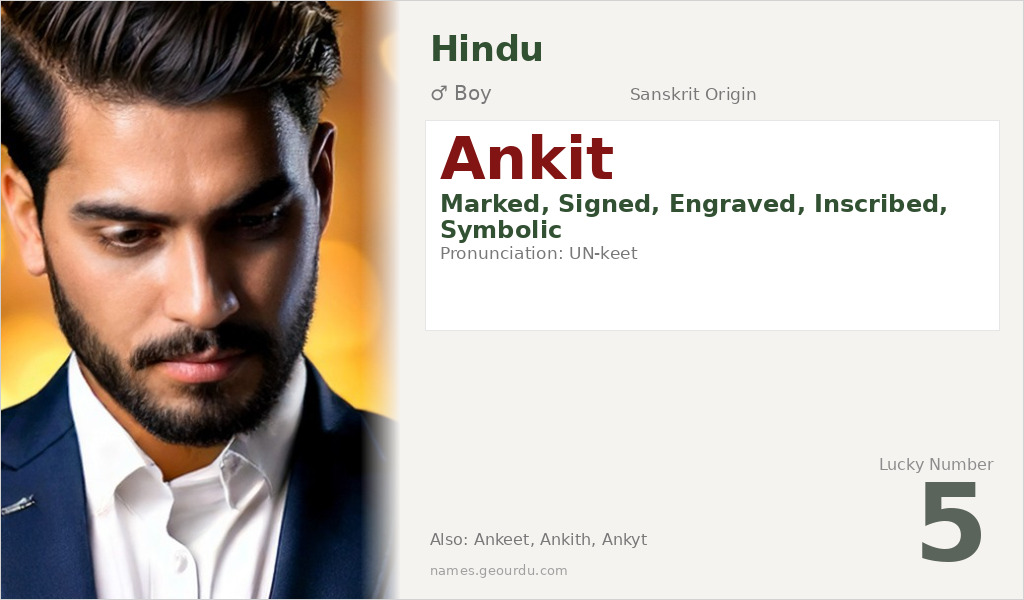
| 📛 Name | Ankit |
| 💎 Meaning | Marked, Signed, Engraved, Inscribed, Symbolic |
| 👤 Gender | Boy |
| 🕌 Religion | Hindu |
| 🌍 Origin | Sanskrit |
| 🗣 Pronunciation | UN-keet |
| ✍️ Urdu | انکت |
| ✍️ Arabic | أنكيت |
| 🔢 Numerology | 5 |
| ✨ Spellings | Ankeet, Ankith, Ankyt |
Origin & Cultural Significance
Ankit has its origins in Sanskrit, an ancient Indo-Aryan language central to Hindu scriptures, literature, and philosophy. It emerged as a given name within Hindu communities in India, where Sanskrit-derived names are common for their spiritual and cultural meanings. The name is predominantly used in Hindu-majority regions like North India, but it has spread to other parts of the country and diaspora due to migration and cultural exchange. Historically, names like Ankit appear in classical Indian texts and modern usage, often chosen to convey a sense of identity and auspiciousness. While it is primarily associated with Hinduism, it may be used by people of other faiths in multicultural contexts, though its core linguistic and cultural roots remain Sanskrit and Hindu.
Personality Traits
People named Ankit are often perceived as innovative and articulate, with a knack for making their presence felt in various endeavors. They may exhibit traits of curiosity and versatility, thriving in dynamic environments where they can express their ideas. This aligns with the name’s meaning of being ‘marked,’ suggesting a person who stands out through creativity and communication. In social settings, Ankits are typically friendly and engaging, building connections with ease.
Similar Names
If you like Ankit, consider: Aniket, Ankush, Ankur, Anil, Anuj
Famous People Named Ankit
- Ankit Tiwari — Indian playback singer and music composer
- Ankit Rajpal — Indian television actor known for roles in Hindi TV series
Frequently Asked Questions About Ankit
What does Ankit mean?
Ankit means 'marked,' 'inscribed,' or 'engraved' in Sanskrit, derived from the root 'ank' meaning to mark or inscribe.
Is Ankit a boy or girl name?
Ankit is traditionally a boy's name in Hindu and Indian cultures; the feminine equivalent is Ankita.
What is the origin of Ankit?
Ankit originates from Sanskrit, an ancient language of India, and is commonly used in Hindu naming traditions.





