
Table of Contents
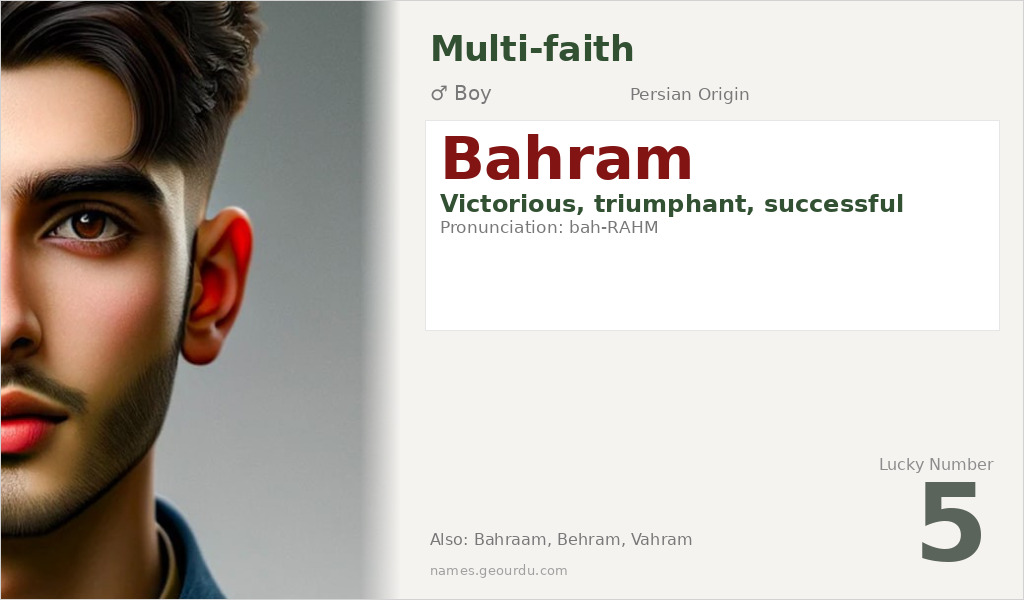
Bahram is a powerful Persian name with ancient roots in Zoroastrian mythology and Persian royal history. Meaning ‘victorious’ or ‘triumphant’, this name has been borne by kings, heroes, and warriors throughout Persian literature and history. From the pages of Ferdowsi’s Shahnameh to the Sassanian Empire, Bahram carries a legacy of strength and success. Today, it remains popular in Persian-speaking communities and beyond.
Meaning of Bahram
Bahram derives from the Avestan ‘Verethragna’, the Zoroastrian yazata (divine being) of victory. The name breaks down to ‘verethra’ meaning obstacle or resistance, and ‘ghna’ meaning striking or smashing, creating the powerful meaning ‘smasher of obstacles’. In Middle Persian, this evolved to ‘Vahrām’, which became ‘Bahram’ in modern Persian. The name is deeply embedded in Persian culture, appearing in the Shahnameh where Bahram is a heroic figure, and historically as the name of five Sassanian kings. In Persian astrology, the planet Mars is called ‘Bahram’, associating the name with martial qualities and red coloration.
| 📛 Name | Bahram |
| 💎 Meaning | Victorious, triumphant, successful |
| 👤 Gender | Boy |
| 🕌 Religion | Multi-faith |
| 🌍 Origin | Persian |
| 🗣 Pronunciation | bah-RAHM |
| ✍️ Urdu | بہرام |
| ✍️ Arabic | بهرام |
| 🔢 Numerology | 5 |
| ✨ Spellings | Bahraam, Behram, Vahram, Vahrām |
Origin & Cultural Significance
Bahram originates from ancient Persian culture, specifically from Zoroastrian religious texts dating back to the Avestan period (circa 1500-1000 BCE). The name gained prominence during the Sassanian Empire (224-651 CE), where several rulers bore the name, most notably Bahram V (Bahram Gur). Through Persian cultural influence, the name spread to neighboring regions including Afghanistan, Pakistan, India, and Central Asia. While commonly used by Muslims today, its origins predate Islam and it remains popular among Zoroastrians (Parsis) and in secular Persian contexts. The name appears in various forms across languages influenced by Persian culture.
Personality Traits
Those named Bahram often embody the victorious qualities of their namesake. They tend to be determined individuals who approach challenges with courage and resilience. With natural leadership abilities, Bahrams often inspire others through their strength of character and persistence. While competitive, they typically maintain a sense of fairness and justice, reflecting the noble heritage of the name’s royal and heroic bearers.
Similar Names
If you like Bahram, consider: Farhad, Khosrow, Ardashir, Rostam, Darius
Famous People Named Bahram
- Bahram V — Sassanian King of Persia known as Bahram Gur, famous hunter and ruler in Persian literature
- Bahram Chobin — Sassanian general and briefly emperor of Persia, featured in the Shahnameh
Frequently Asked Questions About Bahram
What does Bahram mean?
Bahram means 'victorious', 'triumphant', or 'successful'. It comes from the Persian language, derived from the Avestan 'Verethragna', the Zoroastrian deity of victory.
Is Bahram a boy or girl name?
Bahram is exclusively a masculine name in all cultures where it is used, from Persian to Urdu-speaking communities. There is no feminine equivalent in traditional usage.
What is the origin of Bahram?
Bahram originates from ancient Persian culture, specifically from Zoroastrian religious texts. It comes from the Avestan language word 'Verethragna', which evolved into Middle Persian 'Vahrām' and modern Persian 'Bahram'.





